

Step Into the Future: A Guide to Virtual Reality and Marketing
What Is Virtual Reality and Marketing — and Why It Matters in 2026
Virtual reality and marketing have collided to create something traditional advertising simply can’t match: the feeling of being there.
Here’s a quick overview of what that means in practice:
- What it is: VR marketing uses immersive 3D environments to let customers experience products, places, and brand stories — not just see them.
- Why it works: VR campaigns produce 70% higher brand recall than traditional digital ads, and VR experiences trigger up to 27% more emotional intensity than standard 2D content.
- Who’s using it: Brands across retail, automotive, real estate, healthcare, and fashion are already running VR campaigns at scale.
- The business case: 32% of Gen Z and Millennial consumers are more likely to buy a product after experiencing it in VR — and AR product interactions have been linked to 94% higher conversion rates.
- Where it’s headed: The global VR marketing market is projected to exceed $16 billion by 2027, with metaverse platforms, WebXR, and spatial AI accelerating adoption fast.
Traditional digital marketing asks people to look at your product. VR asks them to step inside it. That shift — from passive viewing to active experience — changes how people feel about a brand, how long they remember it, and whether they buy.
That’s not a small upgrade. It’s a fundamentally different relationship between brand and consumer.
I’m Samir ElKamouny, an entrepreneur and marketing strategist who has spent years helping brands scale through innovative, technology-driven strategies — including the rapidly evolving world of virtual reality and marketing. In this guide, I’ll walk you through everything you need to know to turn immersive technology into a real competitive advantage for your brand.
Virtual reality and marketing word guide:
- augmented reality in marketing examples
- augmented reality product visualization
- augmented reality in social media marketing
The Evolution of Virtual Reality and Marketing
The trajectory of digital marketing has always moved toward higher fidelity and deeper interaction. We went from static text to images, then to video, and now to spatial computing. Today, in July 2026, we are witnessing a massive transition where flat, two-dimensional media is no longer enough to satisfy modern consumer expectations.
Historically, marketing was a monologue. A brand pushed a message through a TV screen, a billboard, or a social feed, and hoped the consumer paid attention. With virtual reality and marketing, the dynamic becomes a dialogue. Consumers are no longer passive observers; they are active participants. They can manipulate products, explore virtual spaces, and experience brand narratives in real-time.
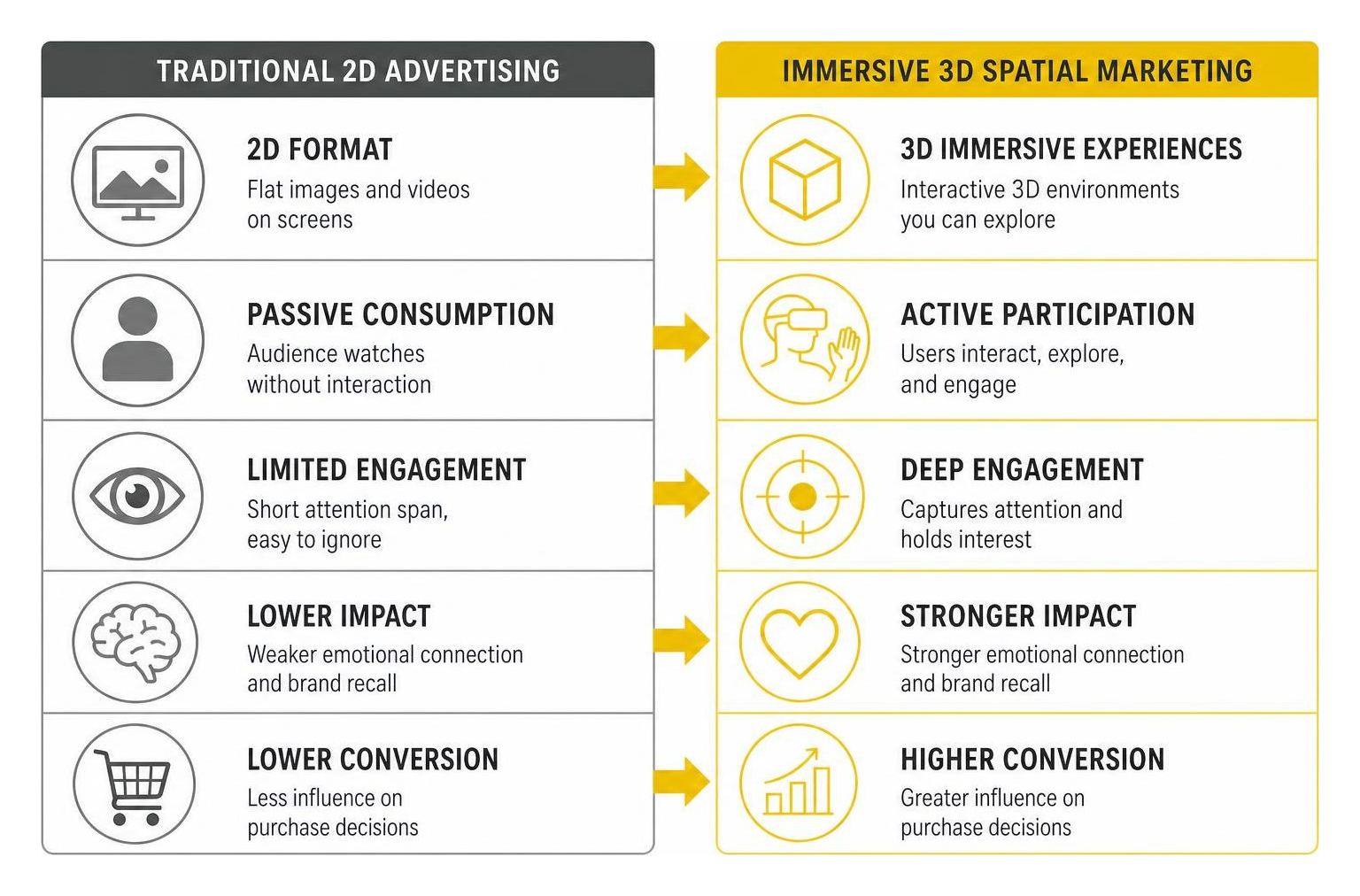
This evolution is fundamentally changing consumer behavior. When a user interacts with a 3D model, they form a spatial memory of the product. This makes the experience feel less like reading an advertisement and more like a physical interaction. If you want to understand why this shift is happening so rapidly, check out our deep dive on Why Your Brand Needs AR and VR in Marketing Right Now.
Understanding the Psychology of Virtual Reality and Marketing
To build a successful VR campaign, we have to look under the hood of human psychology. Immersive media works because of two primary psychological processes: telepresence and narrative transportation.
- Telepresence is the psychological sensation of “being there” in a virtual environment, even when you know you are standing in your living room.
- Narrative transportation is the feeling of being completely swept away by a story.
When these two forces combine, magic happens. According to a study on the Strategic use of immersive media and narrative message in virtual marketing: Understanding the roles of telepresence and transportation, high immersion combined with strong narrative storytelling dramatically strengthens positive brand attitudes.
However, there is a fascinating cognitive trade-off that marketers must keep in mind: high telepresence can sometimes distract users from remembering specific, granular details of a product because their brains are busy processing the sheer scale of the environment. Therefore, if your goal is pure information retention (like technical specs), a medium-immersion format might actually outperform a high-immersion headset experience.
But if your goal is emotional intensity, brand recall, and deep connection, VR is unmatched. As outlined in research on VIRTUAL REALITY IN MARKETING: ENHANCING CUSTOMER EXPERIENCE AND BRAND ENGAGEMENT | Modern Science and Research, VR experiences stimulate up to 27% higher emotional intensity and yield brand recall rates 70% higher than traditional digital advertising.
Key Benefits and Measurable Outcomes of Virtual Reality and Marketing
While the psychological theories are compelling, modern marketing teams run on hard data. Fortunately, the business case for immersive campaigns is incredibly robust, especially when we compare traditional digital metrics to spatial metrics.
| Metric Type | Traditional Digital Ads | VR / Spatial Marketing |
|---|---|---|
| Primary Engagement Measure | Click-Through Rate (CTR) | Dwell Time, Gaze Tracking, Interaction Rate |
| Average Attention Span | 1.5 to 2 seconds | 2 to 5+ minutes (highly focused) |
| Average Brand Recall | Baseline | 70% Higher than traditional ads |
| Conversion Lift | Baseline | Up to 94% higher with interactive 3D/AR |
| Return Rates (E-commerce) | 19% – 20.5% average | Up to 40% reduction |
The ability to track user gaze, dwell time, and physical interactions within a virtual space gives brands unprecedented insights into consumer behavior. For a deeper look at how these immersive ads captivate audiences, explore our guide on Immersive Ads and How AR/VR Advertising Captivates Audiences.
According to the comprehensive AR/VR Marketing Statistics 2026: Verified Data | CO Consulting, mobile AR and web-based spatial experiences are currently the primary drivers of marketing reach, far outpacing standalone headset adoption. Brands that meet consumers on their smartphones with interactive 3D capabilities are seeing massive lifts in purchase intent and customer satisfaction.
Real-World Use Cases Across Industries
We are seeing virtual reality and marketing transform business models across multiple sectors:
- Retail and E-Commerce (Virtual Showrooms & Try-Ons): Brands are creating virtual concept stores that allow users to browse, customize, and try on products from the comfort of their homes. This interactive visualization reduces the hesitation to buy, resulting in a 94% higher conversion rate.
- Automotive (Virtual Test Drives): Automotive brands have successfully implemented VR showrooms and test drives. By letting buyers customize car features and take virtual spins, brands have seen sales increases of nearly 70%.
- Real Estate (Remote Property Tours): Instead of traveling to see ten different homes, buyers can put on a headset or use a browser-based portal to walk through properties, customize wall colors, and inspect layouts.
These applications are not just about showing off cool technology; they are purpose-driven designs built to guide customers through the buying journey. For a strategic breakdown of how to align VR features with consumer behavior, check out the study on VR in customer-centered marketing: Purpose-driven design.
If you want to see how these activations win over audiences, check out our insights on Immersive Brand Activations That Win Hearts and Minds.
Implementing Immersive Campaigns: Best Practices and Future Trends

Launching a successful VR campaign requires shifting your mindset from “creating an ad” to “designing an experience.” If you want to build something that actually drives ROI, you must follow a structured approach. To learn how to avoid common pitfalls, read our article on Immersive Marketing Solutions That Don’t Suck.
Overcoming Technical and Accessibility Challenges
While the potential of virtual reality and marketing is massive, we must address the elephant in the room: implementation hurdles. The primary challenges include development costs, hardware accessibility, and user experience friction.
- The App-Download Barrier: Forcing a user to download a heavy, native app just to view a product is a conversion killer.
- The Browser-Based Solution: This is where WebXR comes in. WebXR allows high-quality 3D and AR experiences to render directly inside a mobile browser. As reported by NeuralWired in their piece on Shopify AR Cuts Return Rates 40% With WebXR (2026) – NeuralWired, browser-based AR experiences see 50-70% higher engagement than app-download-gated ones, helping retailers slash return rates by up to 40% by eliminating size and fit uncertainty.
- Physical Safety and Comfort: Always keep VR experiences relatively short (under 5 minutes) to build anticipation and prevent motion sickness or user fatigue.
To explore how large-scale companies are navigating these hurdles, read Beyond the Hype: What Enterprise AR Solutions Can Do for Your Company.
Emerging Trends: WebXR, AI, and the Metaverse
As we look toward the future, three massive technological forces are converging to reshape the virtual marketing landscape:
- WebXR Standards: Now reaching official W3C candidate recommendation status, WebXR makes spatial computing universally accessible across devices without friction.
- Spatial AI Integration: Artificial intelligence is being used to generate 3D assets in real-time, personalize virtual environments based on user preferences, and power lifelike virtual assistants inside VR spaces.
- Metaverse Platforms: Virtual worlds like Roblox and Fortnite Creative are maturing into highly lucrative advertising channels. According to research on Unpacking Dimensions of Metaverse Platforms to Enhance Immersive Experience and Brand Engagement Among Consumers, these shared 3D spaces offer brands zero production and zero supply-chain costs for virtual products, while letting consumers personalize digital avatars to engage deeply with luxury and retail brands.
By combining these environments with blockchain-enabled security, brands can create verifiable digital ownership, rewards programs, and exclusive virtual events. For a step-by-step roadmap on navigating this landscape, consult The Ultimate Guide to Augmented Reality Advertising Campaigns.
Choosing the Right Partner and Content Strategy

At Avanti3, we believe that immersive marketing shouldn’t be a one-off gimmick. It should be a core component of your digital ecosystem. We specialize in integrating Web3 technologies like NFTs, blockchain, AR/VR, and AI to empower creators and brands with customizable engagement tools and fintech solutions.
We don’t just build beautiful 3D models; we design unique digital experiences, rewards systems, and community-building opportunities that set a new standard in digital engagement and fan monetization. Whether you want to launch a virtual showroom, design a gamified metaverse experience, or build a secure, Web3-powered fan community, we have the strategic and technical expertise to bring your vision to life.
Ready to take your brand into the next dimension? Let’s build the future together. Discover how we can transform your digital presence by exploring our Augmented Reality Marketing solutions today.