


Transform Everyday Marketing into an Interactive Quest with Web3 AR
Web3 AR Gamification Features Turn Marketing Into a Real-World Quest
Web3 AR gamification features combine augmented-reality challenges with verifiable digital rewards. A user might scan a product, visit a location, complete a branded quest, or join a community challenge – then receive a token, collectible, access pass, or voting right they can actually control.
Unlike traditional gamification, where points and badges stay inside one brand’s platform, Web3 can add:
- Digital ownership through NFTs and wallet-based assets
- Play-and-earn rewards designed around useful participation, not speculation alone
- Location-based AR quests that turn stores, events, and cities into interactive spaces
- Smart-contract rewards that distribute automatically under clear rules
- Community governance that lets loyal members help shape future campaigns
For brands, this creates more than a short-lived AR filter. It can build a repeatable action-and-reward loop where fans explore, collect, learn, share, and gain a meaningful stake in the community. The strongest programs balance those external rewards with intrinsic reasons to return: curiosity, status, creativity, belonging, and fun.
I’m Samir ElKamouny, an entrepreneur and marketing strategist focused on turning ambitious ideas into practical growth systems. My work in community building, sales, and digital marketing informs this guide to Web3 AR gamification features and the next steps for designing experiences people genuinely want to join.
Web3 AR gamification features terms to know:
Introduction: The Evolution of Spatial Brand Engagement

Marketing has traveled a long road from static billboards to two-dimensional social media feeds. Today, consumer attention is harder to capture and even harder to retain. We live in an era of rapid spatial computing adoption, where audiences expect immersive, two-way interactions rather than passive brand messaging.
Traditional mobile loyalty programs often rely on arbitrary points that sit locked inside siloed apps. When users disengage, those points vanish into digital obsolescence. In contrast, the rise of the open metaverse and decentralized protocols transforms ordinary physical surroundings into interactive playgrounds. By introducing verifiable action-reward loops directly into the real world, brands can foster authentic digital ownership and drive sustained decentralized ecosystem expansion.
When we integrate spatial computing with decentralized ledgers, routine customer actions—such as exploring a storefront, testing a product, or attending a local gathering—turn into compelling, self-directed adventures.
Core Web3 AR Gamification Features Driving Modern Marketing Campaigns
The shift from centralized digital marketing to decentralized spatial immersion changes how consumers perceive value. Traditional augmented reality initiatives often suffer from novelty decay: a customer scans an AR filter once, enjoys a brief visual animation, and immediately closes the application.
By grounding spatial layers in decentralized protocols, we introduce MetaFi mechanics—the seamless merger of decentralized finance and gamified media—alongside automated smart contracts and portable digital assets.
| Campaign Feature | Traditional AR Marketing | Web3 AR Gamification |
|---|---|---|
| Asset Custody | Platform-locked, non-transferable data entries | True self-custody via cryptographic wallets |
| Reward Architecture | Siloed loyalty points and centralized badges | Verifiable tokens, dynamic NFTs, and liquid assets |
| User Engagement | One-off transactional interactions | Continuous, gamified Augmented Reality Engagement |
| Data & Access | Centralized databases prone to single points of failure | Transparent smart contracts and decentralized cloud systems |
| Economic Utility | Closed corporate ecosystem | Interoperable utility across secondary marketplaces and dApps |
This architectural difference directly affects user retention metrics. Web3 gaming activity expanded dramatically following the initial wave of digital asset experiments, highlighting a permanent consumer appetite for verifiable asset liquidity. When participants realize that their time and physical actions yield permanent, tradeable value, engagement rates rise sustainably.
Geofenced Spatial Quests as Foundational Web3 AR Gamification Features

Geofencing technology allows developers to anchor digital items and interactive triggers to precise real-world GPS coordinates. By blending spatial anchors with blockchain settlement layers, we can build expansive urban treasure hunts that guide foot traffic to designated retail flagships, festival venues, or cultural landmarks.
Instead of paying exorbitant fees for digital ad clicks that yield low conversion rates, companies can deploy location-based rewards that convert physical discovery into on-chain assets. For example, sports organizations and entertainment franchises leverage decentralized distribution models to drop digital passes at stadium gates, a dynamic detailed in The Ultimate Guide to Fan Tokens and AR Reward Distribution.
These low-cost user acquisition funnels spark natural curiosity. Users open their camera viewfinders, locate floating cryptographic fragments or virtual supply crates in their immediate area, and complete localized micro-challenges to claim immediate incentives.
Verifiable Digital Asset Ownership and Play-and-Earn Mechanics
Early blockchain gaming models established initial interest, but purely speculative frameworks frequently encountered economic volatility. The industry has matured toward sustainable Play-and-Earn (PAE) systems, prioritizing compelling mechanics, genuine community mastery, and long-term asset stability over unsustainable yield promises.
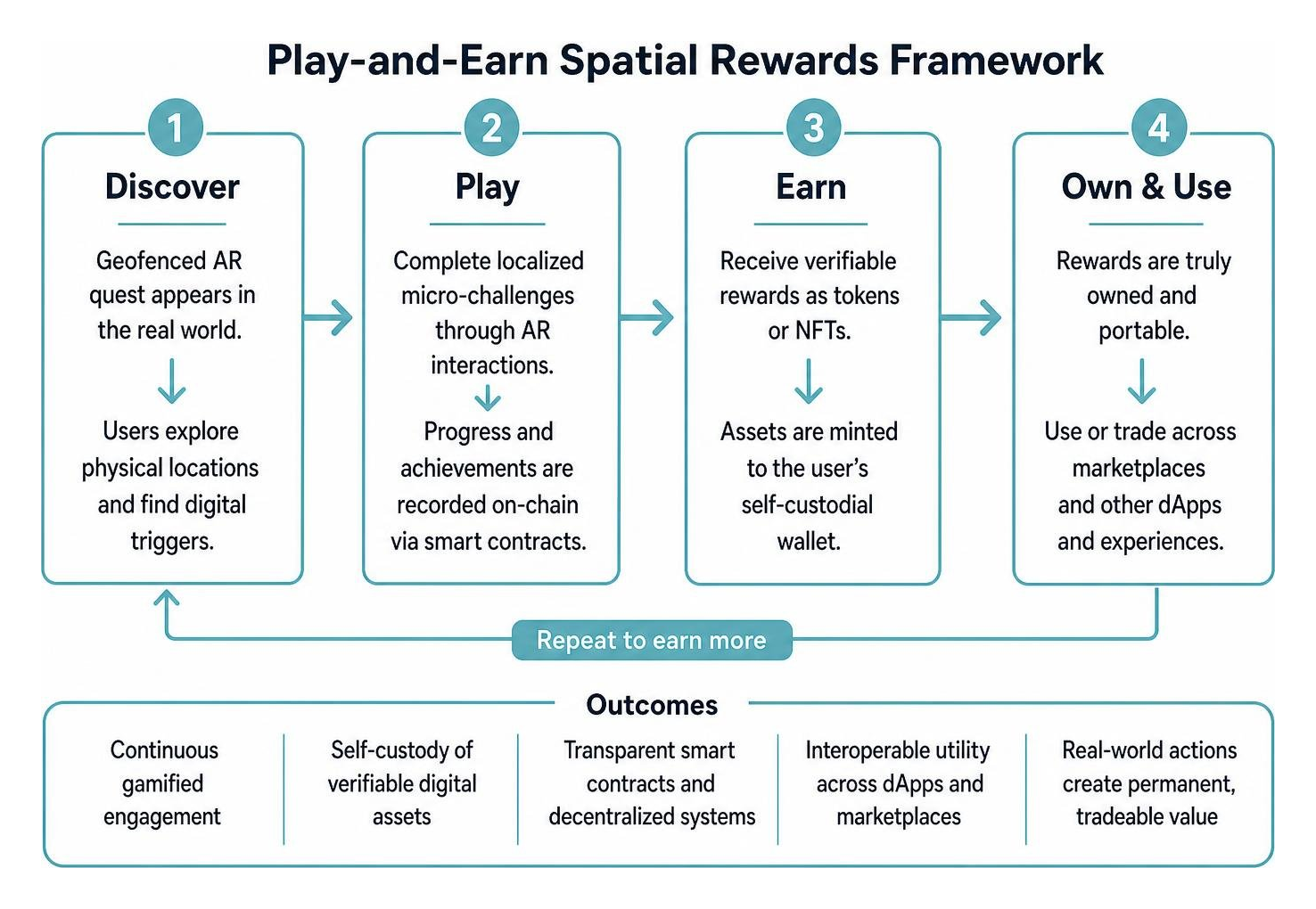
At the heart of this transition is the integration of Self-Sovereign Identity (SSI) and open token standards. When players conquer an AR quest, the resulting reward is not merely a record in a private corporate database. It is a cryptographic item held in their personal wallet.
As explored in our Tokenized Loyalty Programs Guide, non-fungible tokens serve as portable badges of achievement, membership tiers, and cross-platform utilities. A cosmetic skin discovered during a local retail hunt can unlock VIP entry at an international pop-up or grant customized perks across entirely separate digital ecosystems.
Interactive Phygital Collectibles and Core Web3 AR Gamification Features
The line dividing physical merchandise from digital collectibles has blurred into what the industry terms “phygital” retail. By pairing smart packaging, near-field communication (NFC) tags, and QR triggers with spatial computing, physical goods become gateways to interactive digital storytelling.
A customer scanning a physical label can watch an animated 3D narrative come to life over the packaging, revealing hidden clues, mini-games, or one-of-a-kind cryptographic minting events. Successful implementations in modern commerce show that interactive label storytelling can drive millions of mobile engagements and double-digit revenue gains by encouraging consumers to collect diverse product variants.
Mastering thoughtful AR Experience Design ensures that physical-to-digital redemptions feel effortless. Dynamic NFT metadata allows the digital counterpart of a physical item to evolve over time, gaining fresh traits, visual upgrades, or elevated reward tiers the more a consumer interacts with the brand in the physical world.
AI-Driven Adaptive Avatars and Immersive Brand Storytelling
Combining spatial computing with artificial intelligence transforms static marketing campaigns into living, responsive environments. Rather than presenting every user with identical prompts, generative AI engines evaluate participant behavior in real time to generate personalized quest logic and dynamic non-player characters (NPCs).
In professional training and learning ecosystems, AI-guided spatial avatars tailor instructions to match user comprehension speeds. These developments mirror broader Web3 gamification trends in education, where immersive simulations replace dry reference materials with interactive, spatial learning loops.
Users can converse directly with brand ambassadors, historical figures, or virtual guides rendered directly in their living rooms. These non-linear narrative pathways ensure that no two customers experience an activation the same way, deepening emotional connection and long-term brand recall.
DAO Governance Passes and Community Milestone Challenges
Gamification reaches its highest potential when it taps into intrinsic social drivers: belonging, status, and collective purpose. Web3 AR achieves this by connecting spatial accomplishments directly to Decentralized Autonomous Organization (DAO) governance and shared community milestones.
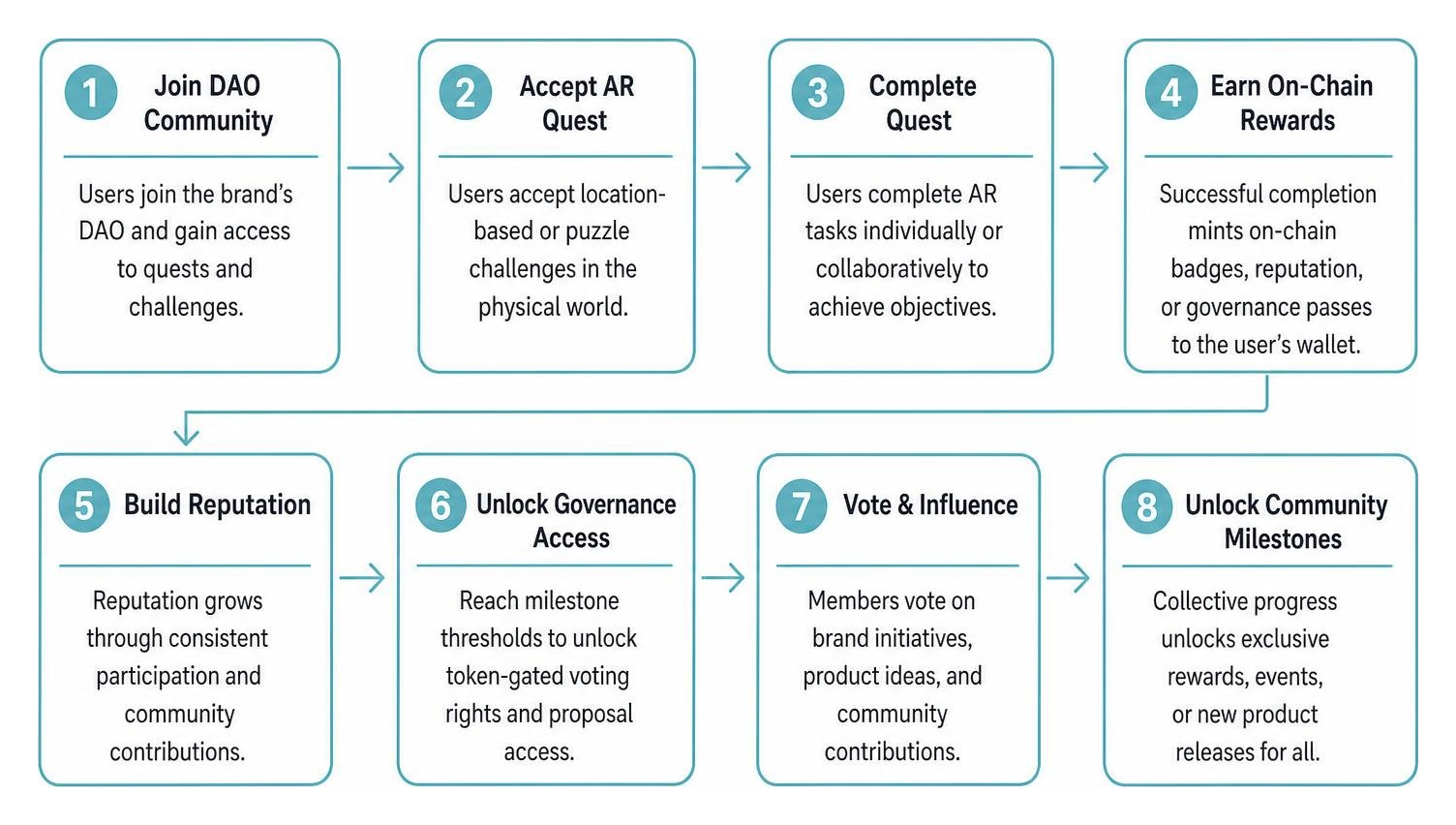
Rather than forcing individual consumers to quest alone, brands can deploy collaborative staking pools and collective unlock challenges. For instance, if an entire city’s user base works together to scan specific public landmarks or assemble puzzle fragments, the entire community might unlock a live musical performance or a new product line.
Participating users earn non-transferable reputation badges and token-gated voting access passes, granting them direct influence over future marketing initiatives, product designs, or charitable brand contributions.
Implementing and Scaling Sustainable Web3 AR Experiences
To roll out an enterprise-grade spatial campaign, organizations must move deliberately from conceptual design to decentralized execution. Building a sustainable system requires addressing underlying economics, technical infrastructure, and consumer trust:
- Tokenomic Equilibrium and Anti-Inflation Design: Establish transparent minting and burning mechanisms for all ecosystem tokens. Ensure rewards incentivize genuine brand loyalty and active usage rather than purely speculative capital extraction.
- Infrastructure Auditing and Smart Contract Security: Subject all digital reward protocols, minting logic, and decentralized cloud storage hooks to comprehensive third-party audits to prevent vulnerabilities.
- Data Protection and Ethical Biometric Safeguards: Immersive technologies gather intimate biological telemetry, raising the risk of “biometric psychography”—the tracking of unconscious physiological cues like pupil movements or facial reactions. Implement strict zero-knowledge identity protocols to safeguard consumer privacy.
- Frictionless Web2-to-Web3 Onboarding: Remove high technical barriers by supporting fiat payment gateways and social-login wallet creation alongside direct cryptographic wallet connectivity.
- Balancing Intrinsic and Extrinsic Motivations: Design visual aesthetic mastery, compelling storytelling, and rewarding social challenges so the experience remains enjoyable even independent of token incentives.
At Avanti3, we integrate Web3 technologies like NFTs, blockchain, AR/VR, and AI to empower creators and brands with customizable engagement tools and fintech solutions. By bridging cutting-edge spatial tech with sound on-chain economics, we build unique digital experiences, rewards systems, and community-building opportunities that set a new standard in digital engagement and fan monetization.
If your team is ready to step beyond temporary marketing novelties and build a lasting spatial community, explore our comprehensive strategies for augmented reality marketing and launch your brand’s interactive real-world quest today.