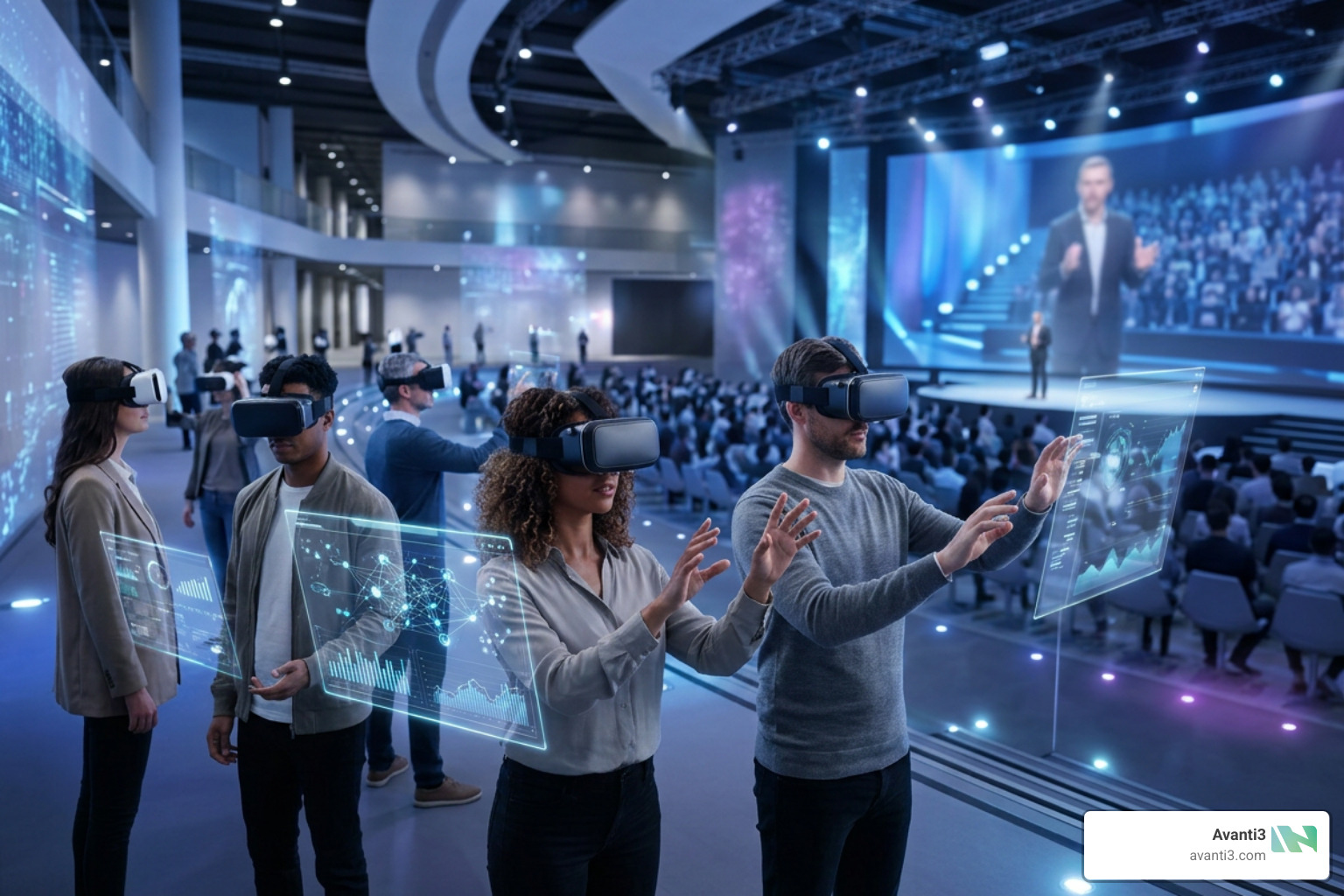


Step Into the Screen: The Ultimate Guide to Metaverse Virtual Events
Why Metaverse Virtual Events Are Redefining Digital Connection
As we head through 2026, Metaverse virtual events are completely transforming how brands and creators connect with audiences globally.
Unlike traditional webinars that keep you trapped behind a flat screen, these events take place inside immersive, persistent 3D worlds.
Here is what you need to know right now:
- Active Presence: Attendees explore 3D spaces as customizable digital avatars, rather than staring at passive video grids.
- Natural Networking: Spatial audio lets you walk up to someone and start a side conversation, just like in real life.
- True Persistence: The virtual venue stays alive and open to visitors long after the live presentations end.
- Web3 Capabilities: Brands can integrate secure blockchain ticketing, digital collectibles, and unique loyalty rewards directly into the venue.
Traditional online events are broken. We are all tired of staring at slide decks while secretly checking our emails. If you want to build a community that actually cares, you need to offer an experience they can step inside.
I am Samir ElKamouny, a marketing expert and entrepreneur who helps brands build thriving communities through cutting-edge Metaverse virtual events. At Avanti3, I combine big ideas with strategic execution to help you unlock new revenue streams and deeply connect with your audience.
Quick look at Metaverse virtual events:
The Evolution and Impact of Metaverse Virtual Events
The rapid acceleration of digital transformation has turned what once seemed like science fiction into standard business strategy. According to industry projections, the global metaverse market size is on track to reach USD 936.57 billion by 2030, as highlighted in the Mordor Intelligence Metaverse Market Report.
This massive growth is not just driven by gaming enthusiasts. Businesses, municipal governments, and educators are realizing that persistent 3D environments offer a level of audience engagement that standard video streams simply cannot match. By breaking down geographic barriers, we can now gather millions of people in a single virtual space—all without the massive carbon footprint and logistical headaches of traditional physical travel.
What Are Metaverse Virtual Events and How Do They Work?
To understand how Metaverse virtual events operate, we must look at the shift from flat, 2D web pages to spatial computing. In a traditional virtual event, you log in, watch a video feed, and maybe type a question into a chat box.
In contrast, a metaverse event places you inside a persistent 3D environment. You navigate this space via an avatar, experiencing spatial audio where conversations get louder as you approach other users.
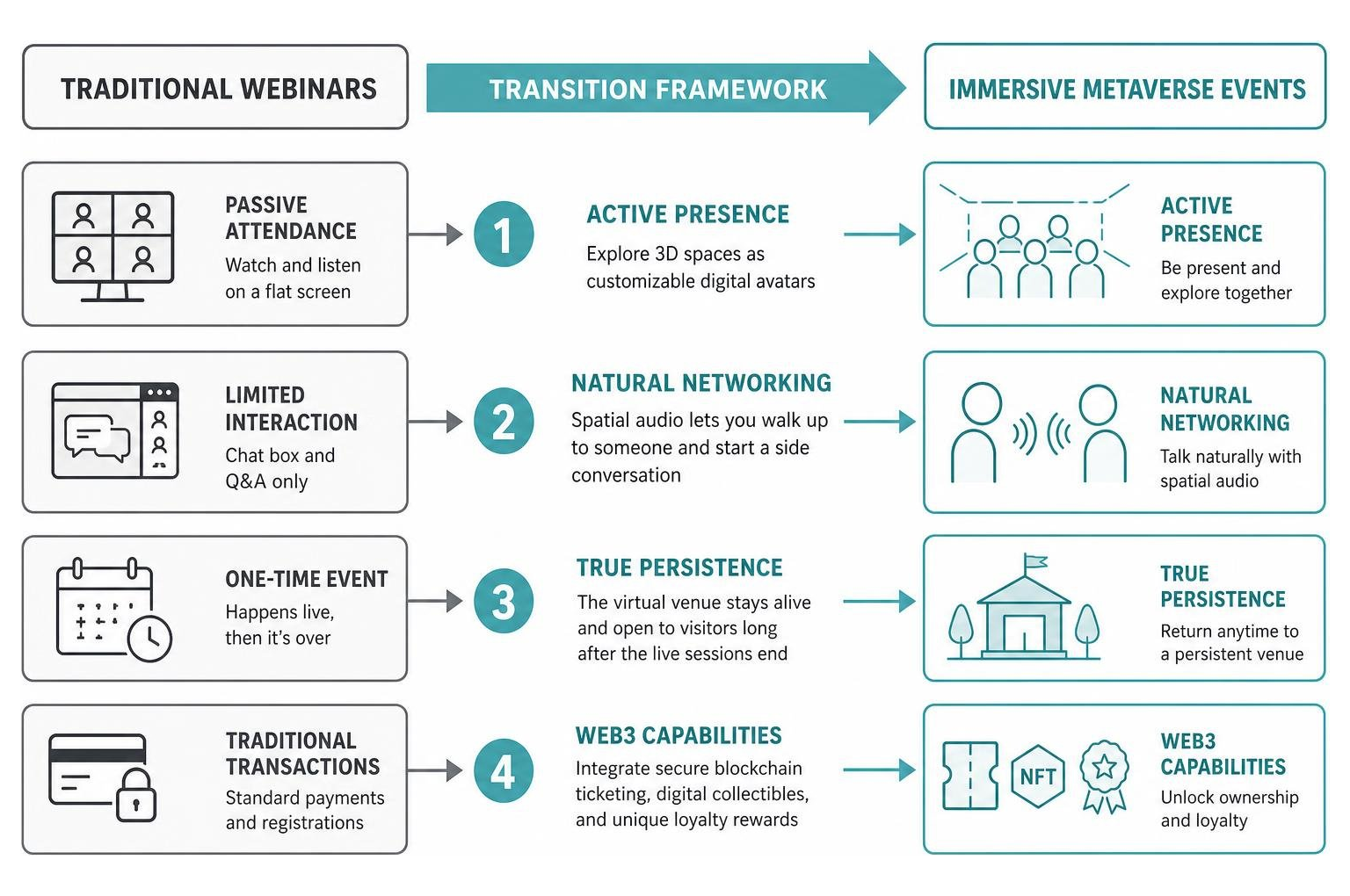
To help visualize this shift, we have mapped out the key structural differences in the table below. For a deeper look at the underlying technology, you can explore our guide to virtual experience platforms.
| Feature | Traditional Virtual Events | Metaverse Virtual Events |
|---|---|---|
| User Presence | Passive spectator behind a 2D screen | Active participant via a customizable 3D avatar |
| Networking | Text chat rooms and forced breakout slots | Organic, spatial audio-driven conversations |
| Environment | Static web pages and video players | Persistent, highly customizable 3D worlds |
| Longevity | Platform closes when the stream ends | Venue remains open for ongoing community use |
| Web3 Integration | Rarely supported (standard registration) | Built-in token-gating, NFTs, and digital assets |
Key Benefits: Why Brands Are Hosting Metaverse Virtual Events
The shift toward these immersive spaces is not a passing trend. According to research, 92% of companies have continued to host metaverse events even after physical venues reopened, and 59% plan to increase their investments in these technologies. Furthermore, McKinsey estimates that the metaverse is expected to generate $5 trillion in value by 2030, as detailed in their analysis on Value Creation in the Metaverse.
When we analyze why brands are making this move, several key business advantages stand out:
- Boundless Reach: You can host an unlimited number of attendees. There are no physical fire codes or maximum room capacities to worry about.
- Massive Cost Savings: By removing physical venue rentals, catering, security, and travel expenses, brands can allocate more budget to the actual guest experience.
- Unmatched Sustainability: Eliminating international flights and physical builds drastically reduces the overall carbon footprint of your corporate gatherings.
- Dynamic Brand Expression: Why host a meeting in a boring gray conference room when you can gather your team on a virtual beach, a floating space station, or a digital twin of your actual office?
To keep your audience hooked from start to finish, check out our best practices on maximizing virtual event engagement. You can also learn how other industries are leveraging these spaces on the Virtway Metaverse Events page.
Core Technologies: From Spatial Computing to Web3 Integration
Building these highly interactive worlds requires a robust, modern technology stack. It starts with real-time 3D engines (like Unreal Engine 5) and WebRTC pixel streaming, which allows high-fidelity graphics to run smoothly on standard web browsers without requiring heavy software downloads.
Equally important is the integration of Web3 infrastructure. By utilizing blockchain technology, we can secure event ticketing, verify user identities, and distribute unique digital assets like NFTs. This allows brands to offer exclusive “token-gated” access to VIP lounges or distribute customized virtual merchandise that attendees can wear across different digital worlds.
The scale of these digital gatherings is already staggering. For instance, Travis Scott’s Astronomical show on Fortnite drew 46 million viewers, while Lil Nas X’s Roblox performance attracted 33 million. To see how these massive spectacles come together, dive into our breakdown of virtual concerts technology. If you want to learn how to create and secure your own digital assets, our guide on how to customize your metaverse assets has you covered.
Overcoming Challenges: Technical Barriers and User Adoption
While the potential of Metaverse virtual events is massive, we must remain realistic about the current hurdles. The industry is navigating a gap between the readiness of metaverse concepts and the limitations of physical infrastructure.
High-end virtual reality headsets can still be expensive for the average consumer, with premium devices costing thousands of dollars. However, the barrier to entry is dropping rapidly. Budget-friendly consumer headsets starting around $299 USD are making the technology far more accessible. Furthermore, leading platforms now support cross-device compatibility, allowing users to join via standard PCs, tablets, or smartphones.
High-bandwidth networks like 5G are also critical for supporting seamless, low-latency spatial interactions. Event organizers can make onboarding easier by providing simple, step-by-step video tutorials and hosting temporary “help desks” (using standard tools like Zoom) to guide non-technical attendees into the 3D space.
For more insights on navigating these accessibility hurdles, read the community discussion on embracing the metaverse in events and explore the IEEE’s technical perspective on how 5G and edge computing enable the metaverse.
Designing Immersive Experiences: Avatars, Gamification, and AI
To truly captivate your audience, a virtual event must be designed around active participation rather than passive listening. This begins with avatar customization, allowing your guests to express their unique digital identities.
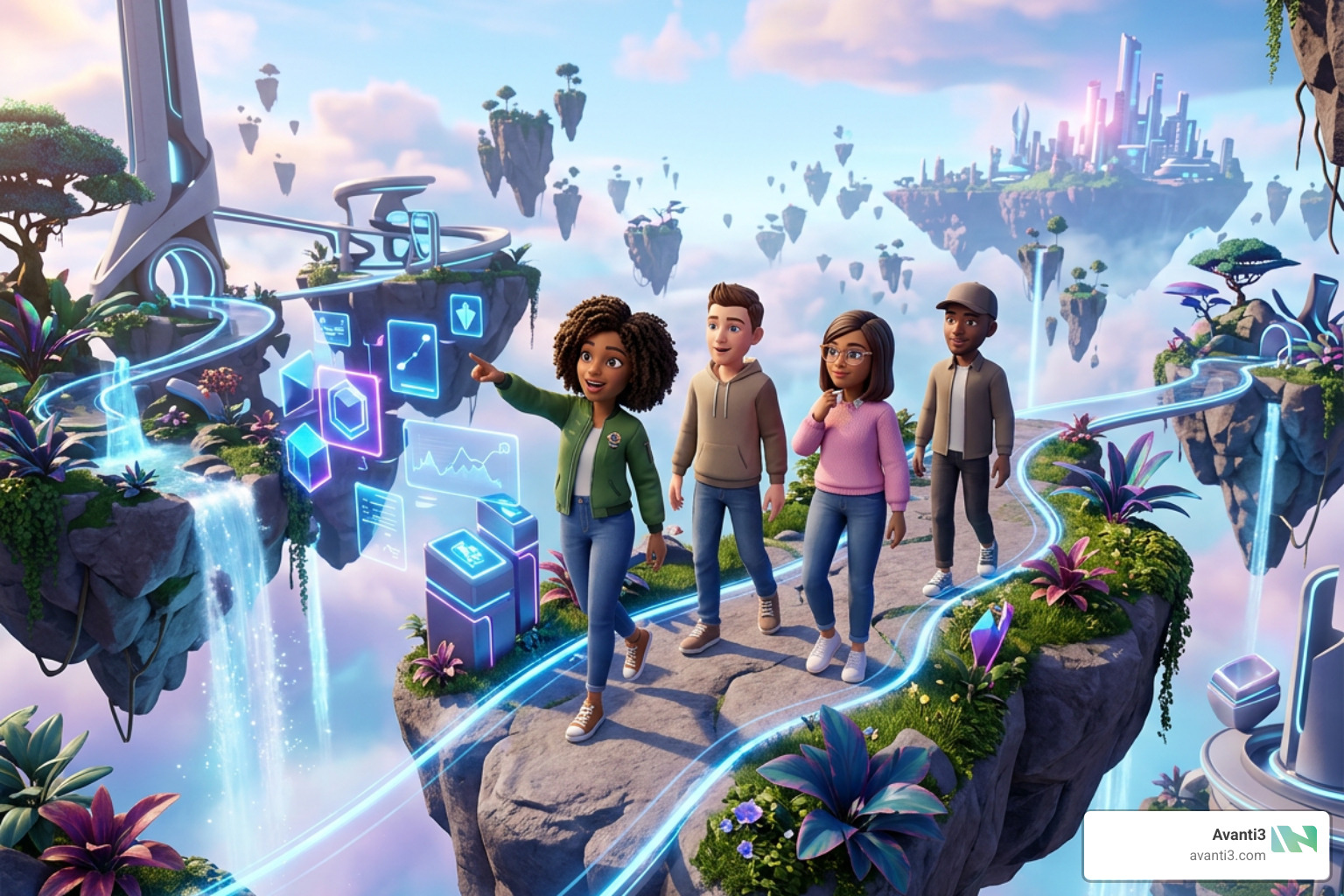
Artificial Intelligence is also playing an increasingly vital role. From generating real-time multilingual translations to driving smart, interactive non-player characters (NPCs) that act as virtual booth guides, AI makes these environments feel alive.
We also highly recommend gamifying your venue. You can set up digital scavenger hunts, interactive trivia challenges, and virtual stamp rallies that reward attendees with digital collectibles or real-world physical merchandise.
A great example of this in action is the massive Virtual Market (Vket), which regularly draws over 1.35 million global visitors. Vket features immersive corporate areas—like virtual test rides for major automotive brands and interactive regional tourism games for local municipalities.
To learn more about how brands are successfully executing these massive digital marketplaces, read about the corporate exhibitor lineup for Virtual Market. For a comprehensive framework on designing your own virtual venue, read our virtual reality exhibition complete guide. To understand the intersection of AI and digital worlds, explore VentureBeat’s coverage of how generative AI is shaping the metaverse.
Data and Analytics: Measuring Success in 3D Spaces
One of the most powerful advantages of Metaverse virtual events is the depth of data they generate. In a physical venue, it is incredibly difficult to know exactly which booths an attendee visited, how long they stood there, or what promotional materials they actually looked at.
In a 3D virtual space, every single interaction can be measured. Organizers can track:
- Precise Dwell Time: Know exactly how long an avatar stood in front of a specific product display or presentation screen.
- Movement Heatmaps: Visualize the flow of traffic through your virtual venue to optimize the layout of future events.
- Asset Engagement: Track which digital brochures were opened, which videos were played, and which virtual items were claimed.
- Instant Feedback: Gauge real-time audience reactions using built-in interactive emoji mechanics.
This granular behavioral data allows brands to calculate a highly accurate return on investment (ROI) and continuously refine their engagement strategies.
A prime example of immersive engagement tracking was showcased during Post Malone’s Twelve Carat Toothache VR Experience, which drew tens of thousands of rsvp’d fans into a highly interactive, intimate digital performance. For actionable tips on designing high-performing virtual booths that capture this valuable data, check out our ultimate guide to virtual reality exhibits for conferences.
Conclusion: Stepping into the Future of Digital Engagement
As we look ahead, the line between physical and digital experiences will only continue to blur. The future of corporate gatherings lies in hybrid events and the use of digital twins—creating exact virtual replicas of physical venues so that remote and in-person audiences can interact in real-time.
Whether you are looking to host a global product launch, an immersive training seminar, or a massive virtual music festival, the tools to build these experiences are available today. If you are ready to see what is possible, browse through these inspiring virtual reality events examples that actually worked.
At Avanti3, we specialize in bridging the gap between cutting-edge Web3 technology and real-world brand engagement. We help you design, build, and monetize custom virtual worlds that turn passive viewers into active community members.
Are you ready to redefine how your brand connects with the world? Let’s build something unforgettable together. Explore our Avanti3 Digital Engagement Solutions and take your first step into the future of virtual connection today. You can also find upcoming local and digital gatherings on Eventbrite’s Metaverse Events directory to experience these spaces firsthand.