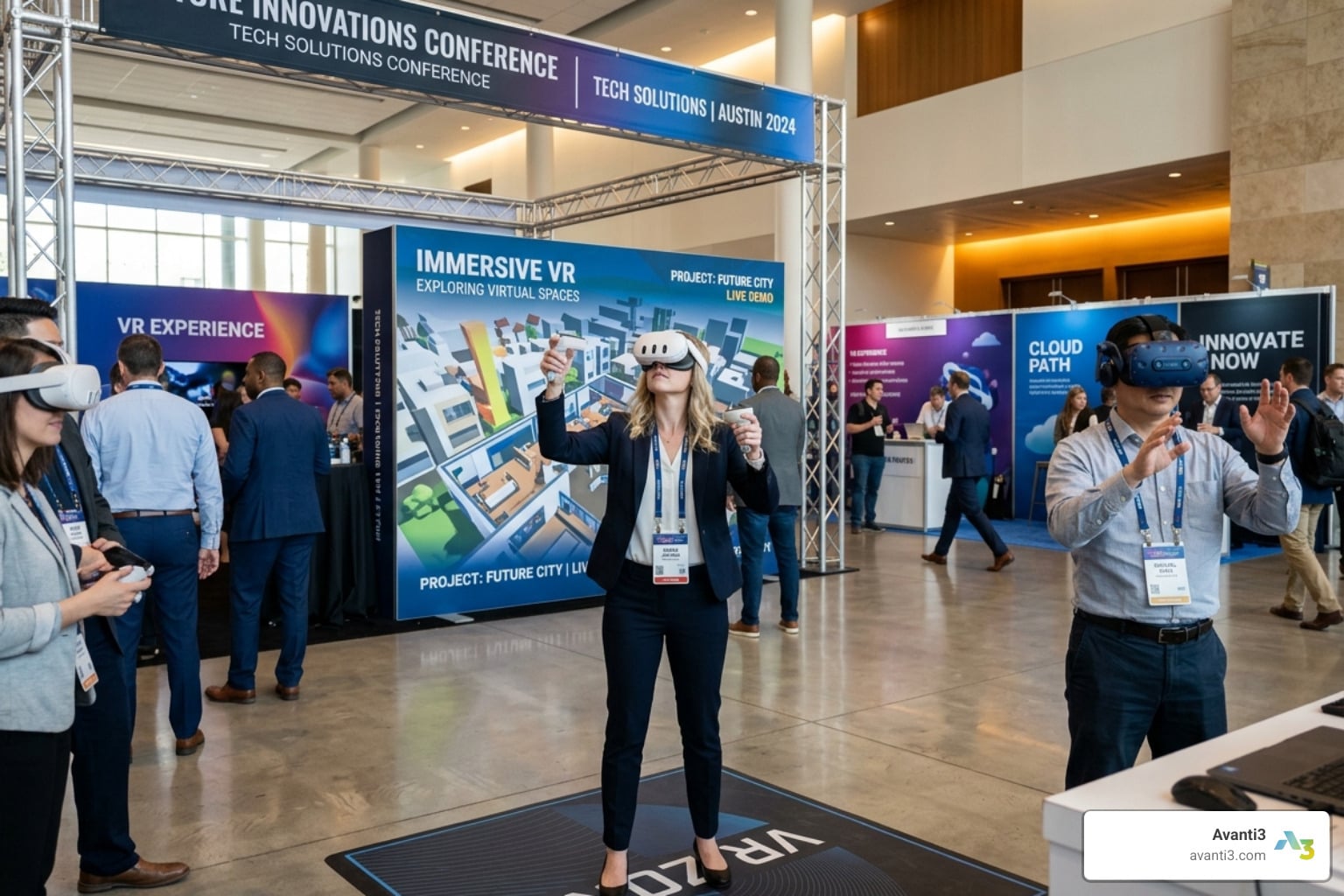


The Ultimate Guide to Virtual Reality Exhibits for Conferences: Wow Your Attendees
Why Virtual Reality Exhibits for Conferences Are Changing the Game in 2026
Virtual reality exhibits for conferences are immersive, interactive digital booths and environments that replace or enhance traditional physical displays at trade shows, expos, and professional events.
Here’s a quick breakdown of what they offer:
- What they are: 3D virtual spaces where attendees explore products, meet brand reps, and interact with content — from any device
- How they differ from traditional booths: No shipping, no physical setup, no geographic limits
- Key benefits: Up to 80% reduction in logistics costs, double the visitor engagement, and real-time analytics on every interaction
- Who uses them: Brands, tech companies, medical institutions, and enterprises across industries
- Best for: Hybrid events, global audiences, product-heavy showcases, and data-driven exhibitors
The shift is already happening. Events like CES and AWE USA draw tens of thousands of senior-level attendees — and the brands that stand out are the ones replacing static displays with experiences people can step inside.
In 2026, attendee expectations have evolved. People want to feel something at a booth, not just read a brochure.
I’m Samir ElKamouny, a marketing expert and entrepreneur who has helped scale businesses using innovative digital strategies — including virtual reality exhibits for conferences — to create deeper audience connections and measurable growth. In this guide, I’ll walk you through everything you need to know to make your next conference exhibit truly unforgettable.
Virtual reality exhibits for conferences terms simplified:
- virtual reality exhibition
- tools needed for virtual reality exhibition
- virtual reality at consumer exhibitions
The Strategic Benefits of virtual reality exhibits for conferences
As we navigate the landscape of 2026, the traditional trade show model is being turned on its head. While physical presence still holds value, the limitations of “four walls and a carpet” are becoming increasingly apparent. Virtual reality exhibits for conferences offer a level of flexibility and impact that physical booths simply cannot match.
Consider the sheer scale of modern events. At CES 2022, around 85,000 people attended virtually. More impressively, 60% of those registered were senior-level executives from 171 different countries. If you are only focusing on the people walking past your physical booth in Las Vegas, you are missing out on a global powerhouse of decision-makers.
| Feature | Traditional Trade Show Booth | VR Exhibit for Conferences |
|---|---|---|
| Reach | Limited to physical attendees | Global; theoretically unlimited |
| Product Demo | Limited by floor space/shipping | Real-scale, full catalog access |
| Interactivity | Static displays, brochures | 4D interactivity, gamification |
| Cost Profile | High shipping, drayage, travel | High initial design, zero shipping |
| Data/Analytics | Manual lead scanning, guesswork | Real-time heatmaps, session data |
| Sustainability | High waste (print, construction) | Low carbon footprint, reusable |
By utilizing Virtual Reality Experiences, we can transport an executive from Tokyo or London directly into our brand environment without them ever leaving their office. This isn’t just a “3D tour”; it’s a functional business environment where real-scale product exploration allows a customer to walk through a virtual factory or inspect a microscopic medical device as if it were right in front of them.
Our focus at Avanti3 is on providing Digital Engagement Solutions that bridge the gap between “cool tech” and “real business results.” VR exhibits aren’t just about the “wow” factor; they are about providing 4D interactivity that mirrors real-world functionality—talking, demoing, scheduling, and selling—all within a digitally accurate venue.
Unmatched Engagement and Global Reach with virtual reality exhibits for conferences
One of the biggest misconceptions about VR is that it’s an isolating experience. In reality, modern Digital Engagement Platforms have turned VR into a social powerhouse. Using technologies like the Multiverse™ audience scaling, we can now support over 10,000 simultaneous users in a single virtual environment.

In these spaces, attendees are represented by personified avatars. These aren’t just floating icons; they have real-life likenesses, etiquette, and gestures that build trust. Imagine walking up to a virtual booth and having a proximity-based chat. Just like at a real trade show, as your avatar gets closer to a brand representative, the audio naturally fades in, allowing for spontaneous, organic networking.
This cross-device accessibility is crucial. While high-end headsets offer the most immersion, 2026’s best platforms allow users to join via a standard web browser on their smartphone or laptop. This ensures that whether someone is using a Meta Quest 4 or an iPhone, they can still engage with your virtual reality exhibits for conferences.
Drastic Cost Savings and Sustainability
Let’s talk about the “elephant in the room”: the cost of exhibiting. Traditional trade shows are notorious for hidden fees—shipping crates, inventory handling, electricity hookups, and the massive carbon footprint of flying a team across the world.
Research shows that switching to mixed reality and VR solutions can eliminate shipping and inventory costs by up to 80%. Instead of shipping a 2-ton piece of industrial machinery, you create a high-fidelity digital twin. This allows for a “virtual catalog presentation” where you can showcase your entire product line in a 10×10 space (or no space at all).
By leaning into Ar Vr Immersive Experiences, we aren’t just saving money; we’re saving the planet. Virtual exhibiting is the ultimate eco-friendly move, reducing the physical waste of one-time-use booth graphics and the environmental impact of global logistics.
Data-Driven ROI and Analytics
How many people really looked at your poster at the last conference? With traditional booths, you’re lucky if you get a badge scan. With virtual reality exhibits for conferences, we have access to “Engagement Scoring” that would make a data scientist weep with joy.
Through sophisticated Digital Experience Design, we can track:
- Session Analytics: Exactly how long an attendee spent looking at a specific product.
- Interaction Heatmaps: Which areas of your virtual booth attracted the most “foot traffic.”
- Trophio™ Gamification: Using rewards systems to encourage attendees to complete a full tour or watch a demo.
- Pipeline Data: Direct integration with your CRM so that a virtual “handshake” becomes a real-world lead instantly.
This level of measurable ROI allows us to move away from “we think the show went well” to “we know 45% of senior executives engaged with the new product demo for more than 3 minutes.”
Implementing High-Impact VR Exhibits: Tools and Best Practices
Getting started with virtual reality exhibits for conferences doesn’t require you to be a coding wizard. In 2026, the barrier to entry has dropped significantly thanks to browser-based, no-download solutions.

The best practices for a successful exhibit involve ensuring your environment is built on HTML5 infrastructure. This means your “world” loads instantly in a browser without requiring the attendee to download a bulky 2GB app. Security is also paramount; enterprise-grade encryption ensures that your private product reveals stay private.
Choosing the Right Platform for virtual reality exhibits for conferences
When selecting a platform, look for features that prioritize user experience over flashy gimmicks. A great VR exhibit platform should offer:
- Customizable Stands: The ability to swap branding, colors, and 3D models on the fly.
- HMD Compatibility: Seamless switching between 2D screen mode and full VR headset immersion.
- Gyroscopic Motion: For mobile users, the ability to look around the virtual room just by moving their phone.
- 360-Degree Environments: Immersive backgrounds that make the user feel they are in a high-end convention center or even a Virtual Art Experience.
Shared multi-user sessions are a game-changer. It allows your sales rep in New York to “walk” a lead from Dubai through a 3D model, pointing out specific features in real-time.
Integrating Hybrid Elements and AR
We often see virtual reality exhibits for conferences working hand-in-hand with Augmented Reality (AR). While VR creates a completely new world, AR brings digital elements into the attendee’s physical space.
Using WebAR technology, you can place a QR code on a physical business card or a simplified “hybrid” booth. When scanned, a 3D product configurator pops up on the attendee’s smartphone. They can customize the product, see it in “real size” on the floor in front of them, and then take that experience home.
We’ve even seen success with Augmented Reality Concerts and live performances used as “draws” to bring people into the virtual space. By creating a “digital twin” of your physical booth, you ensure that the experience is consistent for both the person standing in front of you and the person logging in from across the globe.
Overcoming Challenges and Getting Started in 2026
Of course, no technology is without its hurdles. The two biggest challenges are usually internet requirements and user onboarding. To overcome these, we recommend:
- Technical Support: Always have a “virtual concierge” (either an AI bot or a live person) ready to help users who are new to 3D navigation.
- Clear Instructions: Use simple prompts like “Click and drag to look around” or “Use WASD to walk.”
If you are looking for inspiration, keep an eye on the upcoming 2025-2026 circuit. AWE USA 2026 in Long Beach is expected to be a massive showcase for “Spatial AI,” while CES 2026 and SPIE Photonics West will continue to push the boundaries of XR hardware.
At Avanti3, we believe that Virtual Reality Experiences are the future of brand storytelling. Whether you’re showcasing a new medical procedure or launching a global tech product, VR exhibits allow you to transcend physical walls and connect with your audience in a way that is meaningful, memorable, and—most importantly—measurable.
Ready to leave the static booths of the past behind? The multiverse is waiting, and your attendees are already there.