


Tokens, Tech, and Trust: A Guide to Web3 Business Models
The Internet Just Changed Ownership — Here’s What That Means for Business
Web3 business models represent a fundamental shift in how value is created, captured, and distributed online — moving power away from centralized platforms and toward users, creators, and communities.
Here’s a quick snapshot of the most common Web3 business models in 2026:
| Business Model | How It Works | Best For |
|---|---|---|
| Transaction Fee | Charge a small % on swaps, trades, or mints | DEXs, NFT marketplaces, payment routers |
| Protocol/Infrastructure Fee | Charge developers for API or node access | Oracles, RPC providers, developer tooling |
| Token Utility | Token grants access, staking rights, or governance votes | DeFi protocols, gaming platforms |
| Stablecoin Reserve Yield | Earn interest on reserve assets backing stablecoins | Stablecoin issuers like Tether |
| Marketplace Take-Rate | Clip a % from buyer-seller transactions | NFT platforms, creator marketplaces |
| Subscription + On-Chain | Combine recurring SaaS fees with on-chain perks | B2B fintech, embedded wallet startups |
| Liquidity & Yield-Based | Earn from lending spreads and liquidity provision | DeFi lending protocols |
| DAO Treasury | Govern and deploy a shared community treasury | Decentralized protocols, creator DAOs |
The Web has gone through three major phases. Web1 was read-only — static pages, no interaction. Web2 was read-write — you could post, but platforms owned everything you created. Web3 is read-write-own — for the first time, users hold verifiable ownership of their digital assets, data, and even a share of the platforms they use.
That shift changes everything about how businesses make money.
Instead of harvesting user data to sell ads, Web3 businesses align incentives directly with their communities. Instead of locking value inside a platform, they distribute it through tokens, smart contracts, and decentralized governance. And instead of a few tech giants capturing most of the value, the “fat protocols” model means value often accrues at the infrastructure layer — shared by everyone building on top of it.
The Web3 market is projected to reach $81.5 billion by 2030, growing at a 34.8% CAGR. DeFi alone crossed $100 billion in total value locked in 2024. This isn’t a niche experiment anymore — it’s a new business operating system.
But it also comes with real complexity. Tokenomics, DAOs, interoperability, regulatory uncertainty — these aren’t simple plug-and-play upgrades. They require a fundamentally different way of thinking about customers, revenue, and value.
I’m Samir ElKamouny, an entrepreneur and marketing strategist who has spent years helping businesses scale through innovation — and increasingly, that means navigating Web3 business models where community ownership and decentralized revenue are rewriting the rules. Let’s break down exactly how these models work and how you can use them to build something that lasts.
Know your Web3 business models terms:
Deconstructing Web3 Business Models: Value, Tokens, and the Decentralized Canvas
At the core of the Web3 revolution is a fundamental reimagining of how digital architectures operate. In traditional environments, central intermediaries act as trusted gatekeepers, extracting value in exchange for security and coordination. Web3 replaces these intermediaries with decentralized networks powered by blockchain technology, smart contracts, and decentralized applications (dApps).
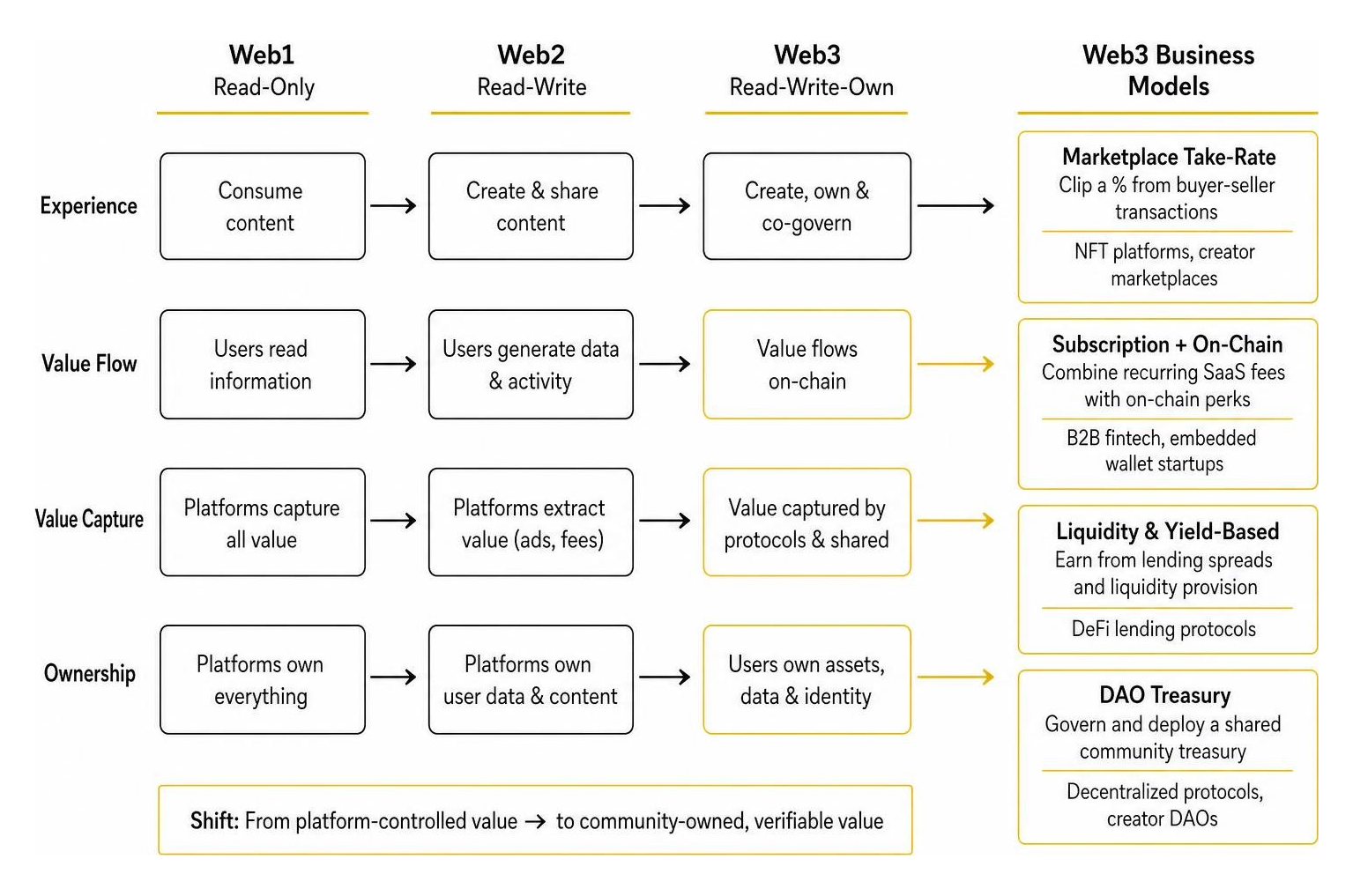
This architectural shift replaces “digital trust” (relying on a brand or platform’s reputation) with “digital truth” (verifiable cryptographic proofs). Key characteristics such as self-custodial wallets, protocol interoperability, and tokenization reshape the monetization landscape. For a deeper dive into how this ecosystem functions, the PwC Web3 Revolution Guide highlights how digital assets behave like physical goods—capable of being owned, verified, and transferred seamlessly without central oversight.
Traditional vs. Web3 Business Models: A Paradigm Shift in Value Creation
To understand decentralized networks, we must look at how value flows. In the Web2 era, platforms like Facebook or Google relied on a “thin protocol, fat application” model. The underlying protocols (like HTTP or SMTP) captured almost no financial value, while the applications built on top captured billions by aggregating user data and selling targeted advertising.
Web3 flips this dynamic through the “fat protocol” thesis. Here, value accrues primarily at the shared protocol layer (such as Ethereum or Solana) because the native token is required to execute transactions.
| Dimension | Traditional (Web2) Business Models | Web3 Business Models |
|---|---|---|
| Primary Value Driver | Proprietary data aggregation & ad targeting | Open-source protocols & tokenized networks |
| Data Ownership | Centralized in platform databases | Distributed; owned by users via wallets |
| Revenue Capture | Subscriptions, ad revenue, platform lock-in | Transaction fees, protocol fees, block space sales |
| User Incentive | Platform utility and convenience | Financial alignment, governance, asset ownership |
| Governance | Board of directors & centralized executives | Decentralized Autonomous Organizations (DAOs) |
In this environment, platform disintermediation becomes a reality. Instead of relying on a centralized clearinghouse, users interact directly via peer-to-peer networks. For a detailed breakdown of these structures, the FourWeekMBA Blockchain Business Models Guide explores how decentralized ecosystems leverage tokenomics as a new coordination mechanism. This structural shift is also driving the rise of programmatic agreements and trustless execution, which we cover extensively in our analysis of The Digital Frontier: Innovative Solutions for Tomorrow’s Economy.
Designing Web3 Business Models with an Adapted Business Model Canvas
The classic Business Model Canvas (BMC) developed by Alexander Osterwalder and Yves Pigneur is a staple for traditional startups, but its focus on centralized value capture makes it insufficient for decentralized systems. To design an effective Web3 strategy, we must expand the traditional canvas to accommodate decentralized governance, token distributions, and community-driven networks.
Academic insights from the Hawaii International Conference on System Sciences Web3 Research suggest a modified framework containing seven updated building blocks. This adapted canvas shifts the focus from simple buyer-seller relationships to complex systems of value co-creation and value distribution.
The updated blocks prioritize:
- Community and Customer Segments: Merging passive consumers with active token holders, developers, and node operators.
- Tokenomics & Treasury Management: Mapping how native tokens circulate, reward validators, and fund future development.
- Incentive and Reward Structures: Designing feedback loops that align the interests of all network participants.
By updating these components, companies can avoid the common trap of treating a utility token as a purely speculative asset rather than a tool for platform utility. To explore how emerging technologies like artificial intelligence further optimize these decentralized canvases, read our guide on AI Web3: Reshaping Business Models One Byte at a Time.
Tokenomics, Incentives, and Value Co-Creation in Decentralized Networks
In Web3, tokens are the lifeblood of the business model. They are not just digital coupons; they represent utility, access, and governance rights. Unlike traditional loyalty programs where points are siloed within a single brand’s database, Web3 incentives are composable, liquid, and tradeable.
We see this clearly in how protocols generate sustainable revenue. According to HTX Insights on Web3 Revenue Drivers, successful decentralized models move beyond cyclical transaction fees to build thick economic moats. This includes models like:
- Stablecoin Reserve Yields: Earning interest on real-world assets (like US Treasuries) backing digital dollars.
- Funding Rate Spreads: Leveraging capital demand in decentralized lending markets.
- Protocol-Level Service Fees: Acting as industry standards (like decentralized oracle networks) with high switching costs.
These mechanisms allow users to participate directly in the platform’s financial success through staking, proof-of-stake consensus validation, and liquidity provision. Furthermore, non-fungible tokens (NFTs) have introduced programmable royalties and digital scarcity, which we analyze in depth in our article on Unlocking Value: How NFTs Revolutionize Digital Ownership and Monetization.
Redefining the Customer: The Power of Web3 Communities and the Creator Economy
In a traditional business, the customer is an external target audience. In Web3, the boundary between customer, employee, and owner blurs. A community member can be an active developer, a token holder with voting power in a DAO, and a passionate brand advocate all at once.

This has unlocked entirely new monetization strategies within the creator economy. As highlighted in the Executive Academy Web3 Business Models analysis, models like virtual real estate (land), avatar customization (skins), and play-to-earn/work-to-earn structures allow users to monetize their digital presence directly.
Instead of relying on centralized social networks that take massive cuts of creator earnings, Web3 platforms allow creators to retain up to 90% of their revenue while building direct relationships with fans. To learn how to implement these strategies for your brand, check out our Web3 Creator Platforms Complete Guide.
Transitioning to Decentralization: Opportunities, Barriers, and Strategic Implementation
For established enterprises, transitioning to Web3 is not about discarding existing systems overnight. Instead, it involves identifying where decentralized technologies can solve real-world inefficiencies—such as reducing transaction costs, automating complex supply chains via smart contracts, or building deeper, gamified customer relationships.
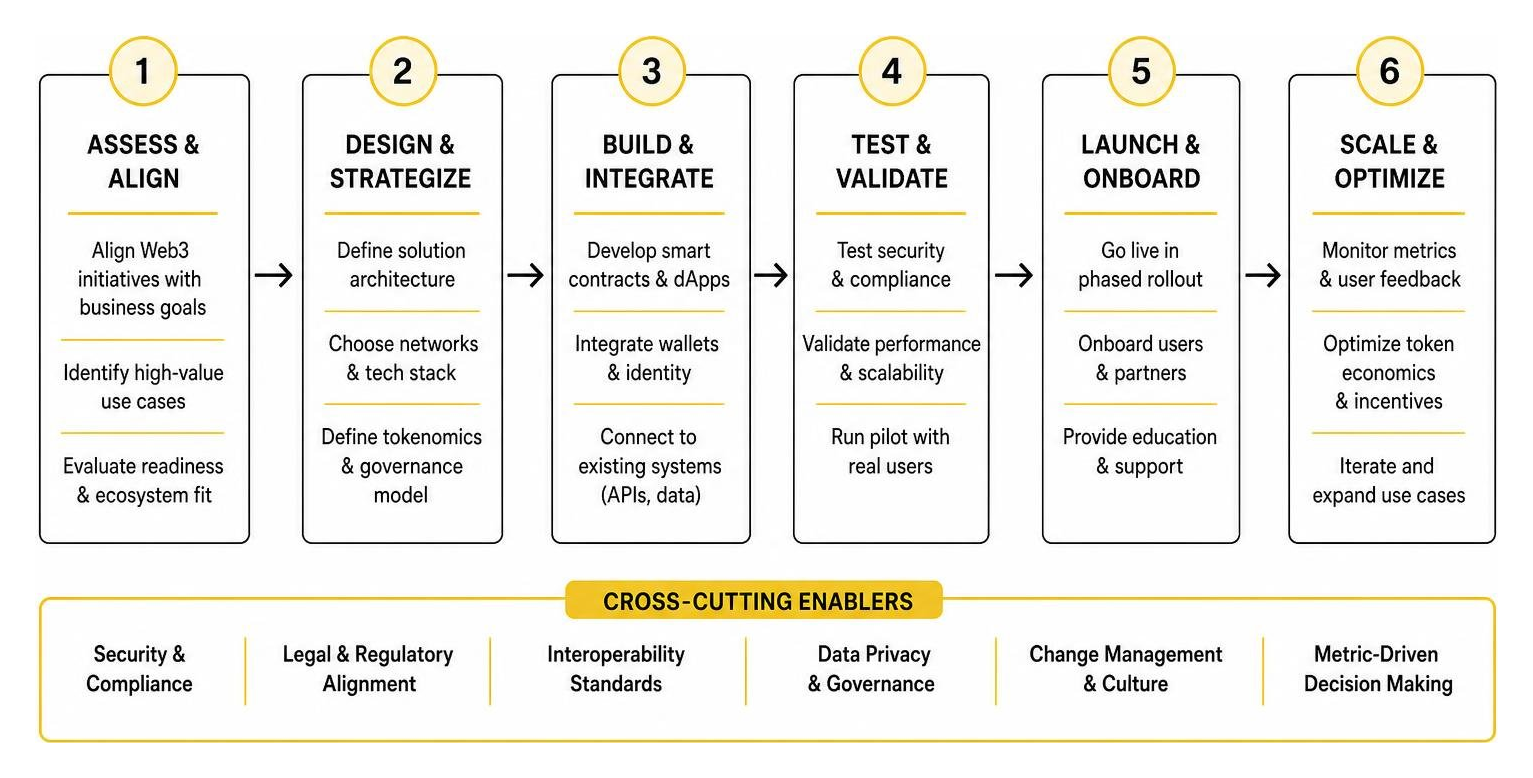
When we look at successful integrations, the focus is always on utility over hype. As explored in the Visartech Web3 Business Transformation guide, businesses can leverage decentralized storage, smart contract automation, and wallet integrations to streamline operations and eliminate redundant paperwork. To understand how this fits into your broader marketing and operational strategy, read The Marketer’s Guide to Surviving the Blockchain Revolution.
Navigating the Transition: Challenges and Barriers for Incumbent Enterprises
While the opportunities are vast, the road to Web3 adoption is paved with regulatory, technical, and organizational challenges. Many enterprise leaders struggle with the transition from centralized control to decentralized governance, fearing a loss of brand oversight.
The primary barriers include:
- Regulatory Compliance: Navigating shifting global frameworks around digital assets, securities laws, and tax implications.
- Technical Complexity: Managing smart contract audits, security vulnerabilities, and integration with legacy ERP systems.
- User Experience (UX) Friction: Overcoming the steep learning curve of setting up wallets, managing private keys, and paying gas fees.
As noted in the Startupik Web3 Business Models for Founders guide, the most common mistake is launching a token before achieving product-market fit or assuming a speculative community equals a loyal customer base. To avoid these pitfalls and build a resilient brand presence on-chain, take a look at our strategic playbook, How to Win at Web3 Brand Strategy Without Losing Your Mind.
Designing and Iterating Your Decentralized Strategy
Building a sustainable Web3 business model requires an agile, iterative approach. Organizations must start by identifying their core value proposition and mapping how blockchain technology enhances—rather than complicates—the user experience.
At Avanti3, we help brands navigate this complex landscape by integrating Web3 technologies like NFTs, blockchain, and AI to build customizable digital experiences. Whether you are looking to launch a gamified customer rewards system, protect digital rights, or create new revenue streams through tokenized assets, we provide the tools to build lasting community trust and engagement.
Ready to design, evaluate, and scale your decentralized strategy? Explore our full suite of Avanti3 Digital Engagement Solutions and let’s build the future of your business together.