

Work Smarter Not Harder with AI Powered Marketing
Strategic Foundation and Tools for AI Powered Marketing
Building a sustainable strategic foundation for AI powered marketing requires viewing artificial intelligence as an organizational dynamic capability rather than an isolated series of ad-hoc software experiments. While over 80% of marketers actively experiment with off-the-shelf tools, true market differentiation happens when we integrate intelligence layers deeply into our operational decisioning governance and data architectures. Research from leading strategy consultants at McKinsey & Company consistently highlights that high-performing organizations treat artificial intelligence as a core driver of commercial value rather than a simple cost-reduction shortcut.
When we ground our marketing strategy in structured AI workflows, our teams move from reactive execution to proactive market orientation. By balancing automated channel execution with clear ROI analysis, we empower cross-functional teams to make goal-aware dynamic budget shifts that capture market share faster while maximizing customer lifetime value.
Core Applications of AI Powered Marketing Across Functions
Modern AI powered marketing impacts every core function within the modern growth organization, driving measurable efficiency and deeper audience resonance across all consumer touchpoints.
The primary functional applications include:
- Hyper-Personalization and Journey Mapping: Utilizing live behavioral cues, past interactions, and real-world signals to deliver customized offers and content directly aligned with individual customer intent through advanced AI-Powered Personalization Tactics.
- Predictive Analytics and Customer Insights: Unifying enterprise first-party data to accurately forecast churn risks, calculate lifetime value (LTV), and uncover unexpected audience segments using comprehensive AI Digital Marketing Solutions.
- Automated Campaign Decisioning: Dynamically reallocating ad spend across paid search, social platforms, and media channels in real time based on goal-aware conversion tracking.
- End-to-End Creative Lifecycle Management: Automating ideation, copywriting, asset resizing, and platform-specific variations to eliminate production bottlenecks.
Essential AI Tools for Content, Analytics, and Automation
To construct an effective technological stack, we must understand how modern AI tooling categories address distinct marketing requirements. While 48% of teams frequently use generative tools for basic copywriting or tagline creation, only 9% have integrated AI throughout their entire creative workflow.
| AI Tool Category | Primary Functional Focus | Key Business Capability & Impact |
|---|---|---|
| Agentic AI Suites | Workflow Automation & Execution | Executes multi-step campaign planning, automated testing, and audience orchestration autonomously. Boosts campaign efficiency by up to 88%. |
| Goal-Aware Analytics | Performance Intelligence | Evaluates cross-channel metrics against specific campaign objectives, distinguishing brand awareness from direct conversions. |
| Content & Creative Engines | Generative Production | Scales copy, video ads, and localized visual assets while adhering strictly to brand voice guardrails. |
| Predictive CDP Platforms | Audience Segmentation | Processes first-party web and offline signals to calculate real-time churn risk and recommend next-best actions. |
Integrating specialized agents and goal-aware reporting platforms allows us to bridge the gap between prompt engineering and true operational scale. By leveraging targeted AI Content Personalization along with robust AI-Powered Insights, growth teams transform raw tracking metrics into clear tactical decisions, frequently shipping high-converting creative concepts 3x faster than traditional execution pipelines.
Building an Organizational AI Marketing Roadmap and Synergy
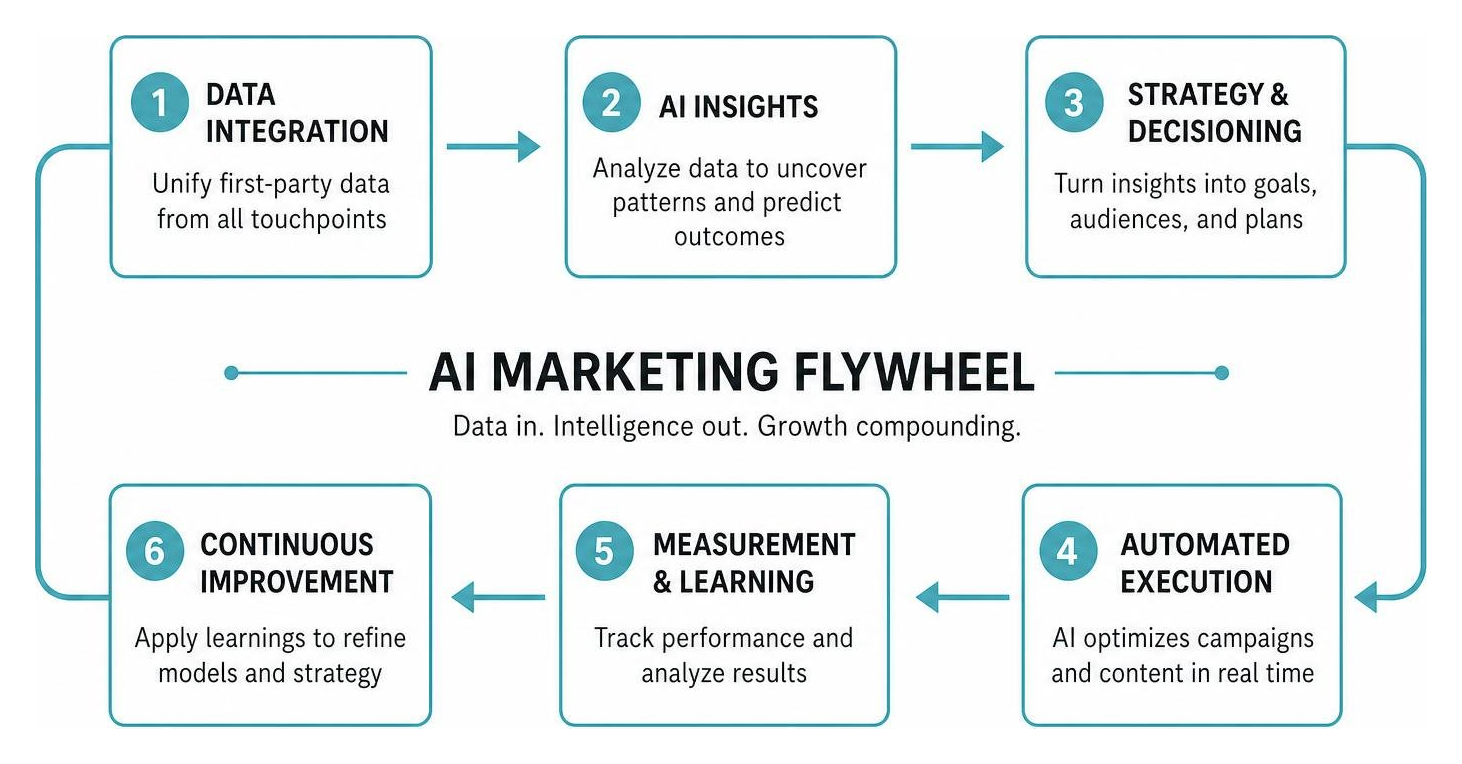
Transitioning from fragmented tool usage to a self-reinforcing marketer-AI flywheel requires thoughtful organizational alignment. Marketers must evolve from tactical executors into strategic orchestrators who direct automated systems while retaining ultimate governance over strategic positioning.
To build an actionable AI roadmap, we recommend establishing cross-functional squads comprising marketing, IT engineering, legal, data science, and finance. Rather than forcing staff to adopt hundreds of disconnected applications, top-performing organizations focus on two or three high-impact quarterly goals. This approach enables dynamic budget shifts while fostering a cross-functional AI culture where human creativity guides automated scale through Mastering AI-Driven Marketing Strategy and tailored Customizable AI Solutions.
Overcoming Limitations and Navigating the Future of AI Marketing

Despite the profound revenue advantages, implementing artificial intelligence across marketing operations introduces real risks that demand active governance. Enterprise leaders frequently express concern regarding regulatory compliance such as the General Data Protection Regulation (GDPR) and CCPA, algorithmic bias in customer targeting, and the potential for hallucinated misinformation to erode customer trust.
To mitigate these operational hazards, we must maintain strict human-in-the-loop oversight across every stage of the funnel. AI systems excel at discovering patterns and automating execution, but human oversight ensures brand voice consistency, ethics, and emotional resonance. Establishing role-based permissions, data encryption standards, and explicit compliance guardrails guarantees that every asset generated aligns with company principles before going live.
Future Trends Shaping AI Powered Marketing in 2026 and Beyond
As we look across 2026 and into the future of digital engagement, AI powered marketing is merging with immersive technologies and decentralized ecosystems. Standard static marketing automation—such as fixed email sequences—is rapidly giving way to real-time contextual signals, ambient computing, and agentic workflows that adapt continuously to audience behavior.
Key emerging trends include:
- Agentic AI Execution: Autonomous AI agents that go beyond simple task assistance to independently plan, execute, and evaluate multi-channel campaigns based on predefined business metrics.
- Web3 and Decentralized Loyalty Integration: Combining machine learning with blockchain technology, digital assets, and tokenized loyalty systems to award verifiable customer participation automatically.
- Experiential and AR Personalization: Blending generative intelligence with augmented reality to deliver hyper-personalized physical and virtual brand experiences, detailed in our breakdown of How AI and AR Get Personal.
- Environmental Contextual Triggers: Utilizing live external signals—such as hyper-local weather alerts, real-time inventory levels, and social sentiment shifts—to trigger immediate, contextual consumer messaging via AI-Driven Customer Engagement Solutions.
Conclusion: Transforming Digital Engagement with Avanti3
At Avanti3, we believe the true potential of AI powered marketing lies in combining intelligent automated execution with deep, memorable audience experiences. By seamlessly integrating Web3 technologies like NFTs, blockchain, AR/VR, and predictive AI, we empower creators and forward-thinking brands to build customizable engagement ecosystems and robust fintech solutions that foster lasting brand loyalty.
Instead of chasing superficial software hacks or overwhelming your team with fragmented workflows, we help you master strategic orchestration—turning standard customer touchpoints into thriving, monetizable digital communities that deliver quantifiable business performance.
Ready to elevate your marketing strategy and foster genuine brand loyalty? Explore our comprehensive suite of Digital Engagement Solutions today and start working smarter to achieve long-term growth.