

Who Are You Anyway? A Guide to Blockchain Based Identity and Web3
Why Blockchain Based Identity Is Rewriting the Rules of Digital Trust
Blockchain based identity is a system where individuals, organizations, and even machines control their own digital credentials — without relying on a central authority like a government database, tech platform, or bank.
Here’s a quick breakdown of what that means in practice:
- What it is: A decentralized approach to proving who you are online, using cryptographic keys and tamper-proof credentials stored on a blockchain
- How it works: You hold your own identity data in a digital wallet, share only what’s needed, and no single company owns or controls your information
- Why it matters: Over 2.6 billion records were compromised in data breaches in 2023 alone — and centralized identity systems are the root cause
- Who benefits: Everyone from Fortune 500 brands to the 850 million people worldwide who currently have no legal ID at all
- Key technologies: Decentralized Identifiers (DIDs), Verifiable Credentials (VCs), and Zero-Knowledge Proofs (ZKPs)
The way we prove who we are online is quietly broken — and most people haven’t noticed yet.
Think about it. You have a login for your bank, another for your healthcare portal, another for every app you’ve ever signed up for. Each one holds a copy of your personal data. Each one is a target. When any one of them gets breached, your information is exposed — and you had no say in how it was stored or who could access it.
This is called identity sprawl, and it’s the defining vulnerability of the modern internet. It’s not just a personal inconvenience. It cost the global economy an estimated $654 billion in a single year from consumer data record exposures alone. Personally identifiable information made up 97% of all data breaches recorded.
And the problem goes deeper than security. Approximately 1.1 billion people worldwide have no officially recognized form of identification at all. That means no bank account, no access to healthcare, no way to participate in the digital economy — not because they don’t exist, but because the systems designed to recognize them were never built with them in mind.
We’re now in 2026, and the stakes are getting higher. AI agents are beginning to transact, sign contracts, and access services on behalf of humans. If we can’t reliably verify human identity today, the agentic era could turn a $200-per-year fraud problem into a $2,000 one.
Blockchain-based identity isn’t just a technical upgrade. It’s a fundamental rethinking of who owns your digital self.
I’m Samir ElKamouny, an entrepreneur and marketing strategist who has spent years helping brands harness emerging technologies — including blockchain based identity — to build more secure, trustworthy, and engaging digital experiences. In this guide, I’ll walk you through exactly how decentralized identity works, where it’s already being used, and how forward-thinking brands can get ahead of this shift.
Blockchain based identity definitions:
The Core Pillars of Blockchain Based Identity
To understand how we can fix our broken digital trust systems, we must look at the structural architecture of decentralized identity. At its heart, blockchain based identity replaces centralized databases with a distributed trust registry. Instead of a single tech giant holding the keys to your digital life, you hold them yourself.
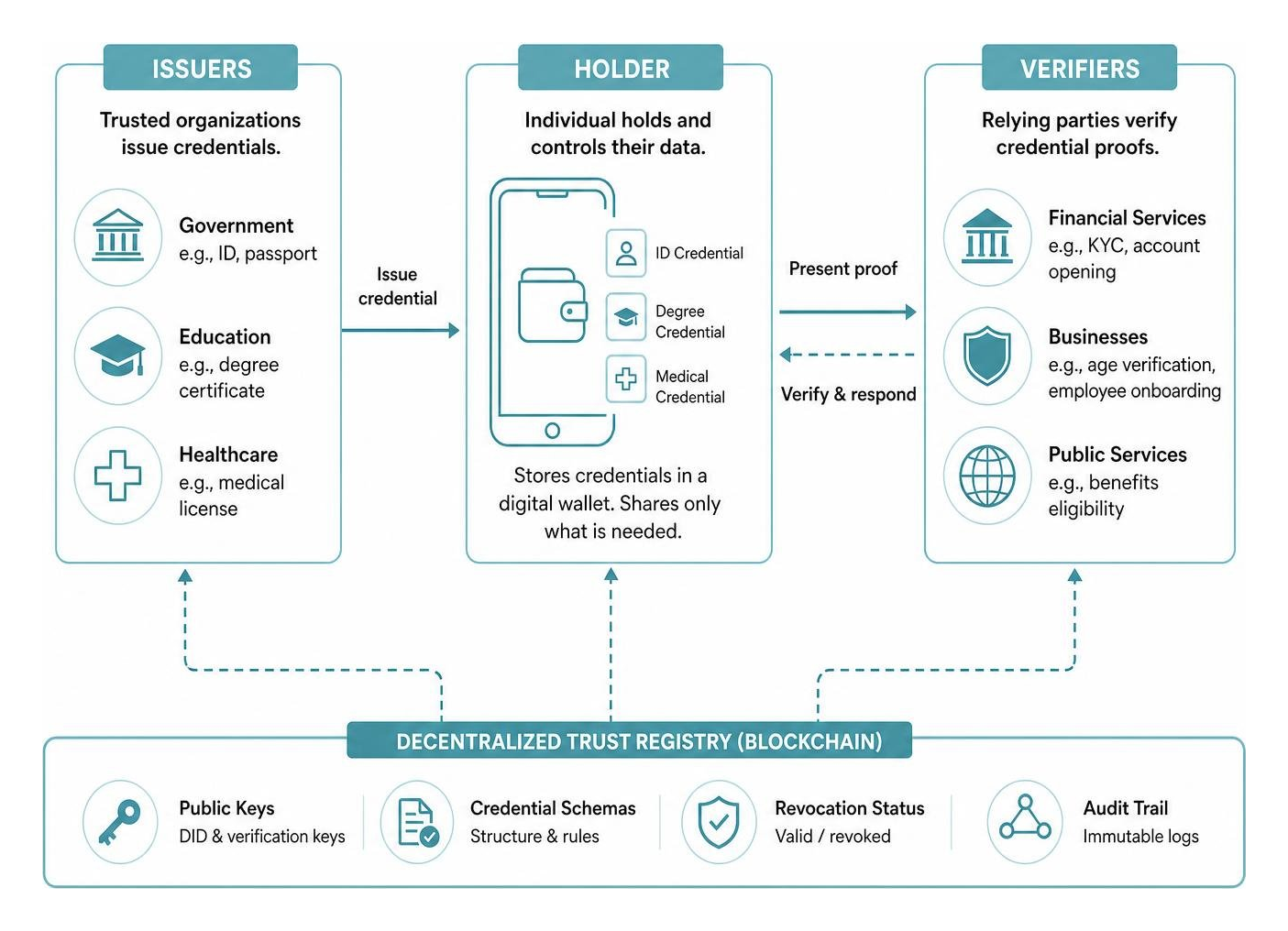
This model relies on Self-Sovereign Identity (SSI)—the philosophical and technical concept that individuals and businesses should store their own identity data on their own devices and choose exactly what information to share with validators.
Crucially, we do not store raw personally identifiable information (PII) directly on-chain. Doing so would violate basic privacy laws like GDPR and create an permanent, public target for bad actors. Instead, we use Decentralized Public Key Infrastructure (DPKI). Your digital wallet generates public/private key pairs. The blockchain simply acts as an immutable registry for public keys, cryptographic proofs, and revocation states, while the actual sensitive data remains safely off-chain in secure local storage.
This system is built on global open standards, primarily defined by the World Wide Web Consortium (W3C). These standards ensure that digital wallets, credentials, and verification tools can seamlessly talk to one another across different platforms and networks. Regulatory frameworks are quickly catching up to this reality. In Europe, the updated eIDAS 2.0 regulations mandate that all EU member states must offer a Digital Identity Wallet that accepts W3C Verifiable Credentials with native support for selective disclosure.
To dive deeper into how these decentralized architectures integrate with broader systems, check out our guide on The No-Nonsense Guide to Blockchain Integration or explore the ConsenSys Blockchain for Digital Identity resource.
The Mechanics of Self-Sovereign Identity (SSI)
To understand SSI, we need to look at the three-way trust triangle that replaces traditional username-and-password databases:
- The Issuer: An authoritative entity (like a government, university, or bank) that cryptographically signs a credential and hands it to the holder.
- The Holder: You (or your digital wallet), who stores this credential locally and maintains complete control over when and with whom it is shared.
- The Verifier: A third party (like a merchant, employer, or service provider) that needs to check your credentials. They verify the cryptographic signature on-chain instantly without needing to contact the issuer directly.
Developers looking to build these secure communication channels often rely on open-source frameworks. Projects like Hyperledger Aries provide the essential peer-to-peer messaging protocols and agent toolkits needed to manage these interactions. Similarly, networks like IOTA Identity focus on implementing scalable, low-fee decentralized identifiers (DIDs) that can represent humans, organizations, and even physical objects.
Preserving Privacy: Zero-Knowledge Proofs in Blockchain Based Identity
One of the most powerful features of blockchain based identity is the ability to prove something is true without revealing the underlying data. This is achieved using Zero-Knowledge Proofs (ZKPs).
Imagine you are standing at the entrance of a venue and need to prove you are over 21. Traditionally, you hand over a physical driver’s license, exposing your full name, exact date of birth, and home address. With ZKPs and selective disclosure, your wallet generates a cryptographic proof that simply says “Yes, this user is over 21.” The verifier gets a binary confirmation, and zero personal data changes hands.
There are two primary ways modern identity systems handle this selective disclosure:
- Selective Disclosure JSON Web Tokens (SD-JWT): The issuer pre-determines which fields can be individually disclosed by the holder.
- BBS+ Signatures: A highly flexible cryptographic signature scheme that allows the holder to construct customized, ad-hoc disclosures on the fly.
| Feature | SD-JWT | BBS+ Signatures |
|---|---|---|
| Flexibility | Moderate (pre-defined by issuer) | High (ad-hoc selection by holder) |
| Cryptographic Overhead | Low | Moderate |
| Privacy Preservation | Good | Excellent (unlinkable presentations) |
| Standardization Stage | Widely adopted in enterprise | Emerging in high-privacy stacks |
Platforms like aethelred-foundation/zeroid are actively putting these concepts into production. ZeroID combines zero-knowledge circuits (compiled via Circom) with Trusted Execution Environments (TEEs) to generate proofs for age, residency, and compliance in under 1.8 seconds, verifying them on-chain with minimal gas costs.
Overcoming Technical Challenges in Blockchain Based Identity Systems
While the promise of decentralized identity is massive, we must remain realistic about the hurdles to global adoption.
The first major challenge is account recovery. In a truly decentralized system, there is no “Forgot Password” button. If a user loses their private keys, they risk losing their entire digital identity. To combat this, modern systems are designing secure recovery flows—such as social recovery (using a trusted circle of guardians) or multi-party computation (MPC)—without re-introducing a single point of failure.
Other hurdles include:
- Attribute Drift: Ensuring that credentials (like a changing home address or professional license status) remain synchronized and up-to-date without constant manual re-issuance.
- Physical-to-Digital Mapping: Creating a secure, tamper-proof link between a physical human or physical asset and their digital DID.
- Interoperability: Preventing fragmented “walled gardens” by aligning development with unified software development kits.
To explore these practical challenges further, the Okta Whitepaper on Blockchain and Identity offers deep analytical insights. For developers looking to build cross-chain, modular identity solutions, tools like the Hyperledger Identus TypeScript SDK provide a robust TypeScript SDK designed specifically for managing DIDs and verifiable credentials on public ledgers.
Real-World Applications and the Road to Mass Adoption
Decentralized identity is no longer just a theoretical concept discussed in academic whitepapers. In 2026, it is actively transforming industries, streamlining regulatory compliance, and unlocking entirely new business models.

By moving away from repetitive, manual verification checks, organizations can dramatically lower administrative costs and eliminate security vulnerabilities. To understand how businesses are structuring these modern frameworks, check out the Dock Blockchain Identity Management Guide and see how these tools are reshaping industries in our deep dive on Fintech’s New Frontier: How Blockchain is Revolutionizing the Industry.
From Finance to IoT: Real-World Use Cases
The practical applications of blockchain based identity span across almost every major sector of the global economy:
- Financial Services (KYC/AML): The average financial institution spends upwards of $60 million annually on repetitive Know Your Customer (KYC) compliance checks. With blockchain identity, a user verifies their identity once with a trusted issuer. They can then reuse that verified credential across multiple banks instantly, eliminating friction and dropping customer onboarding abandonment rates.
- Healthcare: Patient records are notoriously fragmented and vulnerable. Decentralized identity allows patients to hold their own medical histories in secure digital wallets, selectively sharing access with doctors or specialists while ensuring compliance with strict privacy laws.
- Travel and Immigration: International aviation associations and governments are piloting digital travel credentials. Passports are replaced by secure, cryptographically signed credentials in a digital wallet, allowing travelers to breeze through biometric airport gates without presenting physical booklets.
- The Internet of Things (IoT) & Digital Twins: Devices need identities too. By assigning unique DIDs to connected devices (like autonomous vehicles or smart grid components), we can create secure digital twins. An autonomous car can automatically authenticate itself at a charging station, pay for its fuel via Blockchain Payment Integration, and log its maintenance history transparently.
The Economic Impact and the Agentic Era
The economic potential of this shift is staggering. The total addressable market surface gated by identity rails is projected to reach $840 billion to over $1.3 trillion by 2030.
This growth is being supercharged by the rise of agentic commerce—where autonomous AI agents execute financial transactions on behalf of humans. McKinsey and BCG project agentic commerce to reach $5 to $10 trillion by 2030. If an AI agent does not have a cryptographically provable, scoped, and instantly revocable identity, the risk of fraud will skyrocket. Currently, every $1 of fraud costs merchants an estimated $4.61 fully loaded.
Platforms like BitID are building the infrastructure for this agent-first era. BitID, which already has over 5 million verified users in production, anchors identity state changes on the secure Bitcoin ledger. This allows humans to delegate trust to AI agents using restricted credentials—specifying exact transaction limits, timeframes, and authorized merchants—while protecting against identity theft.
As we move beyond basic verification, these secure identity foundations are also paving the way for next-generation customer engagement. Learn how this trust layer is redefining brand relationships in our article Beyond Points: How Blockchain is Redefining Customer Loyalty.
Building the Future of Digital Trust
At Avanti3, we believe that secure, user-controlled identity is the foundation of all meaningful digital experiences. Whether you are a creator looking to launch a tokenized community, a brand building a next-generation loyalty program, or an enterprise integrating advanced fintech solutions, we help you bridge the gap between legacy systems and Web3.
By combining blockchain, AI, and customizable engagement tools, we empower businesses to build direct, secure, and highly monetizable relationships with their audiences. The future of digital trust isn’t about collecting more customer data—it’s about giving customers control over their own identities and rewarding them for their engagement.
Ready to explore how decentralized technologies can transform your brand’s digital strategy? Connect with us at Avanti3 Digital Engagement Solutions and let’s build the future of digital trust together.