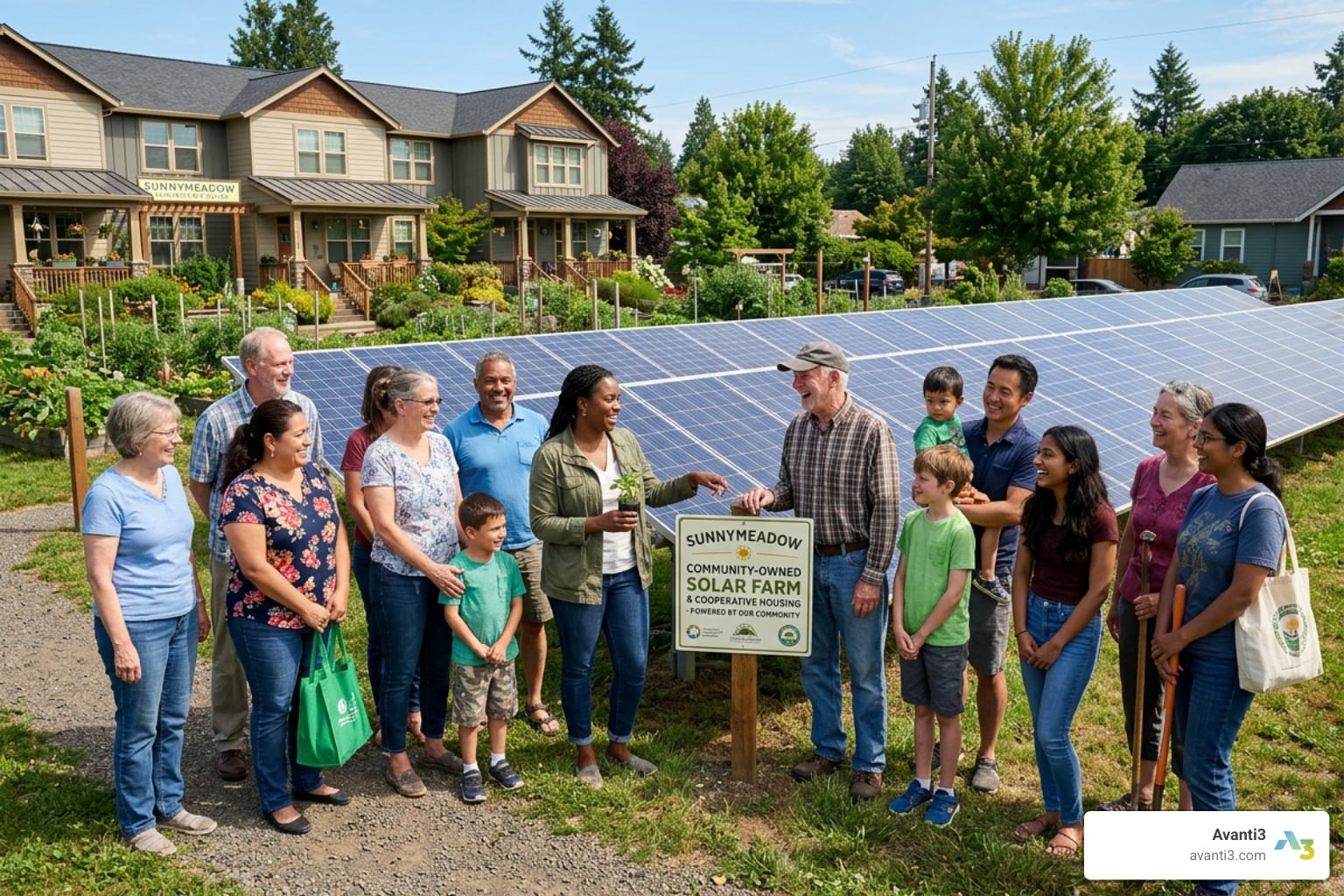


How Reimagined Economic Community Ownership Models Work
What Community Ownership Models Are and Why They Matter
Community ownership models are structures that allow a defined group of people — often residents, workers, or neighbors — to collectively own, govern, and benefit from shared assets like land, housing, businesses, or energy systems.
Here’s a quick overview of the main types:
| Model | What It Is | Key Benefit |
|---|---|---|
| Community Land Trust (CLT) | Nonprofit owns land; residents own buildings | Permanent affordability |
| Limited Equity Cooperative | Members buy shares for occupancy and voting rights | Shared decision-making and lower costs |
| Deed-Restricted Homeownership | Subsidy lowers purchase price; resale is capped | Long-term housing affordability |
| Energy Cooperative | Members co-own generation or storage assets | Lower energy costs and grid resilience |
| Resident-Owned Community (ROC) | Manufactured home residents buy the land together | Security against rent increases |
These models sit at the intersection of individual wealth-building and collective benefit. Rather than one owner extracting value, everyone in the community shares the upside.
The stakes are real. In South Los Angeles, residents raised over $58 million to buy their own neighborhood mall rather than let outside developers control it. On Eigg Island in Scotland, a community-owned energy system now delivers 95% renewable power to all residents. These aren’t outliers — there are more than 4,000 community-owned energy projects globally, and roughly 400,000 to 500,000 limited equity cooperative units in the U.S. alone.
Community ownership isn’t new. It draws from indigenous traditions of collective stewardship, the Civil Rights era land trust movement, and decades of cooperative housing development. But it’s gaining serious momentum as communities push back against displacement, rising costs, and extractive development.
I’m Samir ElKamouny, an entrepreneur and marketing strategist who has worked with businesses and communities building alternative economic models — including community ownership models that shift power toward the people most impacted. In this guide, I’ll walk you through how these models work, what makes them succeed, and how they’re evolving for the future.
Community ownership models terms explained:
Core Types of Community Ownership Models
To understand how community ownership models function, we have to look at how they redistribute property rights. In traditional ownership, one person or corporation holds all the cards: they control the use of the asset, pocket the profits, and decide when to sell. Community models break those rights apart and share them.
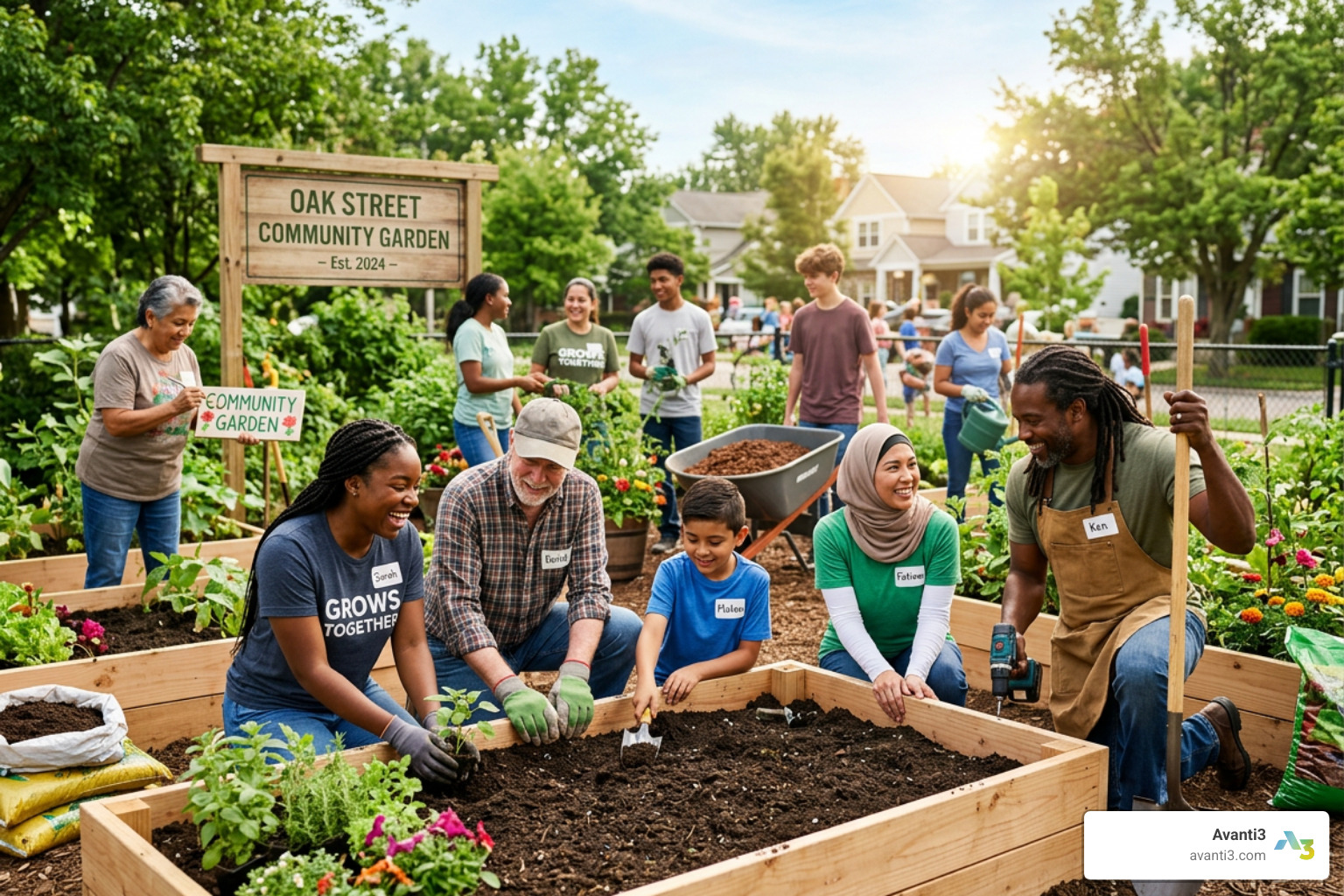
The “solidarity economy” is a term often used to describe this shift. It’s an economic framework that prioritizes social well-being and sustainability over blind profit. By using tools for building online communities, modern groups are now finding it easier to organize these complex legal structures.
The Breakdown of Shared Governance
At the heart of these models is democratic governance. Typically, this follows a “one member, one vote” rule. Whether you invested $1,000 or $10,000, your voice in the community’s future is equal. This prevents wealthy outsiders from “buying” control of local resources.
| Feature | Community Land Trust (CLT) | Limited Equity Cooperative (LEC) | Deed-Restricted Housing |
|---|---|---|---|
| Who owns the land? | Nonprofit CLT | The Cooperative Corporation | Varies (Private or Public) |
| Who owns the building? | The Resident | The Cooperative Corporation | The Resident |
| Resale Price | Restricted by formula | Restricted by bylaws | Restricted by deed covenant |
| Governance | Tripartite Board (Residents, Neighbors, Public) | Resident-only Board | Typically managed by City/County |
These structures require significant capital aggregation. We often see communities pooling small individual investments with larger philanthropic grants to reach the “critical mass” needed to buy real estate or infrastructure.
Residential Community Ownership Models and Shared Equity
Housing is where community ownership models have their deepest roots in the United States. According to a report on shared equity models, these systems are designed to bridge the gap between renting and traditional market-rate ownership.
Limited Equity Cooperatives (LECs) In an LEC, you don’t buy a specific unit; you buy a share in a corporation that owns the entire building. This share gives you the right to occupy a specific unit. The “limited equity” part is crucial: if you decide to move, the price you can sell your share for is capped by a formula. This ensures the next family can afford to move in, keeping the housing permanently affordable. Currently, there are roughly 400,000 to 500,000 limited- or no-equity cooperative units in the U.S.
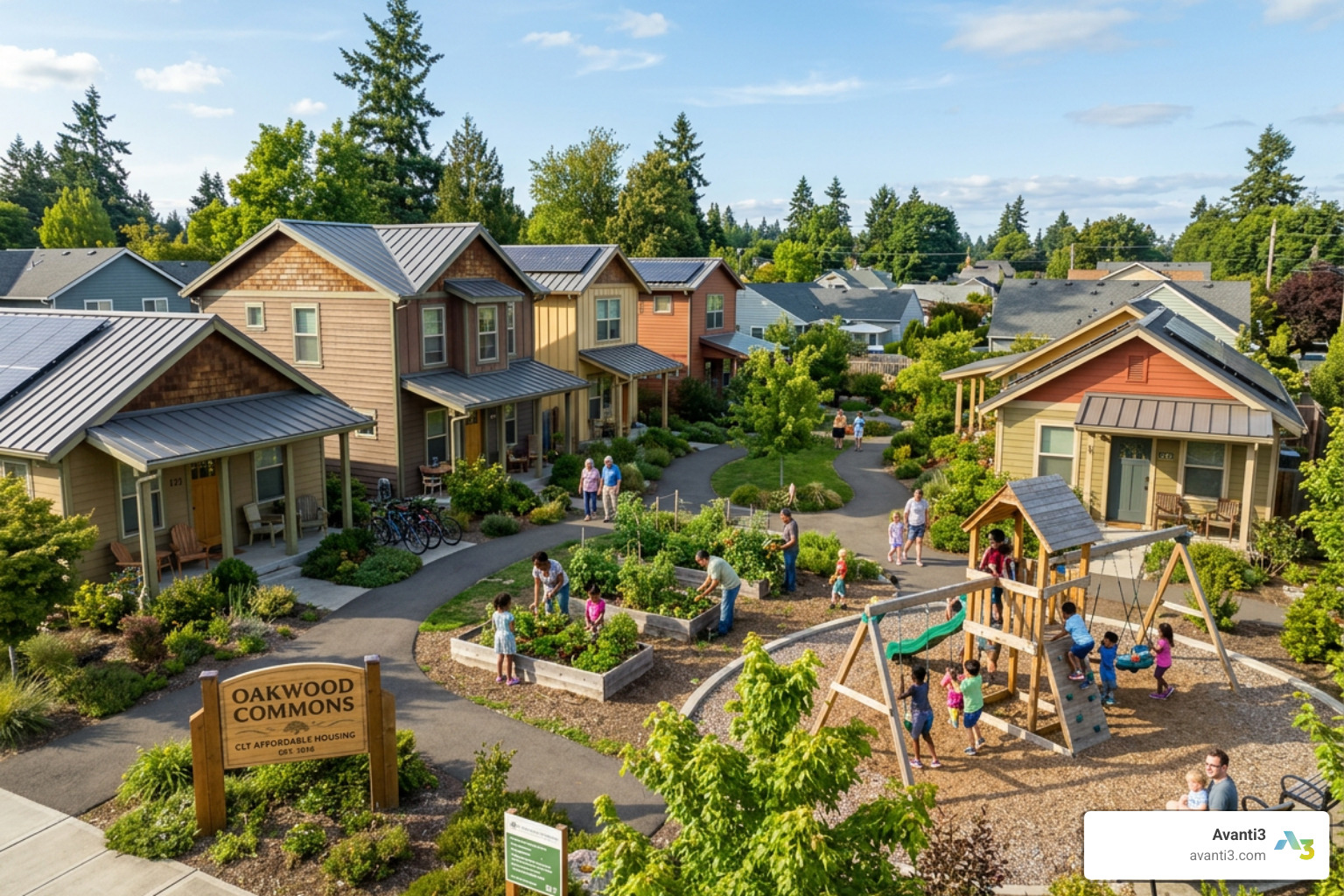
Community Land Trusts (CLTs) CLTs take a “dual ownership” approach. The nonprofit trust owns the land, while the resident owns the home sitting on it. The resident signs a 99-year ground lease for the land. Because the land cost is removed from the purchase price, the home becomes much more affordable. If the owner sells, they keep a portion of the appreciation, but the rest stays with the land trust to keep the price low for the next buyer.
Resident Owned Communities (ROCs) Manufactured housing is a massive part of the U.S. housing stock, yet 33 percent of all residents own their manufactured homes but rent the land beneath them. This leaves them vulnerable to “park” owners who can spike rents or sell the land to developers. Resident Owned Communities allow these neighbors to form a cooperative and buy the land themselves, providing long-term security.
To help residents manage these transitions, we often recommend utilizing community capacity building tools to ensure everyone understands the legal and financial responsibilities of co-ownership.
Commercial and Energy-Based Community Ownership Models
While housing is vital, community ownership models are expanding rapidly into the “power sector” and commercial real estate.
Renewable Energy and Grid Resilience Organizations like IRENA (International Renewable Energy Agency) have highlighted community ownership as a key driver for the energy transition. By co-owning solar PV arrays, wind turbines, or biogas plants, communities can lower their energy costs and increase resilience.
- Example: In Germany, community-ownership projects account for 1 GW of installed capacity (about 1% of the total).
- Example: Ecopower in Belgium supplies 1.5% of households in Flanders, helping members halve their grid consumption through efficiency programs.
These projects often use microgrids to keep the lights on during broader grid outages, providing a literal “safety net” for the neighborhood. For those looking to start such initiatives, tools on building community partnerships are essential for aligning local government, tech providers, and residents.
Commercial Real Estate and Neighborhood REITs Beyond energy, we are seeing the rise of “Commercial Land Trusts” and Neighborhood Investment Trusts. These allow local residents to own shares in the storefronts on their main streets. This prevents “retail leakage” (where money leaves the community) and ensures that small businesses aren’t priced out by gentrification.
Scaling the Future of Shared Governance
For community ownership models to move from niche experiments to mainstream economic drivers, we need better market infrastructure. It’s not just about having the will; it’s about having the “way” — specifically in policy and finance.
Overcoming Barriers to Scale
The path to scaling community ownership is often blocked by a “collective action problem.” Fund managers, investors, and community organizers often speak different languages. Investors want standardized data; communities want local autonomy.
- Structural Racism and Financing Gaps: Historically, property ownership in the U.S. has been rooted in exclusion. BIPOC communities often lack the initial capital or “intergenerational wealth” to seed these models. Furthermore, traditional banks often view collective ownership as “higher risk” because it doesn’t fit their standard individual mortgage boxes.
- Regulatory Hurdles: Many securities laws make it difficult for small-scale “crowdfunded” community investments. However, innovations like SBA 7(a) Loan Securitization and the use of the Community Investment Note are beginning to create “capital aggregation” pathways that institutional investors can actually use.
- The Need for Shared Language: We need to move past the “alphabet soup” of CLTs, LECs, and ROCs. By establishing a shared language and using tools for building a community, we can create a more recognizable “asset class” for impact investors.
The Role of Digital Innovation and Web3
This is where we at Avanti3 see the most exciting shift. Traditional community ownership models are often bogged down by administrative paperwork and slow decision-making. Web3 technologies — like blockchain, NFTs, and DAOs (Decentralized Autonomous Organizations) — offer a digital upgrade.
- Transparency: Blockchain provides an immutable ledger of who owns what share, making auditing and profit distribution instantaneous.
- Fractional Ownership: Through NFTs, we can “tokenize” a community building. Instead of needing $50,000 for a down payment, a resident could buy a $500 digital token that represents a share of the equity.
- Smart Contracts: Governance can be automated. If a community votes to reinvest profits into a new solar array, a smart contract can execute that transaction automatically once the vote passes.
By integrating Web3 community management and community loyalty programs, we can reward residents for their participation in governance, turning “civic duty” into a tangible benefit.
Defining Community and Governance Structures
One of the hardest questions in any model is: Who is the community? Most models define this through:
- Geographic Boundaries: Residents within a specific zip code or neighborhood.
- Income Prioritization: Ensuring that those with the lowest earnings have the first right to shares or housing units.
- Stakeholder Roles: Including “culture-keepers,” such as local artists or educators, who provide social value but are often displaced by rising costs.
Governance isn’t just about voting; it’s about stewardship. It’s the ongoing process of managing the asset for the “common good.” This is why digital community building is so important — it provides a space for these ongoing conversations to happen outside of formal board meetings.
Conclusion: Building Resilient Economic Ecosystems
Community ownership models represent a fundamental reimagining of how we relate to the world around us. Instead of being passive consumers or renters, we become active stewards of our neighborhoods.
The benefits are clear:
- Economic Resilience: Communities that own their assets are better shielded from market shocks and global inflation.
- Wealth Redistribution: By sharing equity, we can begin to close the racial and economic wealth gaps that have persisted for generations.
- Social Empowerment: There is a profound psychological shift that happens when a resident realizes, “I don’t just live here; I own a piece of this.”
At Avanti3, we believe the future of engagement lies in this sense of ownership. Whether it’s a fan owning a piece of a creator’s journey or a neighbor owning a share of the local grocery store, the tools are now here to make this a reality. By leveraging community building software and community building platforms, we are moving toward a world where development is equitable, sustainable, and — most importantly — owned by the people.
The “solidarity economy” isn’t a dream; it’s a blueprint. And with the right mix of policy, finance, and digital innovation, we can build a future that belongs to all of us.