

Giant Screen, Tiny Package: The Best AR Glasses for Steam Deck Ranked
Why the Steam Deck’s 7-Inch Screen Is Begging for an Upgrade
Finding the best AR glasses for Steam Deck gaming in 2026 comes down to five key options:
| Rank | AR Glasses | Best For | Virtual Screen | Weight |
|---|---|---|---|---|
| 1 | Xreal One Pro | Overall comfort + optics | 171-inch | 91g |
| 2 | Viture Beast | Contrast + brightness | 174-inch | 96g |
| 3 | RayNeo Air 4 Pro | HDR10 + lightest fit | 135-inch | 76g |
| 4 | ROG Xreal R1 | High refresh rate gaming | 171-inch | 91g |
| 5 | Xreal 1S | Best value + comfort | 171-inch | 85g |
The Steam Deck is a genuinely impressive machine. But its 7-inch screen creates real friction — especially in RPGs with dense menus, strategy games that demand zooming, or cinematic open-world titles where environmental detail matters.
AR glasses solve this by projecting a private virtual screen — anywhere from 130 to 174 inches — that only you can see. No monitor. No TV. Just you, your Steam Deck, and a massive display that fits in your bag.
The technology has matured fast. In 2026, the top models offer Sony micro-OLED panels, 3DoF head tracking that anchors your screen in place, and USB-C plug-and-play compatibility with the Steam Deck right out of the box.
But not every pair is worth your money. Some drift. Some sound flat. Some weigh enough to cause fatigue after 30 minutes.
This guide cuts through the noise.
I’m Samir ElKamouny, an entrepreneur and technology strategist who has spent years exploring how emerging hardware — including AR wearables — reshapes the way we experience digital content. My hands-on research into the best AR glasses for Steam Deck setups draws on both technical testing and a deep understanding of how immersive display technology is changing portable gaming. Let’s get into it.
Evaluating the Best AR Glasses for Steam Deck in 2026

Selecting the best AR glasses for Steam Deck requires looking beyond marketing buzzwords. In 2026, the baseline standard for AR displays has evolved significantly. We are no longer dealing with washed-out, low-resolution “smart glasses.” Instead, today’s top-tier options utilize high-density Sony micro-OLED panels that project stunning, high-contrast imagery directly into your field of view.
When evaluating these devices, three core pillars dictate the quality of your gaming session:
- Display Quality and Optics: You want deep, inky blacks, high color accuracy (such as 98% DCI-P3), and minimal reflection.
- 3DoF (Three Degrees of Freedom) Spatial Tracking: Essential for anchoring the virtual screen in a fixed physical space. Without stable 3DoF, the screen moves every time you turn your head, which can quickly trigger motion sickness.
- Ergonomic Comfort: Because the Steam Deck is already a heavy handheld, the glasses must be feather-light and offer balanced weight distribution to prevent nose bridge fatigue.
To understand how these elements elevate your setup, check out What Are the Best AR Glasses for Steam Deck? The Complete 2026 Guide for an in-depth dive into the underlying display requirements.
Key Features of the Best AR Glasses for Steam Deck
Before we look at individual models, let’s compare the technical specs that define the current landscape:
| Feature | Xreal One Pro | Viture Beast | RayNeo Air 4 Pro | ROG Xreal R1 | Xreal 1S |
|---|---|---|---|---|---|
| Field of View (FOV) | 50° | 58° | 46° | 57° | 50° |
| Weight | 91g | 96g | 76g | 91g | 85g |
| Peak Brightness | 500 nits | 1250 nits | 1200 nits | 700 nits | 500 nits |
| Audio Tuning | Bose-tuned | Harman-tuned | Open-ear Stereo | Bose-tuned | Bose-tuned |
| IPD Adjustment | Digital | Magnetic Inserts | 3-Level Nose Pad | Physical Sizes | Digital |
| HDR Support | Yes | Yes | HDR10 Certified | HDR Tone Mapping | Yes |
| USB-C Alt Mode | Yes | Yes | Yes | Yes | Yes |
Top Contenders: Xreal One vs. Viture Beast
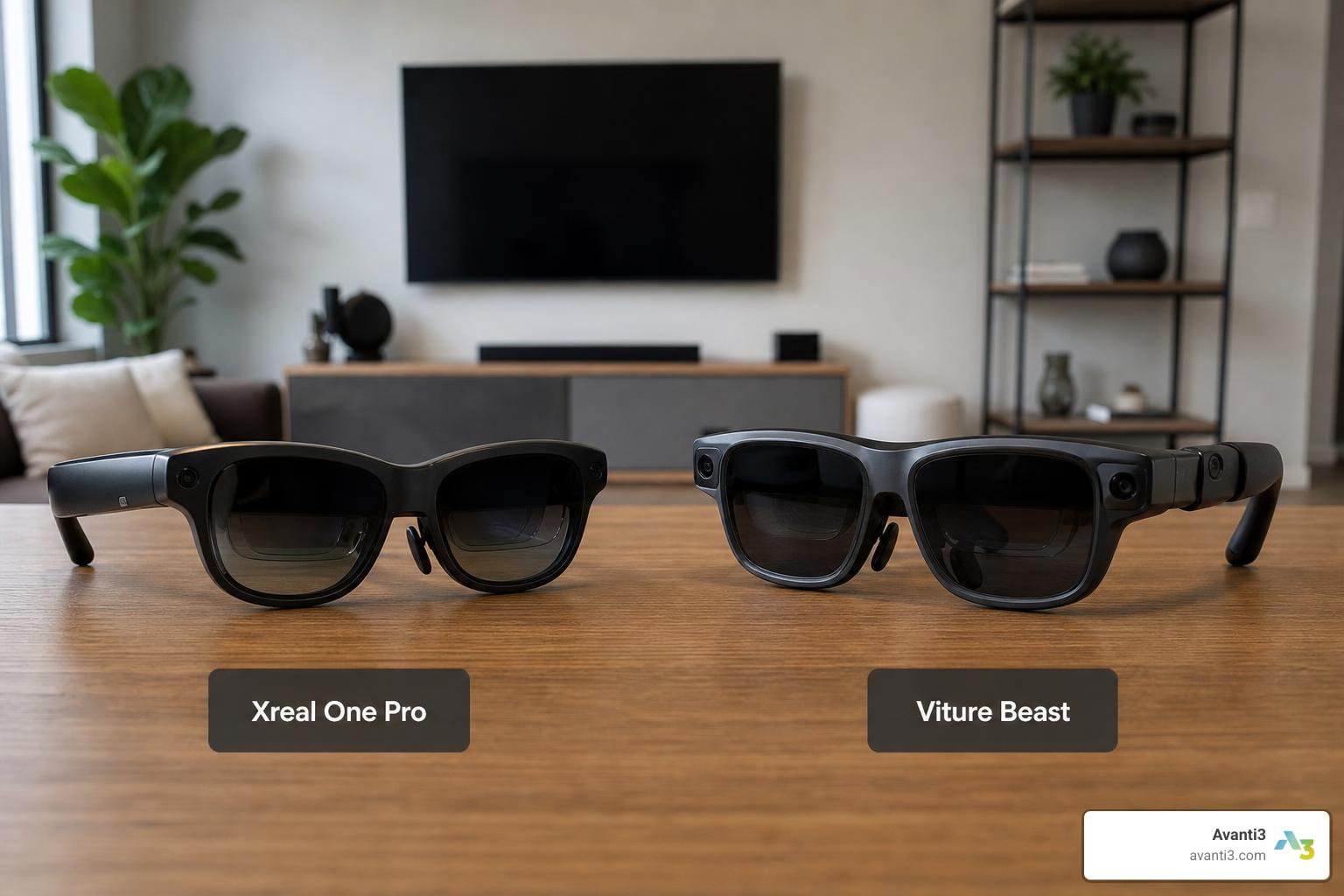
The real battle for the crown of the best AR glasses for Steam Deck in 2026 is fought between Xreal and Viture.
The Xreal One Pro ($649) and Xreal 1S ($449) feature an integrated custom X1 spatial processing chip. This allows them to handle native 3DoF tracking directly on the glasses without needing external software or a tethered accessory. The Xreal One Pro weighs 91 grams and features top-tier optics that virtually eliminate internal reflections. For a deeper look at the performance of this family, read the Xreal One Review (2026) — 8.3/10 | Smart Glass Logic.
In terms of audio, Xreal glasses deliver Bose-tuned sound. This configuration produces a richer low-end performance and warmer bass, which makes cinematic explosions in games like Elden Ring feel incredibly satisfying.
On the other side of the ring sits the VITURE Beast XR Glasses Review – Impulse Gamer. Weighing in at 96 grams, the Viture Beast features a wider 58-degree FOV and a massive 1250 nits peak brightness. It delivers a jaw-dropping “OLED TV” style visual experience with rich contrast and deep, inky blacks. However, Viture’s Harman-tuned audio emphasizes mids and highs, resulting in less bass punch than Xreal’s Bose-tuned setup.
Furthermore, while the Viture Beast delivers unmatched brightness, some users note that its 3DoF implementation can suffer from minor screen drift over extended sessions, requiring manual recentering. For more on their ecosystem, see Why VITURE Takes the Crown: The Best AR Glasses of 2026 | VITURE.
RayNeo Air 4 Pro: High-Fidelity HDR10 Gaming
For gamers who prioritize lightweight comfort above all else, the RayNeo Air 4 Pro is a stellar choice. Weighing an incredibly light 76 grams, it features a 46.7%:53.3% golden ratio weight distribution that keeps pressure off your nose bridge.
The Air 4 Pro projects a 135-inch equivalent virtual screen and is the world’s first consumer AR glasses to feature official HDR10 certification. Powered by the Vision 4000 processor, it offers real-time AI SDR-to-HDR conversion. This makes it an exceptional companion for the Steam Deck, bringing rich color depth and high-fidelity lighting to vibrant indie titles and dark, atmospheric blockbusters alike.
ROG Xreal R1: Ultra-High Refresh Rate Performance
If you play competitive shooters or action games on your Deck, the ROG XREAL R1 Gaming AR Glasses: 240Hz, 0.01ms & 171″ Display represents the cutting edge of gaming-focused AR.
Co-developed with Asus, the R1 boasts a blazing-fast 240Hz refresh rate and a near-instantaneous 0.01ms response time. It projects a massive 171-inch screen with a 57-degree FOV. The R1 also features built-in electrochromic dimming with three tint levels, allowing you to instantly block out external light to focus entirely on your game. It’s an absolute powerhouse for zero-latency, high-frame-rate portable play.
Limitations of Using the Best AR Glasses for Steam Deck
While gaming on a giant virtual screen is incredibly immersive, there are real-world hurdles to keep in mind:
- Battery Drain: Driving a high-brightness micro-OLED display directly from your Steam Deck’s USB-C port consumes extra power. You can expect your battery life to drop by 15% to 20%. To combat this, accessories like the $130 Viture Pro Mobile Dock provide a 13,000mAh battery to keep both your Deck and glasses powered up.
- Screen Drift: Even the best AR glasses for Steam Deck can experience slight 3DoF tracking drift over time. You may find yourself needing to press a recenter button occasionally during long play sessions.
- Prescription Lens Inserts: Because the optical lenses sit close to your eyes, any minor vision impairment is amplified. While some models (like the Viture Pro) offer built-in myopia adjustment dials, others require magnetic prescription lens inserts.
- Linux and Firmware Updates: The Steam Deck runs on Linux-based SteamOS. While basic plug-and-play screen mirroring works flawlessly, updating the firmware on some AR glasses still requires connecting them to a Windows PC or a compatible Android phone first.
For a detailed look at the hurdles of building the ultimate portable setup, check out the Steam Deck + XREAL One Pro Build guide.
Enhancing Game Genres: RPGs, Strategy, and Text-Heavy Titles
Using AR glasses completely transforms how you interact with different game genres on the Steam Deck:
- RPGs (e.g., Baldur’s Gate 3): Complex skill trees, dense inventories, and tiny text become beautifully legible. You no longer have to squint to read item descriptions.
- Strategy Games (e.g., Civilization VI): The expanded screen real estate allows you to view your entire empire at once without constantly zooming in and out.
- Action & Open-World (e.g., Elden Ring): The massive field of view pulls you into the environment. Dark dungeons benefit immensely from the deep contrast ratios of micro-OLED panels.
However, be cautious with extremely text-heavy HUDs positioned at the absolute edges of the screen (like in Disco Elysium). Depending on your facial shape and how the glasses sit, the very outer edges of the lenses can sometimes exhibit minor blur, requiring you to adjust the physical fit or scale the game’s UI slightly inward.
Conclusion: Elevating Spatial Experiences with Avanti3
The era of portable, giant-screen gaming is officially here. Pairing the best AR glasses for Steam Deck with your handheld console turns any flight, train ride, or couch session into a private, premium theater experience. Whether you choose the refined comfort of the Xreal One Pro, the dazzling brightness of the Viture Beast, or the feather-light HDR performance of the RayNeo Air 4 Pro, you are stepping into the future of display technology.
At Avanti3, we believe this is just the beginning of how spatial computing will transform our daily digital lives. We integrate Web3 technologies, blockchain, AI, and cutting-edge AR/VR solutions to help brands and creators build highly customizable, immersive digital experiences. As hardware continues to shrink while virtual screens grow, the opportunities for community building, interactive marketing, and fan monetization are limitless.
Ready to explore how spatial computing and immersive technology can elevate your brand’s digital presence? Discover how we are shaping the future at Avanti3 AR Marketing Solutions.