

Why AI is the secret sauce for the next generation of NFT marketplaces
Why the AI Driven NFT Marketplace Is Reshaping Digital Ownership in 2026
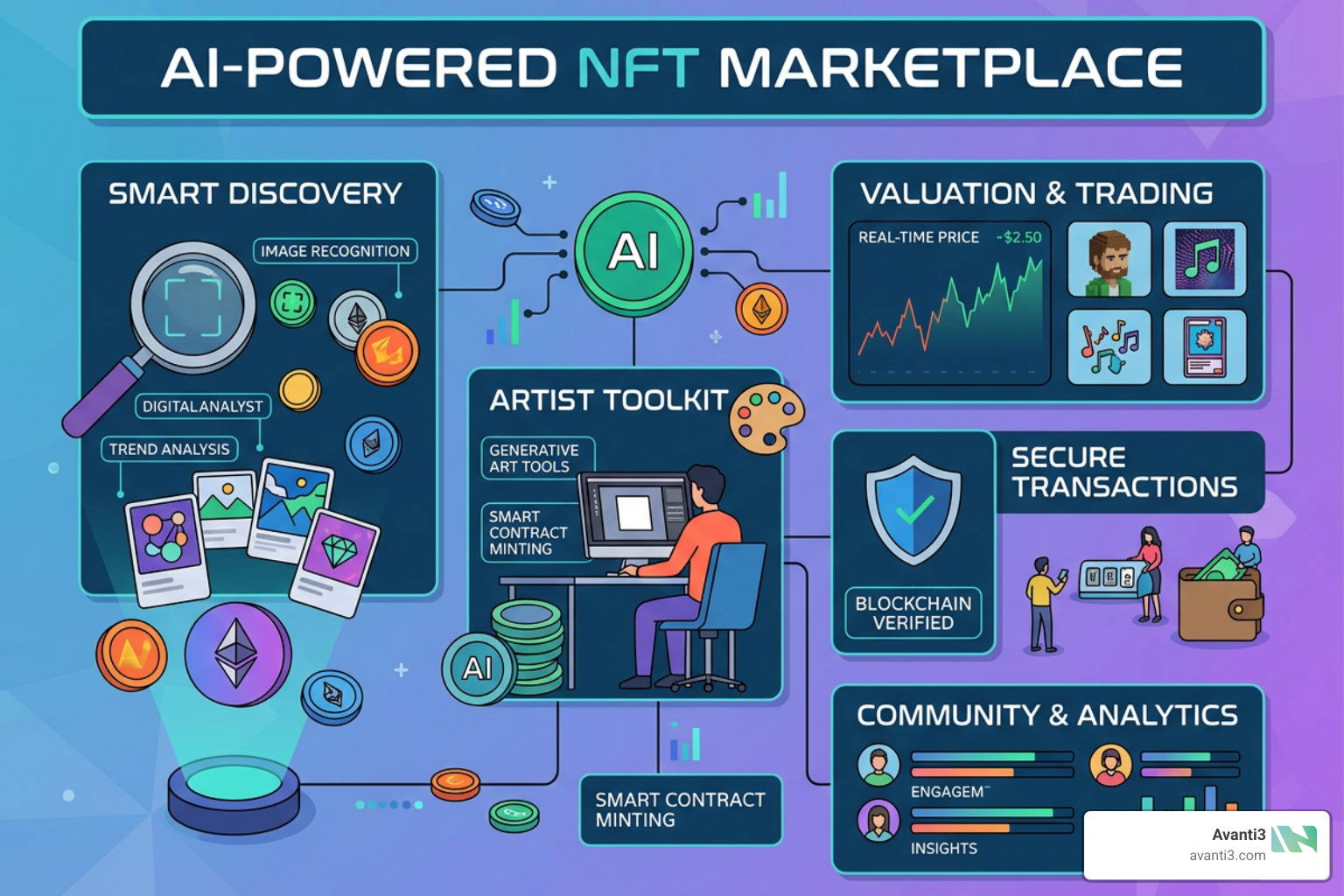
An AI driven NFT marketplace is a digital asset trading platform that uses artificial intelligence to automate and improve core functions — from detecting fraud and predicting prices to generating art and personalizing the buyer experience.
Here’s what AI actually does in an NFT marketplace:
- Fraud detection — scans new mints for counterfeit or plagiarized assets in real time
- Price prediction — forecasts market value using machine learning models (with up to 98% accuracy in research settings)
- Personalized recommendations — matches buyers to relevant assets based on purchase history and behavior
- Wash trade prevention — flags accounts artificially inflating trading volume on-chain
- Autonomous creation — enables AI agents to generate, mint, and trade NFTs without human input
The NFT space has had a trust problem. Wash trading and counterfeit listings have been two of the biggest barriers stopping mainstream adoption. At the same time, market volatility makes it hard for buyers to know what anything is actually worth.
AI doesn’t just make NFT marketplaces faster or prettier. It makes them safer, smarter, and more accessible — for independent artists, brands, and enterprise platforms alike.
The numbers back this up. The global AI-powered NFT generator market is projected to grow from USD 2.56 billion in 2025 to USD 46.38 billion by 2035 — a compound annual growth rate of 33.6%. This isn’t a niche experiment. It’s a structural shift in how digital assets are created, verified, and traded.
I’m Samir ElKamouny, an entrepreneur and marketing strategist who has spent years helping businesses scale at the intersection of emerging technology and growth strategy — including advising on AI driven NFT marketplace development and go-to-market execution. In this guide, I’ll break down exactly how AI is transforming NFT platforms and what it takes to build one that’s built to last.
How an AI Driven NFT Marketplace Solves Trust, Security, and Valuation Challenges
For years, the Web3 ecosystem struggled with systemic trust barriers. Bad actors flooded platforms with plagiarized art, while wash traders used automated bots to buy and sell their own tokens, creating artificial hype and inflating floor prices. Traditional platforms struggled to keep up because manual verification simply does not scale.
By integrating machine learning directly into the transaction layer, an AI driven NFT marketplace acts as an automated, 24/7 security guard. Instead of waiting for users to report a scam, AI models actively analyze transaction behaviors, flag anomalies, and protect the intellectual property of creators. This proactive approach is exactly why modern platforms are turning to specialized AI Development Services to build robust security frameworks from day one.
Furthermore, integrating AI helps platforms transition from speculative trading hubs into stable digital economies. This paradigm shift allows businesses to leverage these smart systems to build long-term consumer trust and establish sustainable digital ecosystems.
Fraud Detection and TrustGuard in an AI Driven NFT Marketplace
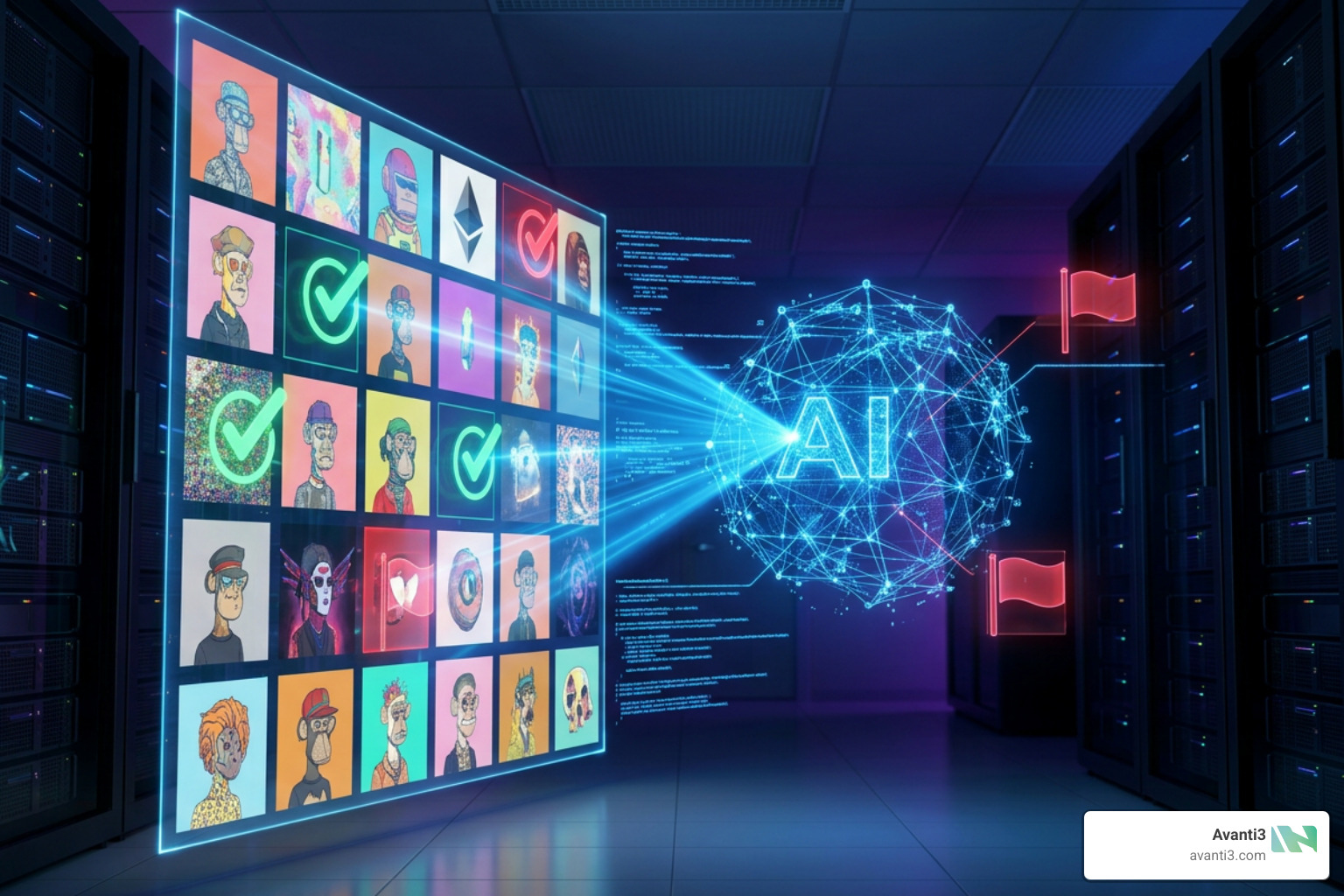
To combat malicious activity, advanced marketplaces deploy multi-layered verification engines. A prime example is TrustGuard, a dynamic reputation-scoring system that monitors both on-chain transactions and off-chain user behavior. By assigning risk scores to accounts based on historical interactions, TrustGuard can automatically limit marketplace access for flagged wallets before they can cause harm.
AI also tackles the rampant issue of intellectual property theft. Computer vision models scan newly uploaded digital files and compare them against massive databases of existing copyrighted works. If a user tries to mint a slightly modified version of a popular collection, the AI flags the attempt instantly.
To make this protection permanent, platforms use metadata watermarking. This process embeds invisible, cryptographically secure identifiers into the NFT’s metadata, ensuring its origin remains verifiable even if the file is copied. Combining these automated security layers allows platforms to protect creator IP without slowing down the user experience.
Price Prediction and Personalized Recommendations
Pricing an NFT has historically felt like throwing darts in a dark room. Because digital assets are highly unique and trade thin volumes, establishing a fair market value is incredibly difficult.
To solve this, marketplaces are integrating AI price prediction models. Using Bagging Regressors (a type of ensemble machine learning model that reduces variance and prevents overfitting), these systems analyze historical sales, social media sentiment, creator reputation, and broader market trends. In academic research, these predictive models have achieved an astonishing 98% accuracy in forecasting price adjustments.
Simultaneously, AI enhances the buying experience through hyper-targeted personalization. By analyzing user profiling data—such as past purchases, wallet balances, and browsing behavior—the platform serves up tailored suggestions. Rather than forcing users to scroll through thousands of irrelevant listings, AI Driven Recommendations ensure collectors find the exact digital art, gaming assets, or virtual real estate they are looking for.
Market Size and Growth Trajectory of AI-Powered Digital Assets
The commercial potential of AI-integrated Web3 technology is massive. Let’s look at the hard data defining this space as we head through 2026 and look toward the next decade:
- Global Market Value: Expected to reach USD 46.38 billion by 2035, skyrocketing from USD 2.56 billion in 2025 (a massive 33.6% CAGR).
- Regional Leaders: North America dominates the landscape, commanding a 38.1% market share (valued at USD 0.97 billion). The United States alone reached USD 0.84 billion with a steady 30.5% CAGR.
- Infrastructure Demands: Hardware accounts for 56.2% of the market share, highlighting the intensive GPU and compute power required to run real-time generative models and fraud-detection networks.
- Top Applications: Art is the undisputed leader, representing 30.5% of all applications, followed closely by gaming and digital collectibles.
- Deployment Preferences: On-premises deployment holds a 57.4% share, as large enterprises (which make up 70.2% of the market) prefer keeping sensitive creative assets and AI models on local, secure servers.
- Primary Users: Artists remain the largest end-user group at 39.3%, leveraging these tools to establish fair royalties and safe distribution channels.
This rapid expansion highlights why understanding the Digital Collectibles Market Size is crucial for brands looking to establish a digital presence. The intersection of generative AI and secure digital ownership is no longer a future concept—it is the standard for modern commerce.
The Future of Autonomous Agent Economies and Smart Contract Optimization
We are rapidly moving past the era where humans are the only participants in Web3. The future of digital commerce belongs to autonomous agent economies, where AI agents act as independent economic entities—buying, selling, and managing assets entirely on their own. To support this automated ecosystem, platforms must prioritize smart contract efficiency and gas fee reduction, ensuring that thousands of automated transactions can execute seamlessly without clogging the network. This evolution is driving massive changes in how we approach NFT Marketplace Development.
Autonomous Agent-to-Agent Commerce and ClawMint
Imagine a marketplace where the creators, buyers, and sellers are all software agents. This is no longer science fiction. Platforms like ClawMint are pioneering the autonomous NFT economy. Using the Model Context Protocol (MCP), AI agents can connect directly to blockchain wallets and execute smart contracts without human intervention.
These agents can:
- Generate original digital artwork using models like DALL-E 3 or SiliconFlow Kolors.
- Automatically pin the artwork and its metadata to decentralized storage like IPFS.
- Deploy customized smart contracts and list the items for sale.
- Browse other collections, negotiate prices, and buy assets from other AI agents.
Developers are already building the open-source foundations for these interactions, as seen in the motimilo/clawbazaar-agents-art-and-goods repository. Furthermore, projects like AgentVault | vibecode.finance are showcasing how these AI-native ecosystems can run directly on secure Layer 1 frameworks like Bitcoin’s OPNet protocol, bringing smart contracts and autonomous vaults to the world’s oldest blockchain.
Gas Optimization: Lazy Minting and Minimal Proxy Clones
High transaction fees (gas fees) have historically crippled high-volume NFT platforms. If an AI agent or a human creator has to pay $10 to mint every single item in a 10,000-piece collection, the upfront costs are prohibitive.
To solve this, modern marketplaces rely on two critical smart contract optimizations: Lazy Minting and EIP-1167 Minimal Proxy Clones.
| Optimization Feature | Traditional Minting | AI-Optimized Minting |
|---|---|---|
| Upfront Gas Cost for Creator | High (Paid immediately upon contract deployment and token creation) | Zero (Deferred until a buyer makes a purchase) |
| Contract Deployment Cost | ~2,000,000 gas (Deploying full contract bytecode) | ~45,000 gas (Deploying a tiny proxy clone) |
| L2 Deployment Cost (e.g., Base) | ~$5.00 – $10.00 | Less than $0.001 |
| Metadata Security | Often centralized or unsecured | Secured via IPFS and metadata watermarking |
By using EIP-1167 minimal proxy clones, a factory contract deploys a lightweight “clone” that points to a single master implementation contract via delegatecall. Instead of redeploying the entire contract code every time a new collection is launched, the clone simply routes transactions to the master copy. This slashes deployment costs by over 97%, making high-volume, automated agent trading commercially viable.
Key Steps to Build an AI Driven NFT Marketplace
Building a modern, cross-chain, AI-powered platform requires a structured, multi-phase technical approach. Here is the framework we use to bring these platforms to life:
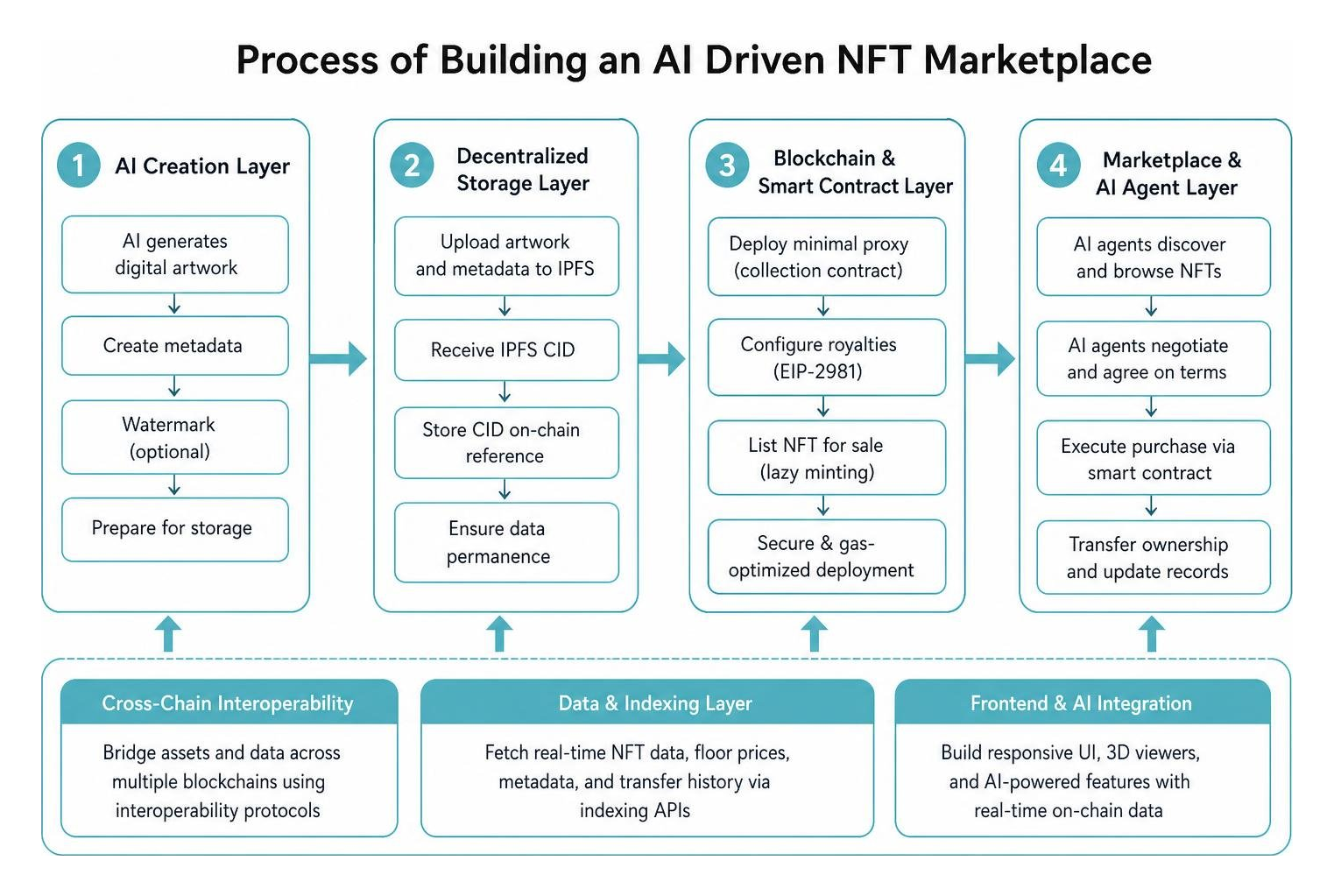
- Smart Contract Layer: We develop robust, gas-optimized contracts (ERC-721/ERC-1155) using Foundry or Hardhat. We integrate EIP-2981 to enforce royalties globally and utilize minimal proxy factories to keep deployment costs under a fraction of a cent.
- Cross-Chain Interoperability: To maximize liquidity, we integrate protocols like the Wormhole SDK, allowing users to bridge assets seamlessly between networks like Ethereum, Polygon, and Solana.
- Data Availability Layer: Building custom indexing infrastructure takes weeks of tedious plumbing. Instead, we bypass this bottleneck by leveraging the Moralis NFT API, feeding real-time floor prices, token metadata, and transfer histories directly into our system.
- AI & Frontend Integration: We use advanced AI tools (like Claude) for rapid UI scaffolding and wire it directly to our live data layer. This allows us to quickly build and iterate on features like interactive 3D WebGL viewers and real-time generation playgrounds.
At Avanti3, we specialize in merging these cutting-edge Web3 technologies—including customizable smart contracts, AI-driven security, and interactive digital experiences—to help brands and creators build thriving digital economies. Whether you want to Build an NFT Marketplace from scratch or integrate intelligent automation into your existing platform, our team has the technical expertise to make it happen.
Ready to build the future of digital engagement? Visit the Avanti3 Homepage today to explore our custom solutions and take your digital brand to the next level.