


Beyond Pageviews into the Decentralized Future
Web3 engagement analytics marks a shift from traditional web analytics. It combines on-chain blockchain data with off-chain user behavior to offer clear insights into user actions and community health.
Key Components of Web3 Engagement Analytics:
- On-chain data: Smart contract interactions, wallet transactions, token holdings, and governance participation.
- Off-chain data: Social media engagement, community discussions, and traditional web metrics.
- User pseudonymity: Privacy-respecting analytics that provide actionable insights.
- Blockchain transparency: Public, verifiable data that eliminates guesswork.
- Decentralized measurement: Wallet-based user tracking that moves beyond cookies.
The core difference between Web2 and Web3 analytics is data ownership and transparency. Web2 relies on cookies and pixels, while Web3 leverages data from decentralized platforms, blockchains, and smart contracts. This provides superior transparency and real purchase data, not just social media interactions.
However, many Web3 projects struggle with basic engagement questions: Why do 45% of users connect their wallet but never swap tokens? Why do only 15% of users who view a staking page actually stake?
Understanding these patterns isn’t about vanity metrics—it’s about survival in a competitive decentralized landscape.
As Samir ElKamouny AV, I’ve helped businesses open up growth through data-driven decisions, specializing in emerging technologies like Web3 engagement analytics. My experience has proven that execution combined with proper measurement is crucial, especially in the Web3 space.
Why Measuring User Engagement is Crucial for Web3 Success
The Web3 space is exploding. The Web 3.0 blockchain technology sector was worth over $6 trillion in 2023 and is projected to grow at a 44.6% CAGR through 2030. This explosive growth also means intense competition.

Web3 engagement analytics provides a significant competitive advantage. Understanding how users interact with your dApp or community allows you to make data-driven decisions that drive real results. You stop guessing what users want and start seeing what they do.
This insight leads to optimized user experiences and improved retention. It can also reduce your customer acquisition cost (CAC) by up to 70% by identifying users who are most likely to become active participants. This is the difference between profitability and burning through your treasury.
Understanding community health is crucial because your users are stakeholders. Web3 engagement analytics helps you validate product-market fit in real-time, which is essential for effective Digital Brand Engagement strategies.
Understanding the User Journey
Web3 engagement analytics reveals patterns impossible to see with traditional tools. For instance, wallet connection rates are your first key engagement metric, but the story doesn’t end there.
We’ve found that 45% of users connect a wallet but don’t swap tokens. This huge drop-off signals a problem—perhaps confusing UX, high gas fees, or user hesitation. Analytics helps pinpoint where users get stuck.
Even more telling, 70% of users view a staking page, but only 15% actually stake. This gap represents millions in potential locked value. By A/B testing UX and analyzing user segments, you can convert browsers into participants.
Effective onboarding funnels are critical. Users who complete onboarding are 2x more likely to return within their first week, providing a clear roadmap for designing engaging experiences.
Building a Stronger Community
Web3 communities are unique; members are token holders, governance participants, and brand ambassadors. Web3 engagement analytics helps identify your power users—the 20% driving 80% of community activity.
Rewarding participation becomes strategic when you can identify who contributes value. This data is gold for fostering loyalty and designing meaningful incentives.
Measuring sentiment via community discussions and social media activity acts as an early warning system for community health. This insight is vital for successful Digital Community Building strategies.
Top Web3 projects use analytics to power their Community Loyalty Programs, creating reward systems that incentivize behaviors that grow the project.
Key Metrics for Comprehensive Web3 Engagement Analytics
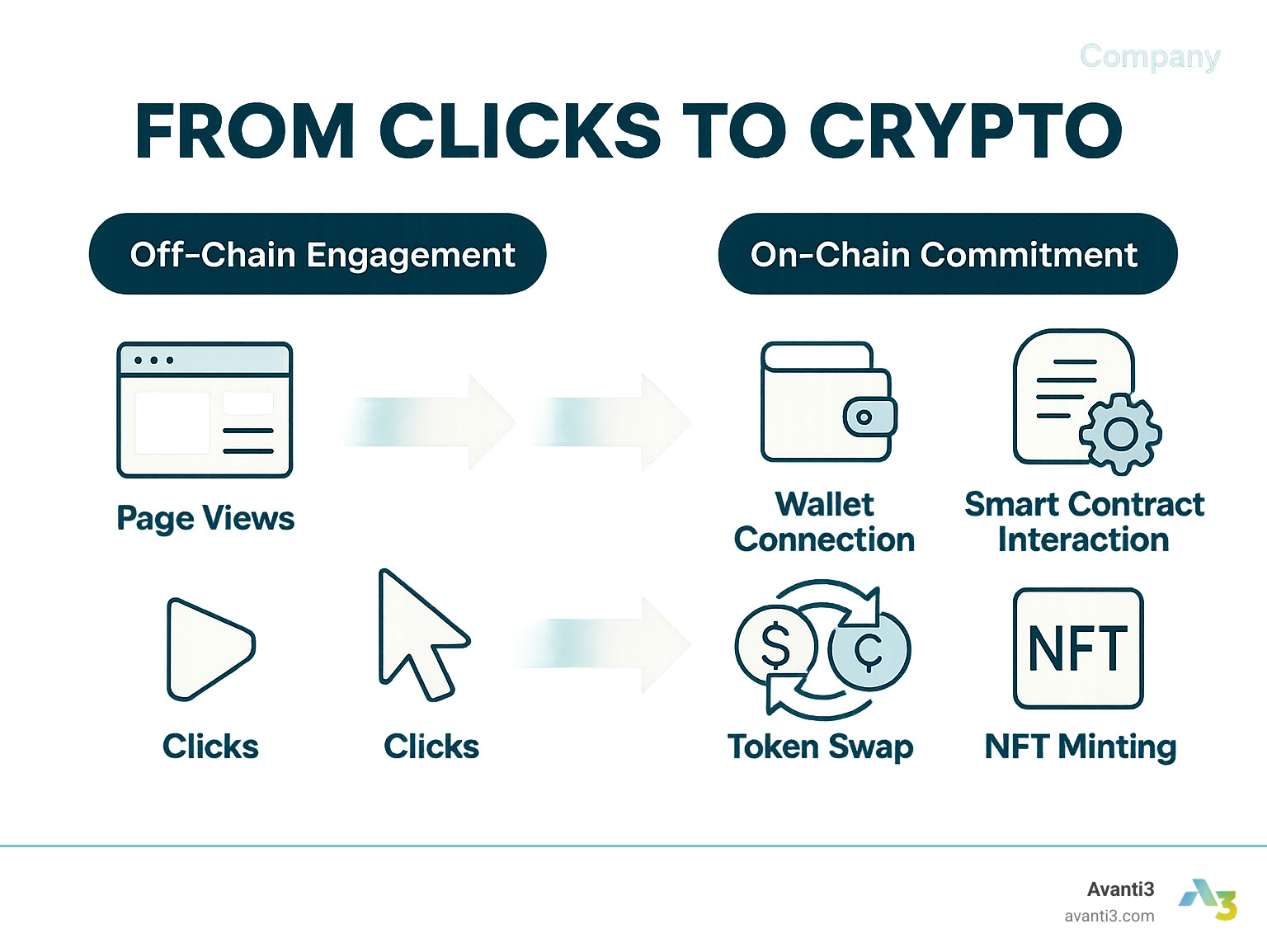
Web3 engagement requires a new approach beyond traditional metrics like pageviews. We must dive into blockchain data and community dynamics to get the full picture. Unlike Web2’s reliance on clicks, Web3 provides verifiable data on real financial commitments and actions, such as staking tokens or voting on a governance proposal. This represents a genuine investment in your project’s future.
| Traditional Web2 Metrics | Web3 Equivalents (Examples) |
|---|---|
| Pageviews | Smart Contract Interactions (e.g., token transfers, NFT mints, dApp function calls) |
| Session Duration | Active Wallet Sessions, Time spent in dApp |
| Bounce Rate | Wallet Connection Drop-off Rate, Transaction Abandonment Rate |
| Conversions | Token Swaps, NFT Purchases, Staking Events, Governance Votes |
| Daily Active Users (DAU) | Daily Active Wallets (DAW), Unique Wallet Addresses interacting with smart contracts |
| Customer Lifetime Value | Wallet Lifetime Value (based on transaction volume, holdings) |
| Social Media Engagement | Discord/X (Twitter) Activity, Community Sentiment, DAO Participation |
| Customer Acquisition Cost (CAC) | Cost per Wallet Connection, Cost per First Transaction |
On-Chain Metrics: The Source of Truth
On-chain data is the core of Web3 engagement analytics. It’s transparent, verifiable, and tells a story about user commitment.
- Active wallets: Your new DAUs. Tracking daily, weekly, or monthly active wallets shows how many unique addresses meaningfully interact with your project.
- Transaction volume and frequency: High volume indicates value, while frequent transactions suggest sticky, engaging features.
- Smart contract interactions: These track feature usage with real financial consequences, like minting NFTs or providing liquidity. For NFT Marketplace Development, these interactions are gold.
- Gas fees paid: Consistent payment of gas fees shows commitment, but high abandonment due to gas costs signals a need for optimization.
- Token and NFT holdings: Identifies your most loyal community members. Staking and governance participation signify users who are invested in your project’s success.
- Wallet retention rate: Your true measure of stickiness, tracking how many wallets remain active over time.
Off-Chain & Community Metrics: The Voice of the User
Off-chain metrics explain the “why” behind user actions, adding crucial human context.
- Social media engagement: Monitoring platforms like X (Twitter) and Discord keeps you connected to your community’s mood.
- Community sentiment analysis: Uses NLP to analyze discussions and gauge whether your community is excited or concerned.
- Governance proposal discussions: Active debate beyond voting indicates a strong, sustainable community.
- Event participation: Attendance at AMAs and meetups demonstrates direct investment from your most engaged users.
- Click-through rates from community channels: Bridges the gap between community chatter and on-chain action, proving the ROI of Web3 Community Management.
Product & dApp Metrics
These metrics bridge blockchain data and user experience within your dApp.
- Feature adoption rate: Shows which dApp features are valuable to users, helping prioritize development.
- User journey pathing: Maps how users steer your dApp, revealing popular flows and friction points.
- Session replays: Helps visualize user interactions to debug UX issues, though can be challenging in a decentralized context.
- Onboarding completion rate: Critical for retention, as players who complete onboarding are 2x more likely to return.
Combining these on-chain and off-chain metrics provides a complete picture of project health. Our Digital Engagement Solutions help turn these insights into actionable growth strategies.
Challenges and Methodologies for Effective Analysis
Analyzing Web3 engagement analytics presents unique challenges not found in Web2. The decentralized nature of the ecosystem creates complexity, but with the right approach, these obstacles become opportunities for deeper user insights.

Common Problems in Web3 Analytics
- Data complexity: Blockchain data is raw, massive, and requires specialized knowledge to interpret.
- Bridging on-chain and off-chain data: Connecting an anonymous wallet address to a social media profile is crucial for understanding the full user journey but is difficult to do while respecting privacy.
- Data privacy concerns: While blockchain data is public, respecting user pseudonymity is essential. Analytics must be conducted ethically without doxxing users.
- Lack of standardized tools: The Web3 analytics space is fragmented, with tools varying widely in their capabilities and approaches.
- Identifying real users versus bots: Automated accounts (“farmers”) can skew engagement metrics, making it hard to measure genuine user activity.
- Technical expertise required: Handling blockchain data often requires deep technical knowledge that not every team possesses.
Proven Methodologies for Improving Web3 Engagement Analytics
Despite these challenges, proven methodologies can open up powerful insights. This involves adapting traditional techniques and developing new, Web3-specific approaches.
- Funnel analysis: Tracks users through critical sequences like NFT minting or staking. Identifying where users drop off—like the 45% who connect a wallet but never swap—provides clear targets for improvement.
- Cohort analysis: Groups users by their start date to track long-term behavior and retention, revealing the impact of product updates or marketing campaigns.
- User segmentation: Uses rich on-chain data to segment users by token holdings, activity levels, or on-chain history, allowing for custom strategies for different user types.
- A/B testing for dApp features: Tests different UIs or onboarding flows to see which performs better, measuring success with both Web2 and Web3 metrics.
- Path analysis: Uncovers how users steer a dApp, revealing popular flows and points of confusion, which is especially valuable for complex protocols.
Combining these methodologies with specialized platforms is key. Our Web3 Platform Solutions address these challenges by integrating data sources and providing intuitive dashboards. While Web3 analytics is more complex, it’s also more powerful, offering insights into what users do with their assets, not just what they click.
Tools, Applications, and the Future of Measurement
The Web3 engagement analytics tool ecosystem is evolving rapidly, offering solutions that help projects move beyond gut feelings to data-driven decisions.
Types of Analytics Tools and Platforms
The Web3 analytics toolkit includes several key categories:
- Blockchain explorers: Essential tools like Etherscan that allow anyone to view individual transactions, blocks, and wallet addresses.
- Data indexing protocols: Platforms like The Graph organize raw blockchain data, making it easily searchable for developers.
- Specialized analytics platforms: Comprehensive solutions that combine on-chain and off-chain data into user-friendly dashboards with features like funnel analysis.
- Web3 Creator Platforms: These integrate analytics with NFT creation and community management tools, providing a holistic view of audience engagement.
- No-code dashboards: These tools democratize data access, allowing non-technical users to build custom analytics dashboards.
- NFT Engagement Tools: These focus specifically on the NFT ecosystem, tracking metrics like trading volume and community sentiment.
Real-World Applications of Web3 Engagement Analytics

Analytics are already driving success in various Web3 applications:
- Gamification strategies: Projects like Axie Infinity track in-game transactions and NFT ownership to optimize their play-to-earn economies and improve user flows.
- Building exclusive communities: NFT marketplaces like SuperRare use analytics to identify top collectors and track bidding patterns, helping them create exclusive content that resonates with their community.
- Optimizing in-game economies: Developers analyze token flows and trading volumes to balance their economies, prevent inflation, and ensure long-term sustainability.
- Enhancing Digital Fan Engagement: Brands use analytics to understand how fans interact with digital collectibles and loyalty programs, building deeper connections.
- Powering a Digital Reward System: Analytics helps identify and reward the most active community members for genuine engagement, such as providing liquidity or voting in governance.
The Impact of Emerging Technologies
The future of Web3 analytics is being shaped by powerful new technologies:
- AI for predictive analytics: AI can analyze massive datasets to predict user churn, identify fraud, and forecast market trends, enabling personalized experiences.
- AI for bot detection: Advanced algorithms are becoming crucial for distinguishing real human activity from bot behavior, ensuring data accuracy.
- Decentralized databases for user data ownership: These systems will empower users to control their data while still enabling valuable, permission-based analytics, aligning with our commitment to Personalized Data.
- ZK-proofs in privacy-preserving analytics: Zero-Knowledge Proofs allow for analysis of sensitive data without compromising user privacy, building a foundation of trust.
Frequently Asked Questions about Web3 Engagement Analytics
Here are answers to common questions about Web3 engagement analytics that can help you make better decisions for your project.
How is Web3 behavioral analytics different from wallet analytics?
This is a crucial distinction. Wallet analytics is like a bank statement; it focuses on the financial what. It tracks transaction history, balances, and overall financial activity of a wallet.
Behavioral analytics, on the other hand, explains the why. It tracks how users interact with your dApp, which features they use, and where they get stuck. For example, wallet analytics shows a user sent tokens to a staking contract. Behavioral analytics reveals they visited the staking page five times and abandoned the process twice due to high gas fees. This is the insight that helps you improve your product.
Can non-technical teams implement Web3 analytics?
Yes. You don’t need to be a blockchain developer to understand your users. Modern tools are designed for non-technical teams.
- No-code platforms: These are becoming the norm, allowing you to create dashboards and track metrics without writing code.
- User-friendly dashboards: Most platforms turn complex blockchain data into simple, visual reports.
- Outsourcing to specialists: You can work with Web3 analytics experts to set up systems and interpret data.
The key is to focus on clear KPIs that matter to your business and let the tools handle the technical complexity.
How is user privacy handled in Web3 analytics?
Privacy is fundamental to Web3, and analytics are built to respect user autonomy.
- Pseudonymous wallets: Analysis is done on wallet addresses (e.g., “0x1234…”), not real names or emails. The data is public but the user behind the wallet is anonymous.
- User consent: Projects must ask for explicit permission to connect on-chain behavior with off-chain identities, like a Discord account.
- Privacy-preserving techniques: Technologies like zero-knowledge proofs enable analysis of user patterns without revealing underlying personal data.
- Aggregated data analysis: The focus is on trends across large user groups, not tracking individuals.
The ultimate goal is user data ownership, giving people control over their information. This builds trust and encourages authentic engagement.
Conclusion: From Data to Dominance in the New Digital Economy
The shift to Web3 engagement analytics is a fundamental reimagining of how we connect with users. Mastering these analytics is essential for any project aiming to thrive in the decentralized future.
Unlike the glimpses from Web2’s cookies, Web3 provides transparent on-chain data, showing what users do, not just what they click. This allows for surgical optimization of user experiences, significant reductions in customer acquisition costs, and strategic community building.
A holistic approach is key. Combining the verifiable truth of on-chain data with the human context from off-chain interactions is what separates successful projects from the rest. While challenges like data complexity and privacy exist, proven methodologies like funnel analysis and user segmentation provide clear solutions.
Emerging technologies like AI and zero-knowledge proofs are accelerating this evolution, making analytics more predictive, secure, and privacy-preserving.
At Avanti3, we’ve built our platform on these principles. We provide creators and brands with actionable insights that drive real growth. Our solutions integrate Web3 technologies to turn complex analytics into clear opportunities.
The future belongs to those who act on data, not just collect it. Take control of your project’s growth by building on robust Web3 Creator Platforms that transform engagement analytics into a competitive advantage. The decentralized economy rewards those who understand their users deeply—and now you have the roadmap.