


The Growing AR Landscape and What It Means for Your Budget
The cost to develop an ar app ranges from $30,000 to $300,000 on average, depending on complexity, features, and platform. Here’s a quick overview:
| App Type | Cost Range | Timeline | Best For |
|---|---|---|---|
| Basic AR App | $30,000 – $50,000 | 4-6 months | Simple marker-based experiences, MVPs |
| Mid-Level AR App | $50,000 – $120,000 | 4-9 months | Markerless AR, moderate AI features |
| Enterprise AR App | $120,000 – $300,000+ | 9+ months | Advanced features, multi-platform, AI integration |
Augmented reality is rapidly becoming a key tool for business engagement. With the global AR/VR market projected to hit $62 billion by 2029 and mobile AR users expected to surpass 1.19 billion by 2028, the opportunity for creating immersive experiences is immense.
However, building an AR app requires a clear budget. Costs can range from $5,000 for a simple prototype to over $300,000 for an enterprise-level solution, influenced by features, technology, and platform choices.
This guide will break down the factors that drive the cost to develop an ar app, helping you estimate your budget, uncover hidden expenses, and plan for a strong return on investment (ROI).
I’m Samir ElKamouny AV, and I specialize in turning innovative ideas into strategic action. Let’s explore how to budget effectively and bring your AR vision to life.
Key Factors That Determine the Cost to Develop an AR App

The final price tag for an AR app is a dynamic calculation based on several key drivers. Understanding these is crucial for accurately estimating the cost to develop an AR app. The main factors include:
- App Complexity and Features
- Technology Stack and AR Type
- Platform Compatibility and Design
- Development Team and Timeline
Let’s explore how each of these impacts your budget.
App Complexity and Features’ Impact on the Cost to Develop an AR App
The core of your app’s cost lies in its features. A basic app that overlays a 3D model on a marker is far less expensive than an enterprise solution with AI, gesture controls, and real-time data analysis.
Key feature-related cost drivers include:
- 3D Modeling and Rendering: High-quality 3D models are essential for a compelling AR experience. Costs can range from $5,000 for simple models to over $30,000 for complex, animated assets.
- Object Recognition: Allowing your app to identify real-world objects can start at around $10,000, with advanced systems capable of recognizing many items costing $50,000+.
- AI and Gesture Controls: Integrating AI for smarter experiences or gesture controls for immersive interaction adds significant complexity. These advanced features can add $20,000 to $50,000 or more to your budget.
- Backend Infrastructure: If your app needs user accounts, content management, or data processing, a robust backend is necessary. A custom backend can cost upwards of $60,000, providing scalability and performance.
Our team at Avanti3 understands that immersive experiences are about connecting with your audience. Learn more about AR/VR immersive experiences with Avanti3.
How AR Technology Types Affect Your Budget
The type of AR technology you choose fundamentally shapes the development process and budget.
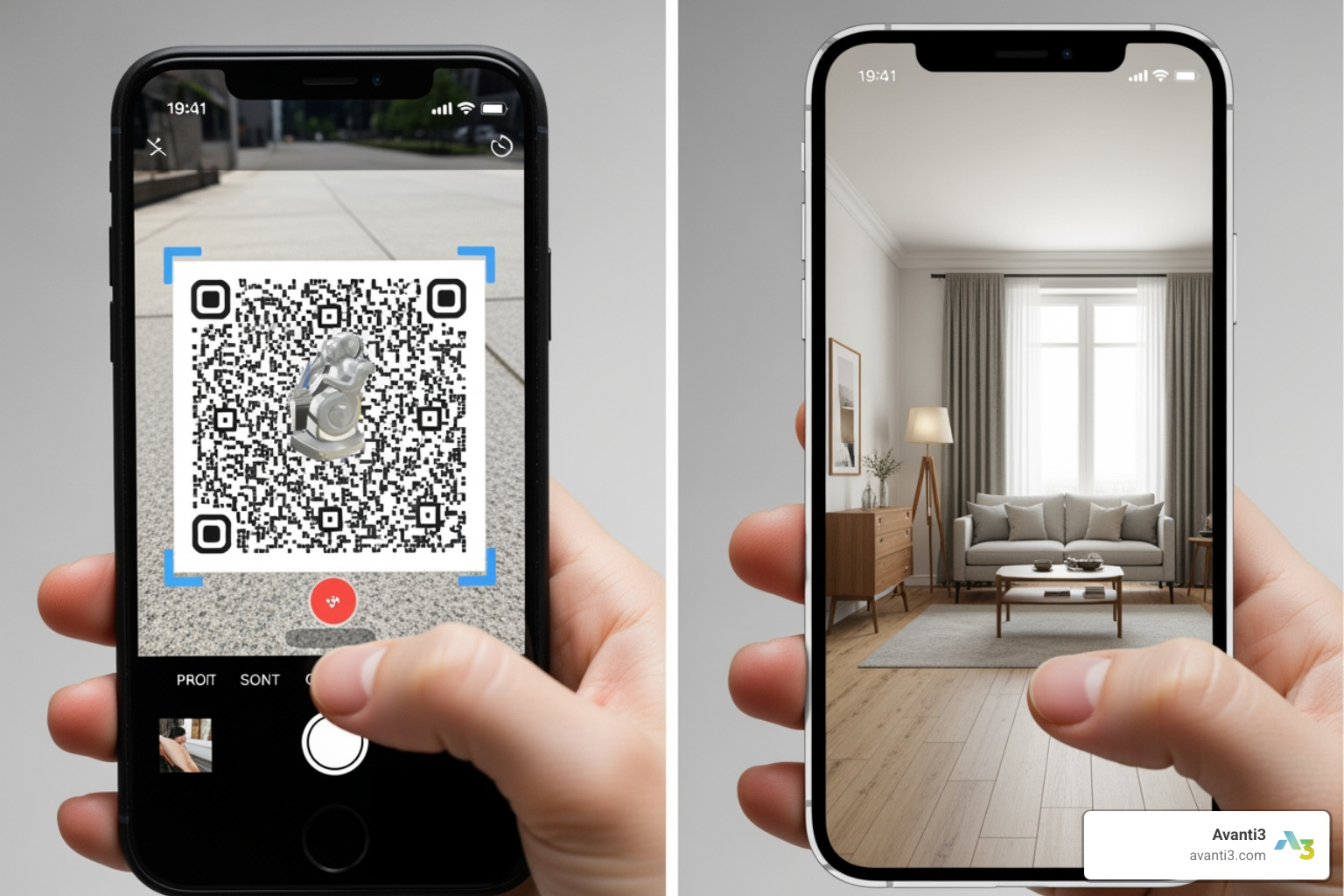
- Marker-Based AR: This is the simplest and most cost-effective option, triggered by specific images like QR codes. A basic app can be developed for $5,000 to $15,000, making it ideal for marketing materials or product demos.
- Markerless AR (SLAM): This technology uses algorithms to detect surfaces and place virtual objects in the real world without a marker (e.g., virtual furniture apps). Development is more complex, with costs starting at $10,000 and potentially exceeding $250,000 for advanced SLAM (Simultaneous Localization and Mapping) systems that require high precision.
- Location-Based AR: This type uses GPS and other sensor data to overlay content onto specific geographic locations, like in Pokémon Go. Development is moderately complex, often starting around $12,000.
Understanding these distinctions helps tailor the technology to your use case, ensuring an effective and budget-conscious solution.
Platform, Design, and Development Team Choices
Beyond core technology, several other factors influence the final cost to develop an AR app.
- Platform Compatibility: Developing for both iOS (using ARKit) and Android (using ARCore) is more expensive than a single platform. Supporting AR glasses like HoloLens adds further cost and requires specialized expertise. WebAR can be a cost-effective alternative for simpler experiences, as it doesn’t require an app download.
- UI/UX Design: An intuitive and visually engaging design is critical. While simple designs are cheaper, a highly interactive, custom-animated interface requires significant investment in both UI/UX designers and 3D artists.
- Development Team: Who builds your app and where they are located is one of the biggest cost variables.
- Structure: Outsourcing to an agency often provides a complete, experienced team (designers, developers, PMs) and can be more cost-effective than building an in-house team. Freelancers may work for smaller projects.
- Location & Rates: Developer hourly rates vary dramatically by region: from $10-$50 in Asia to $50-$250 in North America. For example, a 500-hour project could cost $10,000 with a team in India versus $50,000 or more in the US. You can find developers with varying rates on platforms like Upwork.
- Project Timeline: A rush to market requires more resources, increasing costs. A simple AR app typically takes 4-6 months, while complex projects can take 9 months or more.
Estimating Your Project: From MVP to Enterprise & Beyond
Budgeting for an AR app is best approached strategically. We recommend starting with a Minimum Viable Product (MVP) to test your core idea and gather user feedback. This phased approach helps manage the cost to develop an ar app by breaking it into manageable segments, allowing you to validate the concept before committing to a full-scale application.
The development process generally follows a structured path:
- Research and Analysis: Define market position, target audience, and core value.
- Outline Functionalities: Detail the app’s features and AR capabilities.
- Design UI/UX: Create wireframes, prototypes, and visual designs.
- Planning: Finalize technical architecture and the tech stack.
- Development: Write the code and build the app.
- Quality Assurance (QA): Conduct rigorous testing to ensure a bug-free experience.
- Deployment: Launch the app on the App Store and/or Google Play.
- Maintenance: Provide ongoing support, updates, and bug fixes.
AR App Cost Breakdown: Basic, Mid-Level, and Enterprise
To give you a clearer picture of the cost to develop an ar app, projects can be categorized into three tiers based on complexity. The table below provides a general guideline, but a detailed consultation is the best way to get a precise estimate for your project.
| App Tier | Cost Range | Timeline | Typical Features |
|---|---|---|---|
| Basic AR App | $30,000 – $50,000 | 4-6 months | Simple marker-based AR, static 3D models, basic UI, single platform, minimal backend (e.g., product viewer, interactive marketing material) |
| Mid-Level AR App | $50,000 – $120,000 | 4-9 months | Markerless AR (surface detection), moderate 3D modeling, dynamic content, user accounts, simple analytics, cross-platform compatibility, basic AI features (e.g., virtual try-on, educational app with interactive models) |
| Enterprise AR App | $120,000 – $300,000+ | 9+ months | Advanced markerless AR (SLAM), real-time AI/ML integration, complex 3D scenes with animation, multi-user capabilities, robust backend with cloud infrastructure, IoT integration, custom integrations, advanced analytics (e.g., industrial training, remote assistance, AR gaming) |
Uncovering Hidden Costs and Planning for ROI
Budgeting for development is only part of the picture. To ensure success, you must also account for ongoing costs and plan for your return on investment (ROI).
Hidden Costs to Watch For:
- Hardware for Testing: Ensuring performance across various smartphones, tablets, and AR headsets.
- SDK Licensing Fees: While ARKit and ARCore are free, some advanced SDKs like Vuforia have commercial licensing fees ($99–$499/month or more).
- App Store Fees: Annual fees for the Apple Developer Program ($99) and a one-time fee for Google Play ($25).
- Server and Data Storage: Cloud services for storing 3D assets and user data incur monthly costs based on usage.
- Ongoing Maintenance: This is a critical, recurring cost. Budget 15-20% of the initial development cost annually for updates, bug fixes, and security patches.
Measuring ROI: Real-World Examples:
Despite the costs, AR offers substantial ROI. Businesses are seeing tangible results:
- Increased Sales: Sephora’s AR try-on feature boosted engagement and traffic, while L’Oréal’s StyleMyHair app directly impacted sales.
- Improved Efficiency: In healthcare, AccuVein uses AR to help locate veins, improving procedural accuracy. The AR in education and healthcare markets are projected to grow to $80 billion and $4.2 billion, respectively, by 2031 and 2026.
- New Revenue Streams: Games like Pokémon Go have proven the viability of new monetization models through location-based AR.
Tracking metrics like sales, engagement, return rates, and operational savings will help you measure success. We can help you steer augmented reality marketing to ensure your investment yields results.
How to Estimate and Manage Your AR Project Budget
Effectively managing the cost to develop an ar app is crucial. Here’s a systematic approach:
- Define Clear Requirements: Conduct thorough research and outline every required functionality. A clear vision leads to an accurate estimate.
- Prioritize for an MVP: If you have a limited budget, focus on core features for a Minimum Viable Product (MVP). This allows you to launch faster, gather feedback, and add features iteratively.
- Get Detailed Quotes: Request itemized quotes from potential development partners that break down costs by phase and feature.
- Manage Scope Creep: Establish a strict change management process to evaluate the budget and timeline impact of any new feature requests.
- Factor in Ongoing Costs: Allocate a portion of your budget (15-20% annually) for post-launch maintenance, server hosting, and other recurring expenses.
- Leverage Expertise: Partner with a team that understands both the technical and business aspects of AR to make cost-effective decisions without sacrificing quality.
At Avanti3, we integrate Web3 technologies like AR/VR to empower creators and brands. Our expertise allows us to guide you through the complexities of budgeting and building an impactful application. We prioritize transparency and collaboration, ensuring you have a clear understanding of your project’s cost.
Ready to bring your vision to life? Start building your immersive experience with Avanti3.