Why AR Customer Experience is Changing How Businesses Connect with Customers
AR customer experience is revolutionizing how businesses engage shoppers by overlaying digital information onto the real world. It enables customers to visualize products in their own space, try on items virtually, and make more confident purchasing decisions—leading to higher conversions and fewer returns.
Quick Answer: What Makes AR Customer Experience Effective?
- Improved Personalization – Customers interact with products in their own environment, eliminating guesswork
- Increased Purchase Confidence – 71% of consumers shop more when they can have an AR experience
- Reduced Returns – Better visualization leads to up to 40% fewer product returns
- Higher Engagement – 61% of shoppers prefer retailers who provide AR experiences
- Improved Conversions – AR improves conversion rates by 40% on average
With 1.4 billion consumers using AR to shop in 2023, the technology is no longer a novelty—it’s an expectation. AR bridges the gap between online convenience and in-store confidence, and the market is projected to grow from $19.9 billion in 2024 to $64.6 billion by 2030.
But AR customer experience goes beyond just sales. It transforms the entire customer journey, from pre-sale exploration and interactive packaging to post-sale support with AR-powered manuals.
I’m Samir ElKamouny, and I’ve spent years helping businesses grow through innovative digital strategies. I’ve seen how AR customer experience creates memorable, immersive interactions that turn casual browsers into loyal brand advocates. Let’s explore how you can harness this technology to revolutionize your customer engagement.
Know your AR customer experience terms:
How AR is Revolutionizing the Customer Experience
Augmented Reality (AR) is fundamentally changing how customers interact with brands and products, shifting from passive consumption to active engagement. We’re seeing a true change in the retail sector, where the lines between the physical and digital worlds are blurring, creating what we call “phygital” experiences. This isn’t just about adding a digital layer; it’s about creating a more intuitive, informative, and ultimately, more satisfying journey for the customer.
Key Applications: From Virtual Try-Ons to Interactive Support
The versatility of AR customer experience is remarkable, offering applications that cater to different needs across various industries, particularly in retail. Brands are leveraging AR to solve real customer pain points and provide unique value.

One of the most impactful applications is product visualization. Companies like IKEA and Wayfair pioneered this, allowing customers to virtually place furniture in their homes using a smartphone. This eliminates guesswork and boosts buyer confidence. For example, Gunner Kennels saw a 40% increase in order conversion and a 5% reduction in returns after implementing AR tools for sizing.
Virtual try-ons are another game-changer, particularly in fashion and cosmetics. Valued at $5.57 billion in 2024, this market is booming. Sephora’s virtual makeup trials let users test shades with their phone cameras, while Kohl’s partnered with Snapchat to launch an AR Virtual Closet. These applications provide a “try-before-you-buy” experience that was previously only possible in physical stores.
Beyond direct product interaction, AR is improving in-store navigation. Marks & Spencer’s List&Go app, for example, guides shoppers to specific products, turning a frustrating search into an efficient, interactive experience. This is part of a broader trend of leveraging AR for AR/VR Immersive Experiences.
Interactive packaging transforms product boxes into engaging brand touchpoints. For instance, Rock Paper Reality created a WebAR activation for a Red Bull event that outperformed traditional marketing videos, turning the product itself into a gateway for additional content.
Finally, AR extends into post-sale support with AR-powered manuals and remote assistance. Instead of dense booklets, users can point their phone at a device to see AR overlays with step-by-step instructions. This intuitive self-service has led to a 35% increase in first-call resolution rates, a 25% decrease in support call durations, and a 40% drop in the need for on-site visits.
The Tangible Benefits for Businesses and Shoppers
The adoption of AR customer experience delivers concrete, measurable benefits for both businesses and their customers, impacting the bottom line and improving satisfaction.
One of the most compelling benefits is increased conversions. The ability to visualize products realistically boosts purchase confidence, with research showing AR improves conversion rates by 40%. Marketing with AR integration sees a 94% increase in sales conversions, and brands like Rebecca Minkoff found customers are 65% more likely to place an order after an AR interaction.
Hand-in-hand with this is a drastic reduction in return rates. High returns are a significant challenge for retailers, with many items returned for being ‘not as described.’ AR addresses this directly by providing an accurate product preview. Wayfair, for instance, reduced product returns by 40% using its AR room planning tools.
Brand differentiation is another critical advantage. Implementing AR positions a brand as innovative and customer-centric, which is especially appealing to younger demographics. It creates memorable experiences that set a brand apart, with 80% of brands using AR reporting it helps drive sales and improve brand awareness.
For customers, the interactive nature of AR leads to improved engagement and increased confidence. 61% of shoppers prefer retailers who offer AR, and 71% shop more when they can use it. This confidence also translates to a willingness to spend more, as 40% of consumers are ready to pay extra for AR-customizable products. Finally, businesses gain invaluable data insights by tracking AR interactions, which helps refine marketing and personalize future experiences, a key component of AI Customer Engagement.
Enhancing the Customer Journey Across Every Touchpoint
The beauty of AR customer experience lies in its ability to seamlessly integrate across the entire customer journey, enriching every touchpoint from the initial spark of interest to post-purchase loyalty. We’re not just adding a feature; we’re fundamentally reshaping the customer’s path.
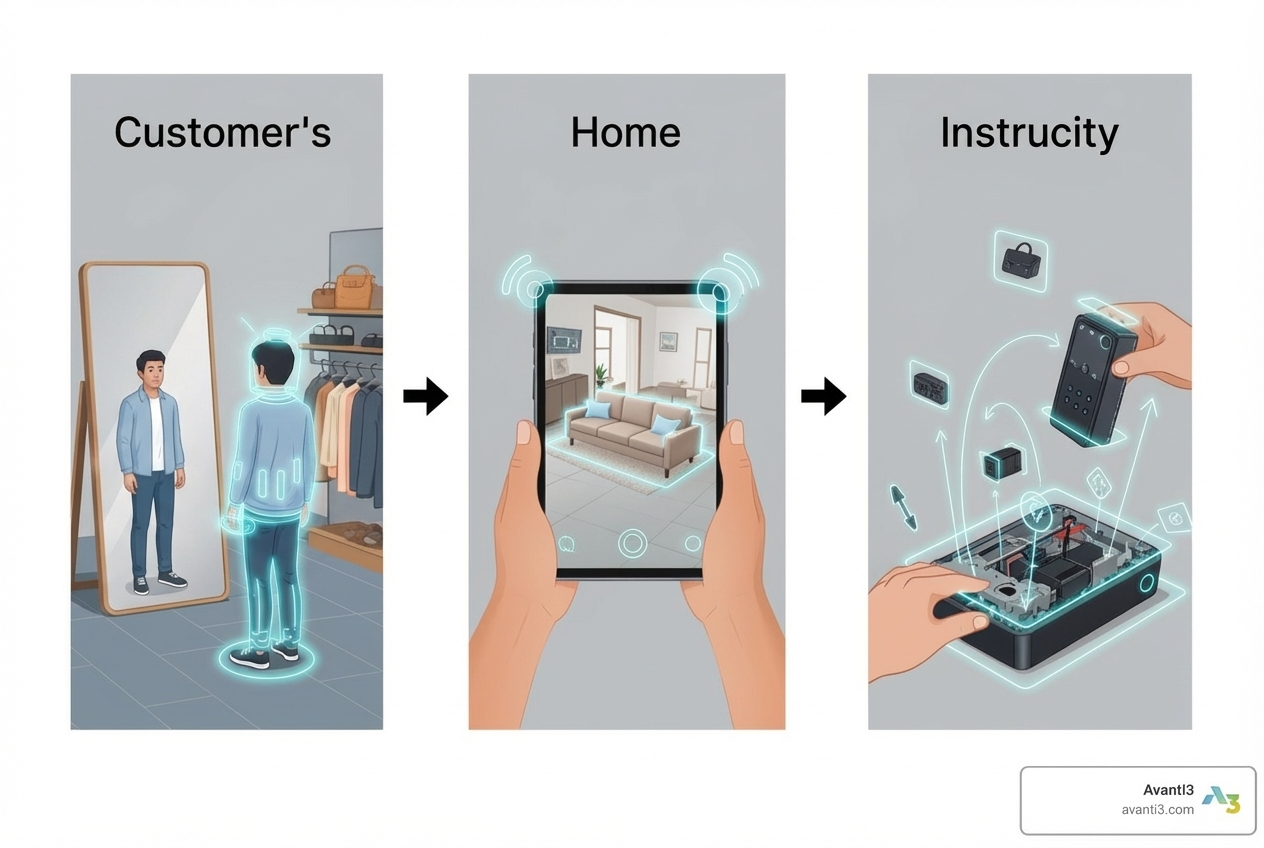
In the pre-sale engagement phase, AR builds awareness and aids consideration. Social media AR filters create buzz, while product visualization helps customers make decisions. For example, Mini’s AR feature allowed users to view a true-scale model of a car anywhere, creating a powerful consideration tool that reached nearly 900,000 people.
At the point-of-sale, AR facilitates the purchase decision. In physical stores, it can transform static displays into interactive experiences. The fashion brand Coach used AR in its SoHo store window, letting passersby virtually try on bags, effectively stopping shoppers in their tracks. Online, shoppable AR allows for instant purchases after a virtual try-on.
In the post-sale support phase, AR cultivates customer loyalty. As mentioned, AR-powered user manuals and remote assistance empower customers with self-service solutions, reducing frustration and building trust. By providing continuous value, AR helps build loyal relationships that lead to repeat business and brand advocacy, which is central to effective Digital Experience Design.
Your Guide to a Successful AR Customer Experience Strategy
Implementing a robust AR customer experience strategy requires careful planning and a clear understanding of both the opportunities and the potential problems. As experts in this field, we understand that while AR offers immense potential, successful adoption involves navigating several key considerations.
Overcoming Common Challenges in AR Adoption
While the benefits of AR are clear, businesses often face challenges when integrating this technology into their customer experience strategies. Understanding these obstacles is the first step toward overcoming them.

One significant hurdle is technical complexity and cost. Developing high-quality AR experiences requires specialized expertise in 3D modeling and software integration, which can represent a substantial investment. Businesses must weigh these costs against the projected ROI.
Device compatibility is another challenge, as not all smartphones can run advanced AR applications, potentially leading to a fragmented user experience. Furthermore, user adoption can be slow if customers are unfamiliar with the technology. We recommend a “progressive improvement” strategy, starting with accessible WebAR (browser-based AR) to lower the barrier to entry.
Finally, privacy concerns are paramount. AR apps can collect data about a user’s environment, so businesses must be transparent about data collection, adhere to regulations, and ensure robust security to maintain customer trust. Addressing these challenges is crucial for a successful implementation, and we can help you steer these complexities with our Digital Engagement Solutions.
How to Measure the ROI of Your AR Initiatives
To understand the impact of your AR customer experience efforts, define clear metrics and measure the return on investment (ROI). We help clients track these Key Performance Indicators (KPIs):
- Conversion Rate Lift: Measure the percentage increase in purchases from customers who engage with AR compared to those who don’t.
- Engagement Time / Dwell Time: Track how long customers spend interacting with your AR experience, as longer times suggest higher interest.
- Return Rate Reduction: Monitor the decrease in product returns for items viewed with AR. This provides a direct, measurable cost saving.
- Social Shares: Track how often customers share their AR interactions on social media, a key indicator of viral potential and organic reach.
- Brand Recall and Awareness: Use surveys and brand lift studies to measure the increase in brand recognition and positive sentiment after AR campaigns.
- Customer Satisfaction Scores (CSAT/NPS): Directly ask customers about their satisfaction with AR features and their influence on brand perception.
- Customer Support Metrics: For AR-powered support, track improvements in first-call resolution, reduced call durations, and fewer on-site service visits.
- Website Traffic and App Downloads: Monitor increases in traffic to AR-enabled product pages or downloads of your app.
By tracking these KPIs, we can demonstrate the tangible value that AR customer experience brings to your business. This focus on measurable outcomes is key to driving effective Digital Brand Engagement.
The Future of AR and What’s Next for Digital Engagement
The landscape of AR customer experience is evolving rapidly, promising even more immersive and integrated interactions that will further blur the lines between the digital and physical.
One major trend is the rise of WebAR, which allows AR experiences to be accessed through a web browser, eliminating the need for an app download and lowering the barrier to entry. This will be improved by AI-powered personalization, enabling AR assistants to offer real-time, customized recommendations.
The mainstream adoption of AR glasses is on the horizon, promising to move AR beyond the phone screen into a hands-free, always-on experience that will transform everything from shopping to navigation. This will deepen social commerce integration, as shoppable AR content becomes standard within social media feeds, creating a seamless path from findy to purchase.
We are moving towards truly phygital experiences—a seamless blend of physical and digital interactions. The market projections are staggering, with some analysts predicting the AR market could reach over $340 billion by 2037. Mobile AR is already mainstream, with 1.73 billion active users expected by the end of 2024.
At Avanti3, we are at the forefront of this revolution. We integrate Web3 technologies like NFTs, blockchain, AR/VR, and AI to empower creators and brands with customizable engagement tools and fintech solutions. We offer unique digital experiences, rewards systems, and community-building opportunities, setting a new standard in digital engagement and fan monetization. We are not just chasing trends; we are shaping a new standard for audience engagement, ensuring our clients are ready for the future of Augmented Reality Marketing.