Stepping into New Realities
An AR and VR experience transforms how we interact with digital content by overlaying virtual elements onto our physical world (Augmented Reality) or immersing us in computer-generated environments (Virtual Reality). Here’s what you need to know:
- AR improves reality – Digital information appears on top of your real-world view through smartphones, tablets, or smart glasses.
- VR replaces reality – Headsets transport you entirely into simulated 3D worlds where you can move and interact.
- XR encompasses both – Extended Reality is the umbrella term covering AR, VR, and Mixed Reality (MR) technologies.
- Growing rapidly – The AR and VR market in hospitality alone is expected to grow at 34.2% annually through 2028.
The traditional way of staring at flat screens is giving way to something more powerful. Immersive technologies are no longer science fiction. They’re changing how businesses connect with customers, how students learn, and how teams collaborate.
Research shows virtual tours make travelers two-thirds more likely to book online, and companies using VR for training have seen a 71% drop in customer complaints. These aren’t future possibilities—they’re happening now across retail, education, healthcare, and entertainment.
I’m Samir ElKamouny, and I’ve spent years helping brands leverage cutting-edge technology for deeper audience engagement and new revenue streams. I’ve seen how the AR and VR experience can transform how brands connect with their audiences, turning passive viewers into active participants.
Let’s explore how these immersive technologies work, their impact, and how you can harness them to build stronger, more engaged communities.
Understanding the Immersive Landscape: AR, VR, and XR Explained
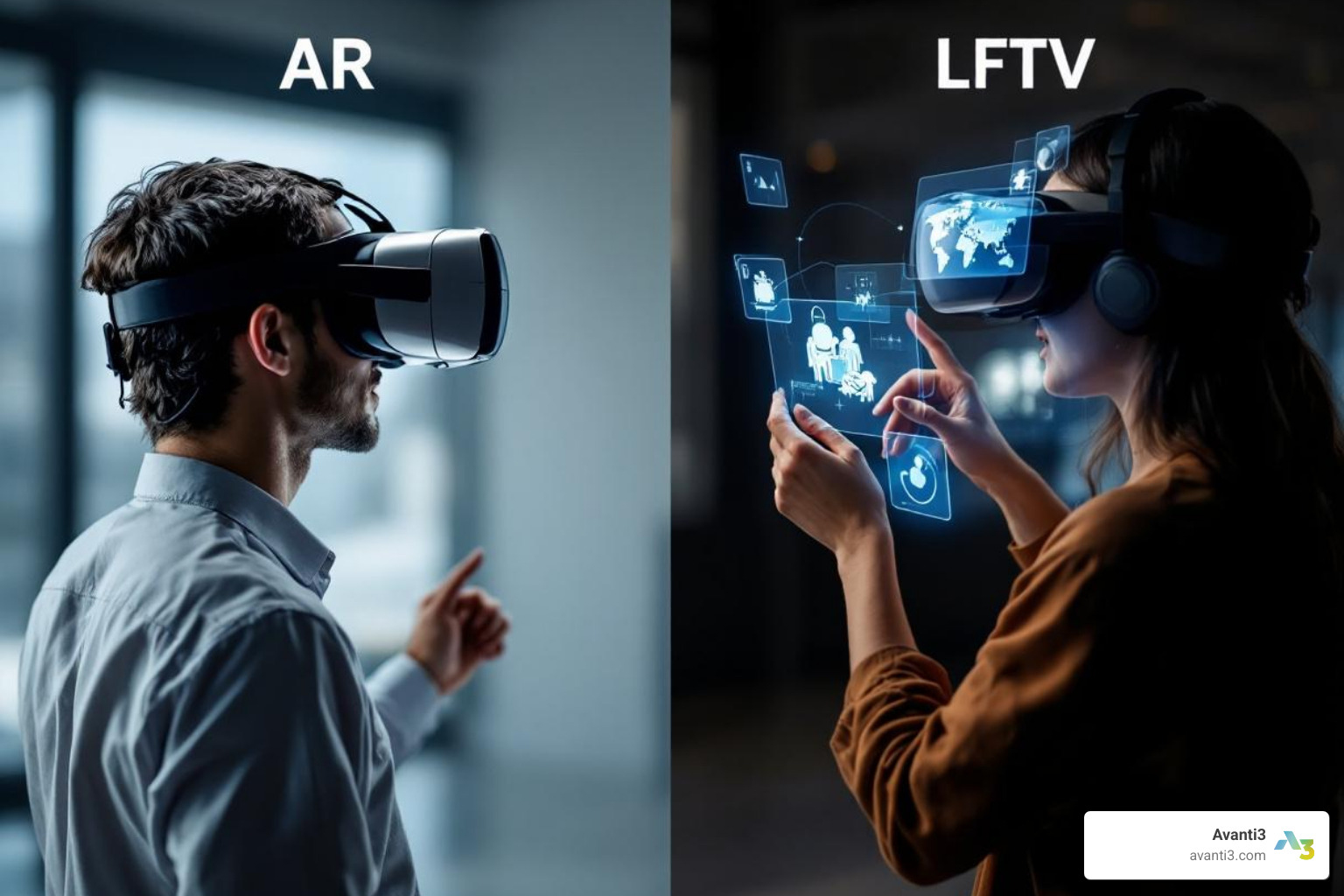
Extended Reality (XR) is an umbrella term for immersive technologies like Virtual Reality (VR), Augmented Reality (AR), and Mixed Reality (MR). These technologies blend digital and physical worlds to create immersive experiences. The “X” in XR stands for anything in the spectrum of immersive experiences.
A compelling AR and VR experience relies on sophisticated technical underpinnings, including advanced display technology, precise tracking systems, and spatial audio to trick our senses. For a deeper dive into the nuances, you can find a deeper look at the differences.
Let’s break down each component:
| Feature | Augmented Reality (AR) | Virtual Reality (VR) |
|---|---|---|
| Environment | Improves the real world with digital elements | Replaces the real world with a completely artificial one |
| Immersion | Partial (digital overlays on real world) | Full (user is entirely immersed in a virtual world) |
| Hardware | Smartphones, tablets, smart glasses, AR headsets | VR headsets (e.g., Meta Quest, Apple Vision Pro) |
| Interaction | Interacts with the real world; digital elements are context-aware | Interacts entirely within a simulated 3D environment |
| Key Use Cases | Navigation, retail try-ons, industrial maintenance | Gaming, simulations, virtual tours, training |
Augmented Reality (AR): Enhancing Your World
Augmented Reality (AR) improves your perception of the real world by overlaying digital information onto it. Unlike VR, it doesn’t transport you to a new world; it brings the digital world to yours.
AR works through devices like smartphones and smart glasses. Using cameras, sensors, and computer vision techniques like Simultaneous Localization and Mapping (SLAM), they understand your physical surroundings to accurately place digital objects, making them appear as if they are truly there.
Popular examples include Instagram filters, the IKEA Place app for visualizing furniture, and games like Pokémon Go. The automotive industry also uses AR windshield displays for navigation. These applications highlight how an immersion augmented reality experience can blend the digital and physical seamlessly.
Virtual Reality (VR): Creating New Worlds
Virtual Reality (VR) creates entirely new, computer-generated 3D worlds for you to step into. The goal is complete immersion, using visuals, audio, and tactile elements to make you feel physically present in an artificial environment.
A VR headset is the primary gateway. It blocks the physical world and uses two displays to create depth perception. Motion sensors track your head and body movements, updating the virtual world in real-time to maintain the illusion of presence. VR controllers allow interaction with virtual objects, and some systems use haptic feedback for tactile sensations.
VR immersion requires believable stimuli from the headset (crisp visuals, realistic sounds) and no disruptions from your physical surroundings. Key elements include a wide field of view, high-quality graphics, and spatial audio (3D sound).
The appeal of VR is clear: in 2022, a third of survey respondents were ‘very interested’ in using VR for property tours. This shows a desire for immersive experiences in practical applications. Popular headsets like the Meta Quest series, Apple Vision Pro, and others are making these worlds more accessible.
Key Challenges and Considerations
While the potential of the AR and VR experience is vast, several challenges hinder wider adoption:
- Cost of Implementation: High-end hardware and content development can be expensive for consumers and small businesses, requiring substantial investment.
- Hardware Accessibility: Dedicated AR/VR hardware is not as common as smartphones, limiting the audience for truly immersive experiences.
- User Adoption Problems: Discomfort like motion sickness or eye strain, especially in VR, can hinder adoption. The need for special equipment is also a barrier for casual users.
- Motion Sickness: A disconnect between what our eyes see and what our inner ear senses in VR can cause motion sickness. While technology is improving, it remains a concern for user comfort.
- Data Privacy and Security Concerns: These devices collect vast amounts of environmental and biometric data, making privacy a paramount concern. Robust security is crucial to maintain user trust. The WebXR Device API, for instance, has security and privacy considerations built into its specification.
The Transformative Power of the AR and VR Experience Across Industries
AR and VR represent a profound shift in how industries operate and engage audiences. Moving beyond niche entertainment, they are becoming indispensable tools in business, education, and healthcare. The hospitality market alone is expected to grow at a Compound Annual Growth Rate (CAGR) of 34.2% through 2028, underscoring their ability to create engaging user experiences.

Key advantages include deep immersion, convenience (like viewing products from home), and enabling previously impractical applications. While disadvantages like cost and accessibility still exist, the benefits are increasingly outweighing them.
Crafting a Better Business and Retail AR and VR Experience
The AR and VR experience is changing the traditional sales process, which often relies on physical interaction.
- Virtual Showrooms and Digital Twins: Businesses use “digital twins”—virtual replicas of physical products—as powerful sales tools. In virtual showrooms, customers can inspect products in detail, a game-changer for B2B commerce that allows for visualization without physical limitations.
- Interactive Product Visualization: AR lets customers visualize products in their own space, like seeing how a new sofa fits in their living room. This addresses practical concerns and boosts purchase confidence, making it a highly effective form of AR powered brand engagement.
- Improved Customer Engagement: AR and VR offer interactivity that can surpass real-world experiences. Customers can manipulate 3D models or virtually “try on” clothes from home, a major convenience that boosts engagement.
- Hospitality Innovation: The hospitality industry uses AR/VR to improve guest experiences. Virtual tours make travelers up to two-thirds more likely to book online. On-site, AR can offer self-guided tours, real-time translation, or act as a virtual concierge, creating an unforgettable stay.

The Future of Learning: The Educational AR and VR Experience
The AR and VR experience is set to disrupt education and training, offering new opportunities for engagement, skill development, and personalized learning.
- Corporate Training and Skill Development: VR is highly effective for corporate training, especially in high-risk jobs. It allows medical students to practice surgery or first responders to train for emergencies in a risk-free virtual environment. For example, Best Western reported a 71% drop in customer complaints after implementing VR training, while other brands like Hilton and Hyatt use it for staff training and recruitment.
- Immersive Education: AR and VR transform abstract concepts into tangible experiences. Students can take virtual field trips, see 3D models of ancient civilizations via AR, or explore a virtual jungle. This immersive learning improves retention and understanding.
- AI in Education: Integrating AI with AR/VR personalizes learning. AI platforms can adapt to student needs, create custom learning paths, and offer real-time tutoring. This empowers educators by automating tasks and providing data-driven insights.
Emerging Trends and the Future of Immersion
The journey of the AR and VR experience is just beginning. As technology advances, we can expect more seamless and powerful immersive experiences.
- Lighter, More Accessible Hardware: The trend is towards lighter, more comfortable headsets with higher fidelity. New platforms like Android XR are emerging for AI-powered glasses, promising a more seamless blend of digital and physical worlds.
- The Rise of Mixed Reality (MR): MR is gaining traction by merging physical and digital worlds, allowing real-time interaction between them. This creates a hybrid experience where digital content coexists with our physical environment.
- Advanced Haptic Feedback: Haptics (the sense of touch) is evolving to provide more realistic sensations, allowing us to “feel” virtual objects and significantly enhancing immersion.
- WebXR for Universal Access: The WebXR Device API is crucial for making immersive experiences accessible directly in web browsers, without dedicated apps. This standardization effort democratizes access to AR and VR content on the web.
- The Metaverse Concept: The Metaverse, a persistent and interconnected virtual world, is a long-term vision reliant on advanced AR and VR. It promises new spaces for social interaction, collaboration, and digital commerce.
- AI-Powered XR: AI will be deeply integrated into XR to make experiences more adaptive and personalized. It can power realistic virtual characters, generate dynamic environments, and optimize performance.
At Avanti3, we are at the forefront of building this next generation of engagement. We integrate Web3 technologies like NFTs, blockchain, AR/VR, and AI to empower creators and brands with customizable engagement tools and fintech solutions. Our goal is to offer unique digital experiences, rewards systems, and community-building opportunities, setting a new standard in digital engagement. We believe the future of interaction is immersive, and we’re here to help you steer it.
To explore how these cutting-edge technologies can transform your brand’s engagement, find more about AR/VR Immersive Experiences.