


The Unstoppable Merger of Finance and Blockchain
Blockchain powered fintech combines secure blockchain technology with innovative financial services. This fusion creates faster, cheaper, and more transparent financial solutions, bypassing traditional banks.
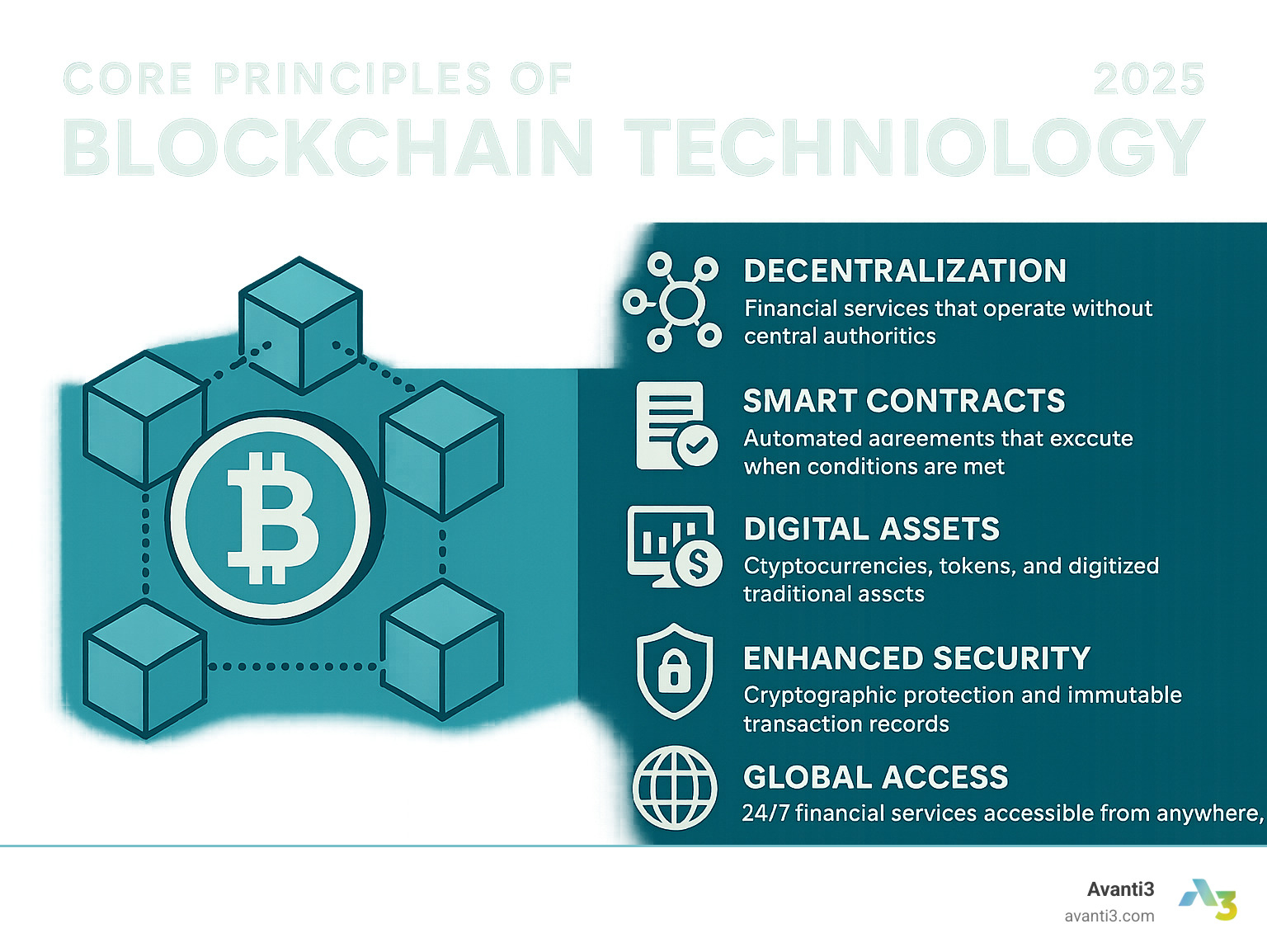
Key Components of Blockchain Powered Fintech:
- Decentralized Networks: Financial services that operate without central authorities
- Smart Contracts: Automated agreements that execute when conditions are met
- Digital Assets: Cryptocurrencies, tokens, and digitized traditional assets
- Improved Security: Cryptographic protection and immutable transaction records
- Global Access: 24/7 financial services accessible from anywhere
The numbers tell an impressive story. The blockchain powered fintech market could reach $46.87 billion by 2030, while the broader blockchain market is projected to exceed $60 billion annually by 2024. Companies like World Liberty Financial have already raised $550 million through token sales, showing real investor confidence.
Traditional finance uses intermediaries like banks to move money. Blockchain replaces this with a decentralized ledger—a shared, unchangeable record book. Transactions are locked into secure blocks using advanced math, ensuring high security.
This technology solves real problems. Cross-border payments that once took days now happen in minutes. Small businesses can access loans without lengthy bank approvals. People can invest in fractional ownership of expensive assets like real estate.
As Samir ElKamouny AV, I’ve helped countless entrepreneurs scale their businesses by embracing innovative technologies that create lasting competitive advantages. My experience in changing traditional business models aligns perfectly with how blockchain powered fintech is reshaping entire industries. Let’s explore how this technology is creating unprecedented opportunities for security, efficiency, and growth.
The Core Benefits and Use Cases of Blockchain Powered Fintech
This section explores how distributed ledger technology is fundamentally reshaping financial services by enhancing security, creating new products, and overcoming traditional barriers. We’ll dive into its practical applications and the challenges that come with such a transformative shift.
Opening up Unprecedented Security, Transparency, and Efficiency
With blockchain powered fintech, financial transactions are like messages in an unbreakable code, stored in a tamper-proof public vault. This is the change blockchain brings to the table.

Improved cryptographic security forms the backbone of blockchain technology. Each transaction is locked into place using advanced mathematical algorithms. This means fraud reduction happens naturally, as it’s too difficult and expensive for bad actors to manipulate the system.
The transparency aspect is brilliant. While personal details stay private, every transaction creates a permanent, visible record. It’s like a glass safe where everyone can see that money moved, but not personal information. This builds incredible trust without sacrificing privacy.
Faster transaction settlement is possible because blockchain removes intermediaries. Traditional payments bounce between multiple banks, adding time and fees. Blockchain lets money move directly from sender to receiver, turning days into minutes for international transfers.
The removal of intermediaries creates massive cost reductions. When you don’t pay banks, brokers, and payment processors, more money stays in your pocket. This is especially powerful for small businesses and individuals sending money across borders.
Immutable records mean that once something is recorded on the blockchain, it’s there forever. This creates an unbreakable audit trail perfect for compliance and dispute resolution. Everything is traceable and verifiable.
These improvements directly improve customer experiences, creating the kind of seamless interactions that keep users engaged. For more insights on building these engaging customer relationships, explore our AI Customer Engagement solutions.
Real-World Applications: How Blockchain Powered Fintech is Changing Services
The real magic of blockchain powered fintech is in its practical applications, which solve everyday financial problems.
Cross-border payments represent one of the most immediate wins. Traditional international transfers can take days and cost hefty fees. Blockchain-based services complete the same transfers in minutes for a fraction of the cost. Companies are already using networks like Stellar to enable instant global payments, reaching underserved regions.
Decentralized Finance (DeFi) is rebuilding the entire financial system. Instead of asking banks for loans, people can borrow directly from other users through smart contracts. Decentralized exchanges let people trade assets 24/7 without intermediaries. The success of World Liberty Financial’s $550 million token sale shows the appetite for these new financial models.
Smart contracts for automation eliminate the paperwork shuffle. These self-executing agreements automatically trigger when conditions are met—no lawyers, delays, or human error. Insurance claims can pay out automatically, and loan payments can process themselves.
Digital identity verification streamlines KYC and AML processes. Users can maintain a secure, blockchain-based identity that gets verified once and trusted everywhere. This makes onboarding faster while improving security.
Tokenization of assets opens up previously impossible investment opportunities. Real estate, art, and commodities can be divided into digital tokens representing fractional ownership. This democratizes access to high-value investments, allowing someone to own a piece of a valuable asset with just a few hundred dollars.
These applications often work best when combined with innovative reward systems that keep users engaged. Learn more about creating compelling user experiences with our Digital Reward Systems.
Overcoming the Problems: Challenges in Blockchain Adoption
However, blockchain powered fintech isn’t without its challenges. These issues must be addressed for widespread adoption.
Scalability limitations remain a significant hurdle. While Visa processes tens of thousands of transactions per second, many blockchains handle far fewer. Solutions like layer-2 scaling and more efficient architectures are emerging, but we’re not there yet.
Interoperability between different blockchains creates a fragmented ecosystem. Many blockchain networks work great individually but struggle to communicate with each other, limiting the seamless experience users expect.
Regulatory uncertainty keeps many companies on the sidelines. Rules vary wildly between countries and change frequently, which slows innovation and investment as companies fear breaking laws that didn’t exist when they started.
High energy consumption gives some blockchains a black eye environmentally. The industry is rapidly moving toward more efficient alternatives, but the reputation damage lingers.
Integration with legacy systems is incredibly complex. Connecting new blockchain systems to decades-old banking software is expensive, time-consuming, and risky.
Shortage of skilled developers creates a talent bottleneck. There aren’t enough people who understand both finance and blockchain, so companies compete fiercely for qualified developers, driving up costs.
Despite these challenges, the potential remains enormous. Success requires careful navigation of intellectual property protection, regulatory compliance, and technical integration. For detailed insights into protecting innovations in this space, explore IP protection in Fintech.
The companies that solve these challenges first will gain significant competitive advantages in the evolving financial landscape.
The Future of Finance: Emerging Trends and Strategic Advantages
Looking ahead, the fusion of blockchain and fintech is set to accelerate, driven by emerging technological trends and the pursuit of a significant competitive edge. This evolution promises a more inclusive, efficient, and interconnected global financial system.
What’s Next for Blockchain Powered Fintech?
The future of blockchain powered fintech involves massive shifts that will reshape global finance, making it smarter, faster, and more connected.

Institutional adoption is happening faster than expected. Major players like JPMorgan and Goldman Sachs are investing billions in digital assets and using private blockchains for daily transactions. As regulations clear, traditional banks will increasingly adopt blockchain for back-office operations and cross-border settlements.
The integration with AI and IoT is where things get exciting. Imagine a smart car paying for parking via blockchain, or AI analyzing blockchain records to spot fraud in real-time. AI provides intelligence, IoT supplies real-world data, and blockchain ensures security and transparency. This convergence opens opportunities for personalized marketing, much like what we explore in AI Digital Marketing.
Central Bank Digital Currencies (CBDCs) are no longer theoretical. Countries worldwide are developing their own digital money on blockchain technology. These government-backed currencies could bridge the gap between traditional money and crypto, making digital payments as trusted as cash.
The evolution of Decentralized Finance (DeFi 2.0) promises to fix current user experience and security issues. Think of it as DeFi maturing—becoming more reliable, user-friendly, and ready for mainstream adoption, bringing sophisticated financial tools to the unbanked.
Sustainability is a non-negotiable priority. The industry is rapidly moving from energy-hungry systems to eco-friendly alternatives, ensuring that growth doesn’t harm the planet.
The fintech blockchain market is projected to reach $46.87 billion by 2030, proving these trends are backed by serious investment and real demand.
Leveraging Blockchain for a Competitive Advantage
In today’s financial world, smart businesses use blockchain powered fintech to gain a significant competitive advantage that is difficult to replicate.
New business models are emerging that were previously impossible, such as peer-to-peer lending without banks, fractional ownership of assets, and micro-payments for digital content. These models create entirely new markets.
Building customer trust is more important than ever. Blockchain’s transparent and unchangeable records prove that customers’ money is safe and transactions are legitimate. This trust builds loyalty.
Global market access becomes simple as blockchain removes friction from international transactions. Businesses can serve customers anywhere without worrying about high fees or long processing times, which is powerful for reaching underserved markets.
Operational efficiency gets a massive boost from smart contracts and automation. Tasks that once took days can now happen automatically in minutes, saving money and freeing up resources for innovation.
Creating unique digital assets opens new revenue streams. Companies can issue tokens for loyalty programs, create digital collectibles, or tokenize services, building ecosystems around their brand.
Personalized financial products become possible with secure blockchain data, allowing companies to offer services custom to individual needs and creating stickier customer relationships.
At Avanti3, we’ve seen how these advantages transform businesses. Our expertise in Web3 technologies helps companies dominate their markets by building unique digital experiences. Our Web3 Platform Solutions are designed to open up these competitive advantages for forward-thinking businesses.
Conclusion: Building the Future of Digital Engagement
Our journey through blockchain powered fintech shows an industry undergoing incredible change. We’ve seen how blockchain brings security, transparency, and efficiency to finance, creating new possibilities like instant global payments and decentralized platforms that empower users.
Yes, there are challenges like scalability, regulatory uncertainty, and integration with old systems. But the industry is actively solving them, with major institutions adopting blockchain and governments developing digital currencies.
For businesses, the message is clear: blockchain powered fintech is a strategic necessity. Companies that adopt this technology now will build customer trust, access global markets, and achieve operational efficiencies that set them apart.
At Avanti3, we’re helping to lead this revolution. We specialize in integrating Web3 technologies like NFTs, blockchain, AR/VR, and AI to create standout engagement tools and fintech solutions. Our goal is to help you build digital experiences that don’t just serve customers, but genuinely excite them.
We believe the future of finance is about creating secure, engaging experiences that drive progress. Whether you’re looking to implement reward systems, build digital communities, or revolutionize customer engagement, we have the tools and expertise to make it happen.
Ready to be part of this exciting change? Find our NFT Engagement Tools to revolutionize your platform and find how we can help you thrive in this new era of digital finance. The future is being built today, and we’d love to help you be part of it.