

Why YouTube Shorts Revenue Matters for Modern Creators
YouTube earnings from shorts have become one of the most talked-about—and misunderstood—topics in the creator economy. Here’s what you need to know:
Quick Answer: YouTube Shorts Earnings
- Average earnings: $30–$100 per 1 million views (RPM of $0.03–$0.10)
- Typical rate: 3¢–7¢ per 1,000 views
- Real examples: $99.87 from 3.1M views, $1,200 from 22M views, $106.85 from 4M views
- Long-form comparison: 30–50x lower than traditional videos ($3,000–$5,000 per 1M views)
- Why so low: Pooled ad revenue model splits earnings among all creators and music rightsholders
| Metric | YouTube Shorts | Long-Form Videos |
|---|---|---|
| Average RPM | $0.03–$0.10 | $3.00–$5.00 |
| Revenue per 1M views | $30–$100 | $3,000–$5,000 |
| Ad placement | Between Shorts (pooled) | Before/during video (direct) |
The brutal truth? A Short with 21,000 views might earn you just 15 cents. Meanwhile, a regular video with 588 views could bring in 73 cents. That’s not a typo—and it’s exactly why creators feel frustrated.
But here’s what most people miss: Shorts aren’t about direct ad revenue. They’re about visibility, subscriber growth, and building assets you can monetize elsewhere. More than 80% of creators who join the YouTube Partner Program through Shorts go on to earn from other features. And in 2025, YouTube Shorts now generate more revenue per watch hour than traditional in-stream videos in the US—a massive shift that changes the game entirely.
The real money comes from treating Shorts as a discovery engine that feeds into brand deals (60–80% of Shorts-driven income), merchandise, digital products, and exclusive fan experiences. That’s where platforms like Avanti3 enter the picture—offering Web3-powered tools to help creators capture value beyond YouTube’s 45% revenue share.
I’m Samir ElKamouny, and I’ve spent years helping entrepreneurs and creators unlock financial freedom through strategic business growth and innovative marketing. Throughout my work scaling businesses and guiding creators toward sustainable income, I’ve seen how understanding youtube earnings from shorts separates those who chase viral moments from those who build lasting revenue streams. Let’s break down exactly how this system works—and how you can make it work for you.
Essential youtube earnings from shorts terms:
Decoding youtube earnings from shorts: The Revenue Share Model
If you’ve ever looked at your YouTube Studio dashboard and wondered why 10 million views only bought you a fancy sandwich instead of a Ferrari, you aren’t alone. The way YouTube pays for Shorts is fundamentally different from the way it pays for long-form content.
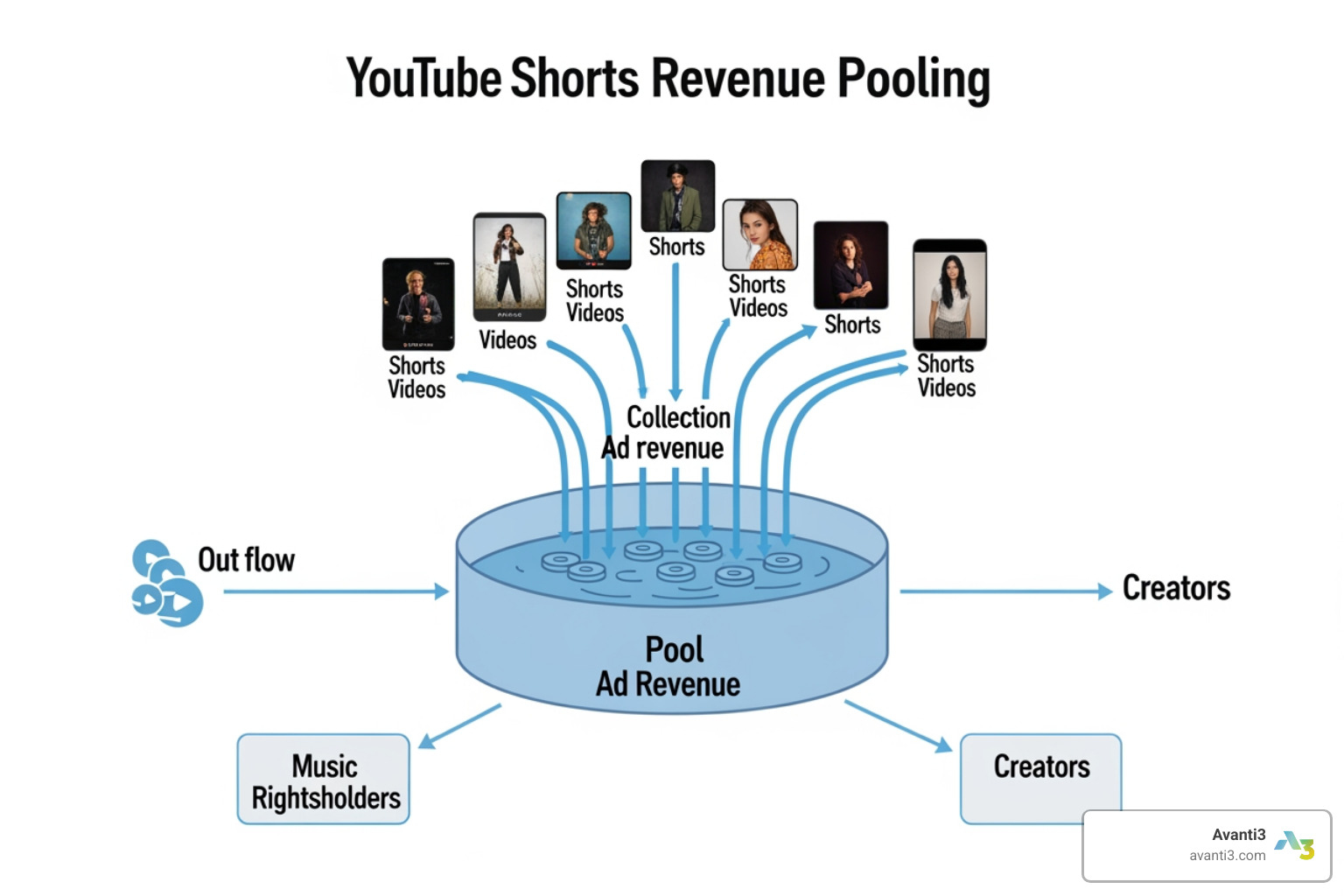
Unlike traditional videos where an ad is stuck directly onto your content, Shorts ads appear between videos in the feed. This means no single creator “owns” an ad. To solve this, YouTube uses a Creator Pool.
How the Creator Pool Works
Every month, YouTube adds up all the ad revenue from the Shorts Feed. Before we get our hands on it, YouTube has to pay for music. If you use a copyrighted track, a portion of the revenue generated by your view share goes to the record labels.
- No music: 100% of the revenue associated with those views goes to the Creator Pool.
- One track: 50% goes to the Creator Pool, 50% goes to music licensing.
- Two tracks: 33% goes to the Creator Pool, 67% goes to music licensing.
Once the music is paid for, YouTube takes its cut, and creators are allocated 45% of the remaining revenue based on their share of total engaged views. For a deeper dive into these mechanics, check out our guide on youtube-shorts-revenue-share.
The “Engaged View” Filter
Not every view counts toward your paycheck. YouTube filters out “ineligible views,” which include:
- Non-original content (re-uploading clips from movies or other creators).
- Artificial or “botted” views.
- Views on Shorts that don’t follow YouTube Shorts monetization policies.
Essentially, YouTube is looking for authentic human engagement. If your Short is just a re-upload of a TikTok trend with a watermark, don’t expect to see much in the way of youtube earnings from shorts.
Eligibility Requirements for youtube earnings from shorts
Before you can start counting your pennies, you have to get through the velvet rope of the YouTube Partner Program (YPP). YouTube has made this easier for short-form creators recently, but the bar is still high enough to require a real strategy.
To qualify for full ad revenue sharing, you need:
- 1,000 Subscribers
- 10 Million valid public Shorts views within the last 90 days (OR 4,000 valid public watch hours on long-form videos in the last 12 months).
There is also a “lower tier” for fan funding (Super Thanks, Memberships) which requires:
- 500 Subscribers
- 3 public uploads in the last 90 days.
- 3 Million valid public Shorts views in the last 90 days.
This tiered system is a great way to start building a “middle-class” creator income before you hit the massive viral numbers. However, you must also have two-step verification turned on and zero active Community Guidelines strikes. It’s like a job interview, but with more ring lights.
Calculating Your youtube earnings from shorts: RPM vs. CPM
In YouTube, two acronyms rule your life: CPM and RPM.
- CPM (Cost Per Mille): What advertisers pay for 1,000 views.
- RPM (Revenue Per Mille): What you actually take home after YouTube’s cut and the music pool deductions.
For Shorts, the RPM is notoriously low. While a finance-themed long-form video might have an RPM of $30, a Short in the same niche might struggle to hit $0.10.
| Metric | YouTube Shorts (Average) | Long-Form (Average) |
|---|---|---|
| RPM (Your Take-Home) | $0.03 – $0.07 | $1.00 – $30.00 |
| 100k Views Payout | $3.00 – $7.00 | $100.00 – $3,000.00 |
| 1M Views Payout | $30.00 – $70.00 | $1,000.00 – $30,000.00 |
Why the massive gap? Advertisers aren’t yet willing to pay as much for a 15-second “blink-and-you-miss-it” ad between Shorts as they are for a 30-second unskippable ad on a 20-minute documentary. Plus, the pooling model means you are sharing the pot with everyone else. If a massive celebrity enters the Shorts space and sucks up 20% of the views, everyone else’s slice of the pie gets slightly smaller.
For more on how these numbers play out in real-time, see our breakdown of youtube-shorts-ad-revenue.
Why Shorts Pay Less Than Long-Form Content
It’s the question every creator asks: “If I’m getting millions of views, why am I still broke?” The answer lies in the psychology of the viewer and the structure of the platform.
- Ad Density: In a 10-minute video, YouTube can show a pre-roll, a mid-roll, and an end-roll ad. In the Shorts feed, an ad might only appear every 3 to 10 videos. There is simply less “ad real estate” to sell.
- The “Scroll” Mindset: Shorts viewers are in a , dopamine-seeking state. They are less likely to click an ad and complete a purchase than someone sitting down to watch a detailed product review.
- The Music Tax: As we mentioned, music rightsholders take a huge chunk. In the year ending June 2025, YouTube paid out $8 billion to the music industry. A lot of that comes right out of the potential income-from-youtube-shorts.
- Watch Hour Value: Even though Google reports that Shorts now earn more revenue per watch hour than long-form in the US, that revenue is spread across thousands of creators. One hour of watch time on Shorts might involve 120 different videos, whereas one hour on long-form might only be two or three videos.
Strategies to Maximize Your Shorts Income in 2025 and 2026
If you’re relying solely on AdSense to pay your rent, you’re playing the game on “Hard Mode.” Successful creators use Shorts as a top-of-funnel strategy.

1. The Funnel Strategy
Think of Shorts as a commercial for your “real” business. Use them to drive traffic to:
- Long-form videos: Where the RPM is 50x higher.
- Livestreams: Where Super Chats and fan funding can bring in hundreds of dollars in an hour.
- Affiliate Links: A 30-second Short showing a “problem and solution” can convert viewers into buyers much faster than a long review.
2. Brand Deals and Sponsorships
This is where the real “big bank” is made. For many creators, brand deals account for 60–80% of their total income. Brands are desperate to reach the Gen Z and Alpha audiences scrolling through Shorts. Even if your AdSense payout is $50 for a million views, a brand might pay you $5,000 to $10,000 for a dedicated shout-out in that same video because of the reach and influence you have.
3. Shoppable Videos and Merch
YouTube is leaning heavily into “Shopping.” By tagging products in your Shorts, you allow viewers to buy directly without leaving the app. This turns a low-revenue view into a high-commission sale.
To understand the historical context of how these payouts have evolved, you can look at youtube-shorts-fund-how-much, which covers the original fund that preceded the current revenue-share model.
Real-World Earnings Examples and Case Studies
Let’s look at the “receipts.” These numbers come from real creators sharing their data on Reddit, Medium, and in public case studies.
- The Viral “Fail”: One creator earned just $18 from 400,000 views. That’s an RPM of about $0.04.
- The “Middle Class” Success: A creator making Zelda content reported earning $180 for 1 million views. This is on the high end and likely due to a high-value audience in the US or UK.
- The Scale Master: TubeBuddy reported earning $99.87 from 3.1 million views, which averages out to roughly $32 per million views.
- The Heavyweight: Erika Kullberg, a famous finance creator, showed that a 48-second Short with 4 million views earned $106.85. In contrast, her 12-minute long-form video with 3.9 million views earned over $45,000.
The Lesson: Niche matters, but format matters more. Finance and tech niches generally have higher RPMs because advertisers are willing to pay more to reach people with money. However, even the best-performing Short will struggle to compete with a mediocre long-form video in terms of pure ad revenue.
Take a look at JennyHoyos, who gained 1.5 million subscribers with only 90 Shorts. While she only earned $1,200 from 22 million views in ad revenue, that visibility allowed her to build a massive brand that is worth millions.
Beyond AdSense: Diversifying with Web3 and Avanti3
If the 45% share and the low RPMs feel like a raw deal, it’s because the traditional Web2 model is designed to benefit the platform first and the creator second. At Avanti3, we believe the future of the creator economy isn’t just about views—it’s about ownership.
We integrate Web3 technologies like NFTs, blockchain, and AI to give creators the tools they need to monetize their fanbases directly. Instead of hoping for a $0.05 RPM, imagine:
- NFT-Based Memberships: Giving your most loyal fans exclusive access to content, digital assets, or real-world perks that they own and can even trade.
- Blockchain Rewards: Implementing a rewards system where fans earn tokens for engagement, which can be redeemed for merchandise or unique digital experiences.
- AR/VR Integration: Creating immersive fan experiences that go beyond a flat screen, allowing for deeper engagement and new monetization paths.
By using Avanti3, you move away from being a “tenant” on YouTube’s land and start becoming the “landlord” of your own digital ecosystem. Our fintech solutions and customizable engagement tools are designed to help you build a community-driven business that survives even if the YouTube algorithm decides to take a nap.
Shorts are an incredible tool for growth, but they are a “leaky bucket” for revenue if they are your only source of income. By combining the reach of YouTube earnings from shorts with the stability and ownership of Web3 tools, you can finally turn those millions of views into a sustainable, high-profit business.
Ready to take control of your creative future? Explore how we are setting a new standard in digital engagement at https://avanti3.com/.
Summary: Is Making “Big Bank” on Shorts Possible?
Yes, but not the way you think. You won’t get rich from the AdSense check alone unless you are pulling in billions of views a month (and even then, the margins are slim).
To truly succeed with youtube earnings from shorts, you must:
- Accept the low RPM: Don’t get discouraged by the 15-cent payouts.
- Focus on Subscriptions: Use Shorts to hit that 1,000-sub mark fast.
- Funnel to Long-Form: Move your “Shorts fans” over to your high-revenue videos.
- Diversify Immediately: Use brand deals, merch, and Web3 platforms like Avanti3 to own your audience and your income.
The “Short” truth is that these videos are the world’s best business card. They get you in the door, but it’s what you do once you’re inside that determines how much you’ll actually make. Stop chasing the “pool” and start building your own “ocean.”